![PortStrategy[GreenPort]](https://www.portstrategy.com/wp-content/uploads/2026/09/PortStrategyGreenPort.svg)


Embracing energy transition
Ports need to play a key role in energy transition and there should be support to help them do it.
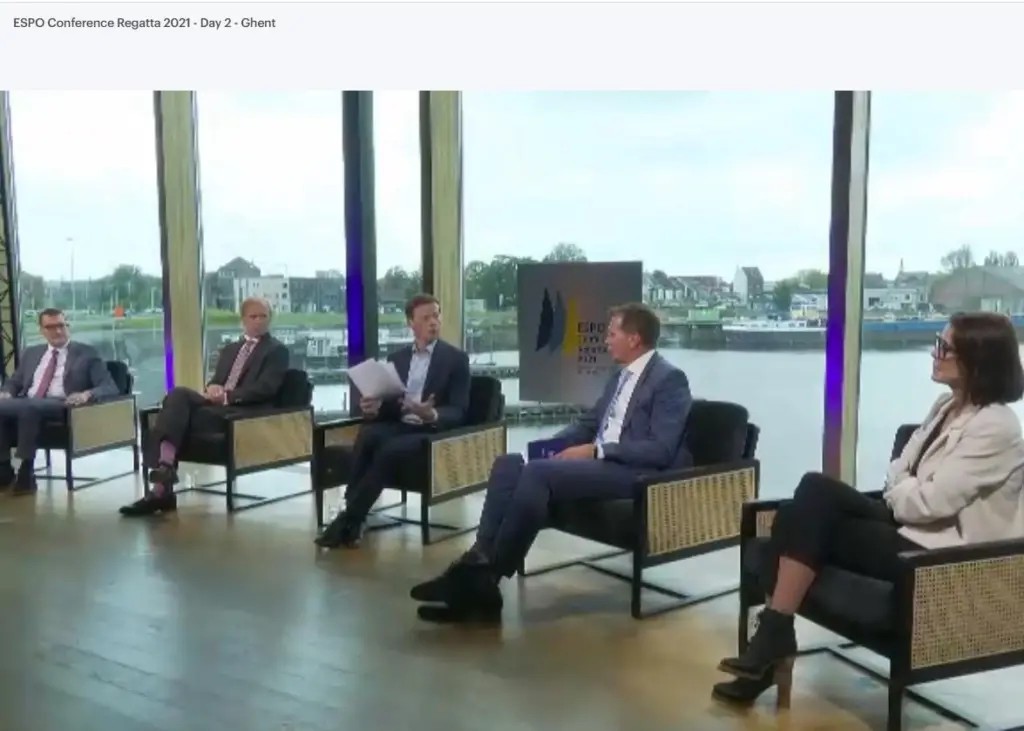
That was take home from the second day of ESPO’s Conference Regatta 2021 held at North Sea Port in Ghent.
“But ambition must change in terms of favouring digitalisation and energy efficiency,” said Kris Peeters, Vice-President of the European Investment Bank.
He said that projects centering around clean energy, digitalisation and collaboration are needed going forward.
Ports can have their say in the EIB’s review of its transport funding policy which runs from July to September.
Lively debate
Members of the European Commission and the European Parliament were grilled in a debate surrounding green recovery and the TEN-T corridors.
Daan Schalck, ESPO Vice-Chair and CEO North Sea Port, emphasised that a holistic approach is needed.
He said that we should be cautious about only backing one approach to tackle emissions in ports, but need to embrace a multitude of options based on demand.
GreenPort asked the panel to outline what support will be available to ports to help them achieve new requirements for shore power and energy transition.
The panel responded that there will be incentives and funding available for projects, but Member states should also include a request for funding in their post-Covid recovery and resilience plans to the EU.
“We need financial instruments to support the process,” Henrik Hololei, Director General, European Commission, DG MOVE, told GreenPort.
“The problem is the package is not yet completed but will be soon. Then we need to devise workable instruments to allow and support our green and digital transformation.”
Hydrogen hopes
The second hotly awaited debate was on the role of ports and hydrogen in Europe’s energy transition.
Ben Oudman, Regional Director CEMEIA (Continental Europe, Middle East, India and Africa) and Country Chair for the Netherlands, DNV, said: “Ports are forerunners in the energy transition.”
“Being facilitators and jobs and infrastructure providers they are in pole position to play an important role in Europe’s energy transition needs.”
Allard Castelein, President and CEO Port of Rotterdam talked about green hydrogen becoming a global energy commodity.
Rotterdam is focusing on imports and believes production is key to the fuel’s success and uptake as a green marine fuel.
Conversation moved on to obstacles in the way of wider uptake. There was talk of carbon prices not being established, the need for major revamp of infrastructure, safety and regulation and geo-political issues, namely trade deals and fuel taxes.
GreenPort asked if there are plans to build hydrogen infrastructure/requirements into a Europe wide strategy for green ports.
Victoria Petrova, Adviser for Hydrogen Economy, European Commission, DG GROW highlighted the work of the Hydrogen Alliance which now has 1200 members.
She told GreenPort that yes, there is the potential for a Europe wide strategy but different standardisation/regulatory requirements need to be overcome.
Bart Biebuyck, executive director Fuel Cells and Hydrogen Joint Undertaking, told GreenPort: “We can’t oblige ports to use hydrogen but we can facilitate them to do so.”
The Hydrogen Joint Undertaking is forming a European hydrogen ports coalition to map hydrogen requirements, production and roadblocks. It will also be launching a global ports initiative in order to come up with a ‘Hydrogen roadmap for ports’, similar to its previous roadmap for LNG.
The aim is to learn from each other and exchange information in order to foster wider uptake.
Related Articles
 ALTERNATIVE FUELS GREENPORT
 NEWS
NEWS