![PortStrategy[GreenPort]](https://www.portstrategy.com/wp-content/uploads/2026/09/PortStrategyGreenPort.svg)


Maasvlakte 2 on schedule
The construction of the Port of Rotterdam’s Maasvlakte 2 terminal is now under way, in preparation for its opening in 2013. The construction and operation of the terminal is being undertaken within strict environmental criteria
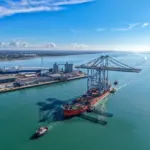
On 1 September 2008, construction work on Maasvlakte 2 began and by early 2009, work accelerated when PUMA put a large number of trailing suction hopper dredgers into operation. Seven of these vessels now operate around the clock, sucking sand from the North Sea 12 km off the coast, and transporting it to Maasvlakte 2. By the end of April 2009, the first land emerged from the sea, and currently a peninsula more than 4 km long and an island stretching about 3 km has been formed. The former forms the new coastline and, on the latter, construction work on the quay wall for the Rotterdam World Gateway container terminal will begin in the Spring this year and scheduled to be operational in 2013.
During 2010, all procedures for the construction and use (land allocation plan) of Maasvlakte 2 will have been completed, which means that both the construction permits and the land allocation plan become irrevocable. However, a number of procedures will follow, for building permits, etc, for the individual companies. Important milestones in 2010 are the start of construction work on the first quay wall for the Rotterdam World Gateway container terminal; the start of work on the hard sea defences and the start of a number of so-called interface projects. The latter will ensure that Maasvlakte 2 will shortly link up seamlessly with existing port infrastructure.
Innovative design for hard sea defences A new design has been implemented for the hard sea defences on the northwest side of Maasvlakte 2, where sea waves are at their strongest during storms. This new ‘dyke’ will shortly look very “un-Dutch”. The sea defences will have a 4-5 m thick top layer of boulders, laid loosely on top of each other, instead of a solid covering. Approximately 25 metres in front of this, the blocks of the existing block dam will be laid in the sea, which cushion the initial impact of a ‘superstorm’.
This solution is a several tens of million of Euros less expensive and better ecologically, because an attractive biotope will emerge between the body of the dyke and the blocks. The design is currently awaiting approval by the Directorate General for Public Works and Water Management, who will ultimately take over the sea defences.
Stones for the hard sea defences
The hard sea defences will be made up of a sand core, with several layers of stone on top. This will involve a total of around 7m tonnes of hydraulic engineering stone. 5m tonnes will come from European quarries and 2m tonnes will be recycled from the existing block dam around the Maasvlakte. Again this Spring, PUMA will begin piling up the concrete blocks for the dam. At the same time, a start will be made on the construction of the so-called E-Crane. with a lifting capacity of 50 tonnes and a reach of 63 metres, being built specifically for the construction of Maasvlakte 2. The unique E-Crane will begin bringing in the concrete blocks and rubble for the hard sea defences in April.
Sustainable industry
Climate discussions, sustainability targets and economic developments will all have an impact on the industrial activity that will soon be getting underway on Maasvlakte 2, and the Port of Rotterdam Authority is keeping a close watch on current worldwide market trends.
Bas Hennissen, Processing Industry and Bulk Goods Director, outlines the potential prospects for industry on Maasvlakte 2:
“With regard to the future of the Port of Rotterdam and the industrial activity that is expected at Maasvlakte 2, we have to look outwards, towards China, India and the Middle East. It is here in particular that in recent years the petrochemical sector has been investing in new production facilities, while reducing its outlays in Europe.
“Demand in China and India is huge, and the oil and gas fields in the Middle East are close by. Clearly, it makes sense to manufacture petrochemical products nearer to the source or nearer to consumers. Recent investments elsewhere in the world in refineries and petrochemical factories are a development that the port of Rotterdam should consider very carefully. It means an increase in the transport of oil products and basic chemicals to Rotterdam at the expense of production of these goods in Western Europe. Rotterdam must concentrate on innovative and modern industries in order to survive.”
New future
Hennissen, regards these developments as opportunities rather than threats. He envisages a new industrial future in which Rotterdam specialises in the storage and transshipment of these new product flows. Moreover, the port is ideally located for new and clean electricity generation and for high-quality chemical industry based on biomass, for example. Hennissen continues: “A precondition is that you have the space for activities of this kind. It is precisely the construction of Maasvlakte 2 that has given Rotterdam the room needed in order to be able to respond to this growing demand.”
Hennissen refers to a development closer to home: the desire to use electric cars quickly, and on a large scale, in the Netherlands. Not only are cars and battery recharging points needed for this, but a basic requirement is also the availability of sufficient electricity. “In order to be able to facilitate this changeover, we need a lot more electricity in the Netherlands than we produce at present. The Cabinet has already made clear that it believes Maasvlakte 2 to be a suitable location for the construction of new electricity power stations.”
The question then is how sustainable they should be, as Rotterdam cannot allow any extra CO2 emissions. The Port of Rotterdam thinks there is potential in the gasification of biomass and coal, especially as it represents a step towards the formation of a bio energy cluster. This is because the synthesis gas produced from coal and biomass can be used to generate electricity, as well as to produce hydrogen, basic chemicals and fuels.
Capturing emissions
It goes without saying that all the CO2 that is emitted by these power stations would be captured, explains Hennissen. This, too, is another central plank of the policies of the City of Rotterdam. The port is seeking to create a network for transporting CO2 that has been captured by factories as part of their production processes. It would then be stored underground in the North Sea. The presence of such a CO2 network would make the port considerably more attractive to industrial companies looking for a base. In future, then, factories will be cleaner due to their use of clean fuels and because harmful emissions will be captured or filtered out.
And what is the situation in relation to making energy consumption more sustainable? Hennissen believes that the use of fossil fuels will be needed for a few decades yet. “As long as that is the case, we in Rotterdam will use them in as clean a way as possible. At the same time, we have room on Maasvlakte 2 for the addition of wind turbines capable of generating 150 Megawatts, in addition to the same number already in place in the port. This therefore offers huge opportunities for responsible growth towards our ambition of being a sustainable port of the future.” The choices facing the Port of Rotterdam regarding the best use of Maasvlakte 2 are determined by various factors. Environmental and sustainability aspects play a major role, as do the degree of innovation concerned and the future prospects of industries. The unique opportunity that Maasvlakte 2 offers for creating a sustainable industrial area is one that the Port of Rotterdam is seizing with both hands. Hennissen concludes, “I would prefer to keep some space open for a longer time in order to be sure that the area was ultimately used in a sustainable manner, rather than turn it over quickly to the highest bidders. We therefore see great potential in a combination of sustainable energy production, the storage and transshipment of oil and chemical products and the use of the area by high-quality biobased chemical industries as their base.”
Related Articles
 ALTERNATIVE FUELS GREENPORT
 NEWS
NEWS