![PortStrategy[GreenPort]](https://www.portstrategy.com/wp-content/uploads/2026/09/PortStrategyGreenPort.svg)




Mitigating noise annoyance at the Port of Dublin
Existing noise assessment procedures consider the noise annoyance evaluation using yearly average noise levels weighted by frequency and time of day.
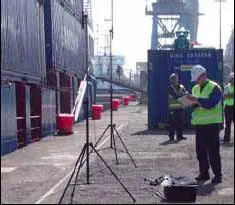
These well established methods apply fairly well to continuous broadband noise such as that of road traffic c. Port noise, however, includes components of a low frequency and an impulsive nature; it must therefore be evaluated in a new way. The team in Dublin started with the usual procedure, measuring several sources. Sound sample recordings were taken for each noise source creating elaborate sound maps. Sound samples were captured from machinery operations as well as from cargo handling events. The team then took a new approach and considered the effect of the weather on sound propagation from the source to the receiver. Weather-effected sounds can reach considerably higher levels than the estimated yearly averages and the annoyance perceived by the residents can be completely different in different weather conditions. The team also investigated how sound and noise is perceived by individuals and found that psycho-acoustic descriptors can better indicate potential annoyance than the commonly used sound pressure levels. Psychoacoustic descriptors describe sound properties in relation to human observations. The total effect on annoyance is a combination of factors; sound loudness, sharpness, fluctuation strength and roughness; these are calculated from sound signals. Additional factors are prominence of tonality and prominence of impulsiveness. These factors are then used in the EFFORTS project to create higher order indicators; unbiased annoyance or sensory pleasantness. The development of these indicators required listening tests which involved processing sound samples to make them suitable for headphone testing. Samples were corrected due to distance or screening by buildings and organized for the tests on 100 persons from different professions, age groups and gender. The results, obtained by statistical analysis, were used to develop a concept to support port authorities to deal with community response. Sound data from port operations is collected continuously around the year and stored on a data server. In case of a complaint, the time history of noise data is retrieved and the data studied at the time of occurrence. By listening to the data, it is identified whether the cause is due to noisy operations or due to weather conditions. After establishing the cause of the complaint, an explanation can be given to the community and actions to prevent further annoyance can be determined. As a result of the EFFORTS project, a response form has been drawn up for ports to obtain all the vital information required to deal with the complaints in an efficient way.
Related Articles
 ALTERNATIVE FUELS GREENPORT
 NEWS
NEWS