


3D CHESS IN SANTOS
Rob Ward examines in depth the forthcoming Santos port privatisation and charts why the process is going to be very complicated.
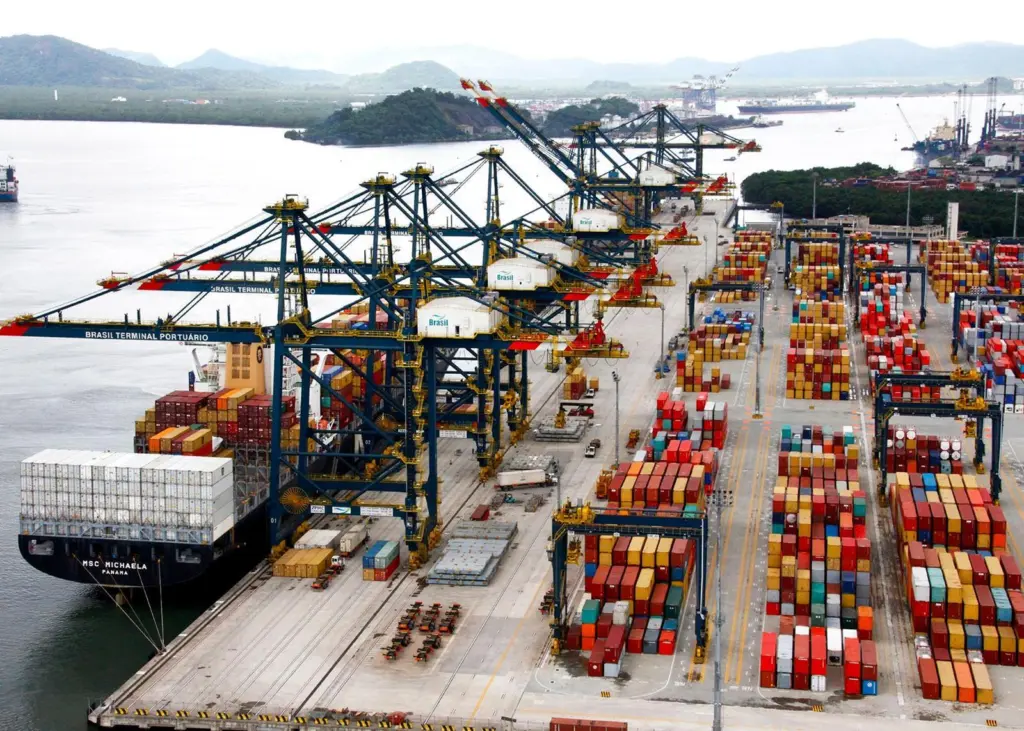
“The situation in Santos today is very complicated with regard to the next phase of privatisation,” says one veteran port consultant based in the Brazilian port city. “In fact, you can compare it to a 3-dimensional game of chess,“ he stressed.
The port of Santos – the continent’s largest for containers, with 4.23 million TEU handled in 2020, up by 1.6 per cent – is girding itself for the privatisation of both the port authority (Santos Port Authority, or SPA), and various vacant or set-for-renewal terminal concessions.
As ever this key port, which aims to become THE hub port for East Coast of South America in the near future, is wrapped up in the usual political and vested interest turmoil for which it has long been famous.
THE NEW “SUPER-TERMINAL”
For nearly a decade, the area at Saboo, close to the historic downtown port area, has been earmarked for a new “Superterminal” which would comprise the old terminal successfully operated as a car terminal by Deicmar, the Rodrimar box terminal (which peaked in 2011 with 203,410 TEU and a 7.5 per cent market share but has been closed since 2017) and Citrosuco, a fruit terminal.
These facilities comprise around 270,000m2 and are sited right next door to Brasil Terminal Portuaria (BTP), the joint venture between MSC Line/Terminal Investment Limited (TIL) and APM Terminals (APMT), which handled 1.75 million TEU last year (already beyond its nominal annual capacity).
The facility replaced Santos Brasil’s Tecon Santos facility as Brazil’s leading terminal for boxes three years ago. BTP currently has a 43.7 per cent share of the market (up from 40 per cent in 2019).
This new “Super Terminal” concession has been described by several Santos stakeholders, including Leandro Carrelli Barreto, a director with the Solve Shipping consultancy, as the “jewel in the crown” or “A Ultima Noiva Linda” (the last beautiful bride) and is the stand-out offering of the current wave of Brazilian port concessions.
“This is the most valuable of all the facilities up for sale and will attract a lot of attention both nationally and internationally,” Barreto told Port Strategy. The “Super-Terminal” is a coveted enough prize in itself, but then came the startling news in early March that not only would Ecoporto Santos (the box terminal turned general cargo facility) not be allowed to bid for the new facility – it lies adjacent to the southeast of the Saboo area just as BTP is to the northwest – but also that it would not be granted an extension when its own concession ends in 2023. Ecoporto used to be the third biggest box terminal in Santos and handled a peak of 325,000 TEU back in 2012 (a 16.4 per cent share).
Luiz Araujo, Commercial Director, Ecoporto Santos, told Port Strategy that Ecoporto had been “fighting to renew the contract since 2014”. “It’s very disappointing news to be told we won’t get our extension because they want to create one more big container terminal,” says Araujo, who has been working at the Ecoporto Santos Terminal (and its previous incarnation as Tecondi) for more than 20 years. “It also does not make any sense because we need more general cargo capacity not more for boxes.”
Ecoporto Santos is currently saddled with three unused ship-to-shore gantry cranes, which cost more than US$25m recently and have barely been used. It is understood that Ecoporto will be partially compensated for these units if the concession does expire and the equipment is used by the incoming operator.
Diogo Piloni, Minister for Ports in Brazil, confirmed to Port Strategy that Ecoporto’s concession would not be renewed as the Ministry of Infrastructure (MINFRA) wants to create a “very large terminal” to be concessioned out to the highest bidder.
“We carried out our detailed analyses and decided we need one more big container terminal of 400,000m2 in Santos because that, added to a breakthrough in cabotage legislation (BR Do Mar), will greatly assist Santos in becoming THE hub port for ECSA,” he confirmed.
WHO WILL WIN?
So who will win the bid for the new area, dubbed the “SuperTerminal” in Saboo? So far a number of international companies have shown an interest including Hutchison Ports, PSA of Singapore, ICTSI and China Merchants Port Holdings (which already has control of TCP in Paranagua, Brazil’s second largest port for boxes).
In addition, Santos Brasil and, of course, BTP are very keen. Hot favourite is BTP but as this will give it a massive terminal of 830,000m2 if added to their existing terminal, it seems likely that this will cause the Brazilian monopolies watchdog, CADE, to step in with a close inspection of the regulations.
However, to bypass CADE, say several reliable Santos sources, one potential scenario is for APMT and TIL to split their joint venture, with APMT keeping BTP for mostly Maersk Line vessels and TIL taking over the new “Super Terminal” on behalf of MSC.
Related Articles
 PORT & TERMINAL NEWS
 PORT & TERMINAL NEWS
 PORT & TERMINAL NEWS