



Spreaders get smart
“Clever” spreaders and electric versions are to the fore
SECTOR ANALYSIS: DIGITAL AND ELECTRIC POWER DRIVE DEVELOPMENT
Growing global trade volumes are boosting the demand for high capacity spreader systems and the ever-growing exploitation of digitalisation and cutting-edge technology is helping the supplier sector step up to the challenge. In addition, the drive to net zero has created a focus on electric, energy efficient spreaders.
The impact of growing trade on the port spreader market is highlighted by the Container Spreader Market Size and Forecast (2026-2033) report, published this year by Verified Market Reports. It valued the container spreader market size at USD1.2 billion in 2024 and has forecast it to grow at a CAGR of 5.2 per cent from 2026 to 2033, jumping to USD1.8 billion by 2033.
The rapid growth of smart spreaders is helping cope with increasing port volumes. As the report says: “Technological integration remains a pivotal trend, with AI and IoT enabling predictive maintenance, real-time monitoring, and autonomous operations transforming traditional port handling paradigms. The shift towards smart ports, particularly in Asia-Pacific, is fostering the adoption of digital twin models and automation solutions that enhance operational transparency and efficiency.”
This theme is reflected in the company by company reviews below, which include Bromma’s recently-launched predictive maintenance solution, Spreader Monitoring System, and Stinis Lifting Equipment’s Stinis Connect, which remotely monitors its spreaders.
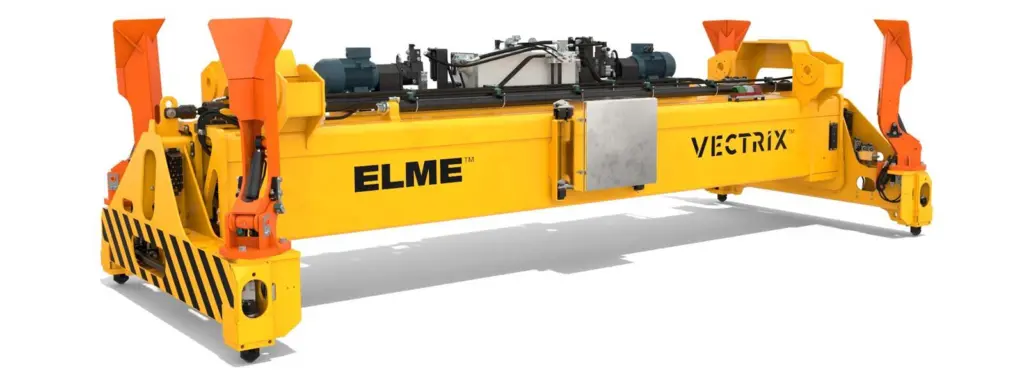
Hybrid and electric spreaders are hugely on the rise as terminals push to reduce their carbon footprints. This trend can be seen among manufacturers, including ELME Spreader, whose new series of crane spreaders Vectrix includes electric models. Electric spreaders have the add-on benefit of being energy efficient, meeting cost efficient port targets.
NEW PRODUCTS, ELECTRIFICATION, EXPLOITING AI AND IoT
Bromma: The Sweden-headquartered company’s portfolio includes an all-electric ship to shore (STS) spreader. The company says of its STS45E G2 PLUS all-electric spreader: “Our spreader easily achieves accurate positioning when telescoping due to increased telescoping and twin separating speed.” The company saYS that eliminating spreader hydraulics reduces power consumption by up to 90 per cent. Bromma has recently launched its predictive maintenance solution, the Spreader Monitoring System (SMS). The company highlights key benefits: SMS provides early indications of potential issues in spreaders. This enables terminal operators to take pre-emptive action. This real-time, cloud-based solution integrates data from other crane systems for better operational insights. It connects with Crane Management Systems, Maintenance Management Systems, and other applications via API.
Recent uptake: Bromma’s Spreader Control Unit Technology has been introduced at Bénin Terminal, a subsidiary of Africa Global Logistics. By equipping four quay cranes with this system, it enables smoother container movements and allows for remote diagnostics of malfunctions, which helps reduce downtime and streamline maintenance.
ELME Spreader: The company debuted its new series of crane spreaders Vectrix at TOC Europe 2025 in Rotterdam. The Swedish company says the series features a modular design that allows for cost-effective customisation to meet specific operational needs. Key enhancements include a boost in operational reliability and energy efficiency. Gösta Karlsson, President and Founder, ELME Spreader, said: “…We have listened to our customers and developed a product that we hope will not only meet but exceeds their expectations in terms of reliability, safety, and efficiency.” The new portfolio includes the 8210 Vectrix model, a telescopic top lift spreader for handling laden ISO containers up to 45 tonnes. Two parallel telescopic beams enable maximum overlap. Beam sections are dimensioned to absorb not only the vertical, but also the horizontal force. The 8210E is the electrical version of this model. The 8610H Vectrix is a hybrid electrical and hydraulic telescopic piggyback top lift spreader. The hybrid spreader combines the efficiency of electric spreaders with the reliability of Elme’s hydraulic piggyback legs system. Designed for operations where twistlock handling is primary, but occasional trailer handling is required, this solution optimises energy consumption while ensuring full versatility. During twistlock handling, the spreader runs fully electrically, making it significantly quieter. As part of the development of its new Vectrix crane spreader series, ELME announced in June this year that it has upgraded its production methods. This includes streamlining production processes and expanding its production area with newly established facilities. The investments will allow for the future expansion of new and current product ranges, says ELME.
Intella: US-headquartered Intella has launched new Ship-to-Shore spreader actuators that can be used across several brands, with the aim to boost life span and durability. It says: ““The new models, engineered by Intella, address the most common complaint of terminal operators: hydraulic leaks. Traditional local rebuilds often fail to solve this issue due to the difficulty of sourcing proprietary seals. Intella’s upgraded actuators eliminate these challenges, providing a reliable solution that minimises downtime, prevents messy hydraulic leaks, and reduces overall costs for container terminals.” One of the companies now providing Intella’s new Actuators is Barlow Technology. It explains: “Ports and harbours face unique challenges, from harsh environmental conditions to the need for precision in heavy-duty tasks. That’s why the Intella Actuators are a game-changer. Engineered with cutting-edge technology, they provide robust, precise, and smooth actuation that ensures the optimal performance of flippers in critical marine applications.”
Konecranes: The Finland-headquartered company has introduced the Spreader Kit 500 to address unexpected service interruptions. The kit is a preventative maintenance solution designed to reduce the risk of twistlock failures and unplanned equipment stoppages. It enables operators to schedule twistlock maintenance every 5000 working hours. Konecranes says: “This regular maintenance interval not only improves operational reliability but also enhances safety by reducing the likelihood of container handling incidents caused by twistlock fatigue.” The kit includes four twistlock replacement kits and essential wear pads for scheduled replacement. Konecranes says that by aligning maintenance with this 5000-hour schedule, operators can avoid: unforeseen service breaks due to twistlock wear; emergency machine stoppages for single wear pad issues and delays caused by unavailable spare parts. Konecranes Noell Spreaders are an accompaniment to the company’s Noell Sprinter and Straddle Carriers, allowing port operators to have fully integrated solutions for key components. The company says that the “clear-cut steelwork” with a minimum of welds enables strong reliability. Konecranes uses CAN bus (Controller Area Network) technology in its equipment to facilitate communication between various electronic control units. It says: “Because the telescopic arms are equipped with our patented hydraulic clamping rather than a mechanical locking device, damage is limited in the event of collisions.”
RAM Spreaders: The Singapore-headquartered company has launched a universal pipe-handling spreader following an offshore project with Australia’s Spliethoff Shipping to handle pipes between Indonesia and Australia. The RAM Octo pipe-handling spreader is designed to allow the handling of a range of pipes from 1 to 3 pipes with diameters from 16 to 60 inches (40 cm to 152 cm) and diameters between 11.8 to 12.7 meters. RAM Octo will first be deployed at a port in Batam, Indonesia, loading the offshore pipes from the quayside into the shipping vessel’s hatch. Another RAM Octo on the vessel crane then transfers the pipes into a transshipment vessel near the coast in Northwest Australia before being transferred again into the pipe laying vessel. Due to the nature of the load and harsh environment, RAM Spreaders says that an essential feature of the RAM Octo is its rotational control system that controls the rotation of the pipes being handled, making for fast and safe operations. The ability to quickly control rotation (up to 360 degrees in less than one minute) allows accurate placement of pipes, saving time and allowing the operator to control the load at a safe distance without the need for ropes or slings. Mechanical sensors on the soft touch end grippers send a signal to the operator’s remote control when the pipes are securely clamped longitudinally.
Stinis Lifting Equipment: The company has launched Stinis Connect to boost the efficiency and reliability of its container spreaders by remotely monitoring and managing them. Its smart spreader addition, which was showcased at TOC Europe 2025, has key features that include the provision of centralised information about the status of each spreader, and the monitoring of metrics including container moves, twistlock operations and operating hours. Stinis Connect has sensors on the spreaders that transmit data about their operation and condition. This data is then securely sent to a cloud-based platform which provides the information through a user interface to terminal operators. Benefits include enabling predictive maintenance, boosting fleet management, identifying trends and optimising resource allocation. Stinis Connect is securely connected through Microsoft Azure. Elsewhere, at the end of 2024, Stinis announced that Paterson Simons will become its sales and aftermarket representative for West and Central Africa. The agreement between Paterson Simons and Stinis represents a “strategic move to enhance the availability and support of Stinis products in this region”, says Stinis. As part of this partnership, Paterson Simons recently commissioned Stinis Overheight Spreaders in the Congo. Other developments include the Netherlands’ company launching a new version of its Long-Twin spreader for mobile harbour (MHC) cranes. This spreader allows for the separation and handling of two 20ft containers with a gap of up to 1.6m, improving flexibility and productivity in MHC operations.
Related Articles
 DIGITAL
 PRODUCTS & SERVICES
 PRODUCTS & SERVICES