

Reducing visual pollution in port cities
Visual impact is a key focus for action in sustainable development explains Thierry Bogaert, of BOGAERT’ Architecture, France. A good example of the integration of industry and nature is the Halkis cement plant in Greece.
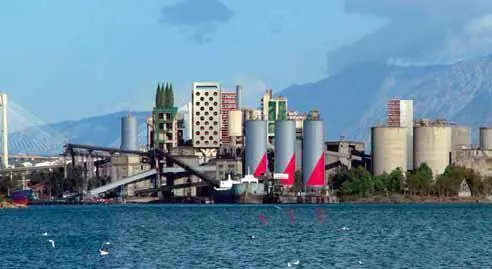
As a built-up area in a natural landscape, a port town is industrial by nature. Such a town needs to be aware of the image it projects, and work on its potential for appeal. Industry forms an integral part of a landscape that is both urban (the town) and natural (the water). It is thus a predominant and crucial component in the overall image of the port town. But industry – a town within a town – is often designed from the inside, with productivity the sole concern and little thought given to its appearance or visual impact. Today, however, visual pollution has every reason to be included as a key focus for action in sustainable development, because it affects the quality of the environment and the town’s performance in terms of attracting businesses, jobs and visitors. The industry needs to be aware of the image it conveys and that perceived by its environment and take and internalise measures to improve its public image. Its own work surroundings and its own practice benefit directly from this effort, which therefore is not without return on investment. In this article, the Halkis cement plant in Greece illustrates the integration of a large-scale industrial set-up into its natural and urban environment. So doing we applied our method for visually analysing sites, with the aim of exploring suitable actions to improve their image. We see that, apart from the integration aspect, this approach can create real potential for attraction, benefiting not only the industry itself, but also – and above all – the image and prosperity of the town as a whole. This was our approach
Adopting the right strategy
There can be no good intervention strategy in terms of visual impact without a methodical analysis of the particular context of each industrial site. The cement plant has its own and universal characteristics.
However, contextual factors confer to each plant its own specificity. One must learn to look for himself and extract the pertinent actions without dividing one’s attention to actions without any real impact, and therefore, the expenditure in certain areas that are not useful.
A cultural context
Many parameters are likely to influence the industrial landscape, beginning with the regional and cultural dimension, which can give the site concerned a particular authenticity. It is clear that if a cement plant has more or less the same principle of operation from one site to another, it is from the site that it borrows its cultural specifics.
A geographical context
The climate, whether it is temperate, continental, tropical or dry brings its own constraints. The climate shapes the local architecture and the architecture of the industrial site and its components. The heat, the cold, the rain, the drought: all induce choices in form, materials and colours. The landscape influences the perception of the site. A figure on the plain, an overhang from a relief, a reflection in the water are all strong elements that need to be integrated in the choice of interventions aimed at improving the visual impact.
A visual context
Seeing is to be seen! When at the top of a silo, one contemplates the surrounding landscape, the same panorama contemplates one with same acuity. This leads to a selection of critical angles of views from which the plant is perceived. One should establish a hierarchy of these perspectives. Distance is a dominant parameter. When viewed from afar ,the plant is without a doubt less oppressive than when viewed from close by. A closer perception often accuses the dramatic dimension of the industrial site. Obviously, a residential or tourist area is more sensitive and more worrying than an industrial zone, desert zone or a road axis that skirts the plant.
This also leads to the need to integrate the concept of perception of speed, from the high speed of an aeroplane, a train, a boat, a car, to the immobility of the neighbour through to the relative slow pace of pedestrians. The eye does not have the same reading of these different speeds for physiological and security reasons. To observe or lead, one must choose! 5. Acting from within By the calibre of its facilities, industry has a responsibility towards the environment as a whole, but the industrialist can only act within the limit of its industrial site. It should therefore take stock of its own built environment (support of future actions)
Concept of intervention
We have discussed above many objective criteria that can integrate the numerous environmental factors specific to an industrial site when considering an intervention. At the end of this methodical and careful observation of a particular site, it is easy to understand that the mere application of a graphic chart, if it exists and regardless of its quality, is not enough to answer all questions. The graphic chart has the great interest of harmonising sites commercially and to provide a sort of coherent whole undoubtedly very beneficial to industrial landscapes so often very confusing, even frightening. But it is almost impossible to codify all environmental issues. Through many projects, in very different circumstances, we have been asked to propose different solutions, but we have endeavoured to be relevant for each of these environments.
Good intervention targets
To make good choices in intervention targets is to identify what will have a beneficial impact in and for the environment. On a visual level, one can hope to act globally and positively on a newly-created site. On an existing site, one inherits a situation every time “original” and always leading to the unexpected and thus always complex. Choices must be made. Not giving attention to unnecessary and costly actions is a knowledge we propose to develop for each case. The methodical analysis of the environment in the broadest sense, the knowledge of the production logic, the technical regulations, the concern for the economically reasonable are the first working and reflection tools. But this will not be enough to ensure the quality of the result without the plastic and artistic dimension – which from a materially delicate and sometimes shameful problem – that makes a site a valuable communication tool for the industry and its environment. Our true satisfaction is to succeed in softening an obsessive perception as well as to reveal the plastic potential inherent to these monumental industrial sites. They are our past, present and future. To conceal them is not an end in itself, we love to reveal them and give them value beyond solely accepting them. We noticed that these sites have become towns (within towns) so why not to treat them with the same concerns to meet the aspirations of our contemporaries, respectful of the same rules, and sufficiently treated by architecture to shape our environment harmoniously.
The new factories also …
The analysis of urban evolution shows that there is a need to anticipate the urban development around a newly-created industrial site. This article therefore focuses both on sites being developed as well as those already established. Indeed, it is clear from the majority of cases, that the best way to build a city is to start with a factory! Sooner or later there will be many people around. Almost all enclosed industrial sites of today have known such a development with the results that are known throughout the world. From conception, industry needs to prepare for future urbanisation, by taking technical and quantitative measures (good traffic management, control of all forms of pollution: dust, noise, emissions, odour, aggressive lighting), qualitative measures (landscaped buffer space, outline planning) and aesthetic measures. Not anticipating is exposing oneself later to tensions with all that comprises one’s environment, and expose oneself to greater costs that could have been committed to at the start of construction.
www.bogaert-architecture.com
Related Articles
 ALTERNATIVE FUELS GREENPORT