


John Bensalhia looks at how RFID technology is being used by in the ports sector and what the premier trends are.
From the latest sounds crackling through hi-fi speakers through to walkie talkie communication, radio waves are part and parcel of everyday life. With continued improvements in modern technology, the radio wave repertoire continues to positively penetrate the ports and terminal sector.
Specifically, Radio Frequency Identification (RFID) – technology, which can play a positive role in tracking assets, equipment and machinery over quite long distances and in sizable numbers.
CHANGING WITH THE TIMES
One catalyst to RFID sector growth is the reality that terminal operators continue to embrace new technology in pursuit of enhanced performance and cost reduction. Introducing new technology to streamline terminal operations inevitably means that RFID is a serious ingredient.
The Port of Felixstowe, for example, has introduced remote control quay cranes and yard cranes to its portfolio. As a way of allocating the relevant jobs to the remote yard cranes, information about vehicles is held in RFID tags, which interface with the port’s terminal operating system.
Visiting hauliers therefore need two RFID tags per vehicle, one positioned in the passenger seat window, the other for the driver seat window. When the vehicle passes through an antenna/reader the RFID tag data is automatically read. Felixstowe’s Automatic Truck Identification System holds vehicle registration numbers, and checks the data read by the RFID tag.
MANY BENEFITS
UK-based Core RFID states that there are many benefits of RFID technology, which “make it possible to build a solid business case for its use in different industries and for different applications.” Improved productivity at a lower cost is seen as high on the list.
Core RFID underlines this is because it can collate data about assets, components and stock, not only in great detail, but at a faster pace and with a higher rate of accuracy and reliability. Practically speaking, this means it is less timeconsuming than previous generation methods such as manual recording and barcode scanning.
RFID also offers greater clarity in real time. A port or terminal can garner up-to-date information for planning and operations management. This fast and accurate data capture thereby significantly reduces the potential for mistakes being made across a wide range of everyday tasks.
Another key advantage cited by Core RFID is the beneficial impact on security levels. The tagging of cargo, for example, enables a port company to monitor and track this. In the case of any problems, RFID technology can alert the relevant party to rectify the situation as swiftly as possible.
FIXED AND MOBILE
RFID technology is available in the form of fixed readers and mobile devices. A case in point of a fixed point reader system is Core RFID’s gateway, which can be used at a port to detect and monitor cargo, goods and containers, and to ensure that everything is present and correct. In order to ensure accurate positioning of the antennas, Core RFID also provides a consultancy service to clients.
An example of a mobile reader is Core RFID CheckedOK solution, which is geared towards complying with and enhancing safety levels. It can be used in conjunction with laptops, mobiles, Android devices and tablets, through which the relevant data can be collected and accessed.
The CheckedOK device is a mobile method of testing and inspecting machinery and equipment including cranes, forklifts (and other lifting machines), work platforms, PPE, fire escape and safety facilities, as well as pumps, valves and pipelines.
The technology can spotlight any items that have been omitted during inspections, past and present, and provide reports that are in line with the relevant regulations. Hence by using CheckedOK, it can be instrumental in reducing the risk of accidents, equipment failure and ensuing legal action.
SIZE IS IMPORTANT
RFID manufacturers are coming up with smaller technology. France-based Maintag, for example, offers a range of compact ceramic tags. Among the CERAtag range are CERAtag D10 and the CERAtag stick, both of which use ceramic material which Maintag claims offers better operating and further reading distance properties than other conventional tag materials.
At only 10mm x 1.6mm, both of these tags are small enough to be fitted on narrow, metallic surfaces. The tags, which are compatible with a standard Gen2 reader, are said to have a memory service life of in excess of 30 years at a temperature of up to 50degC.
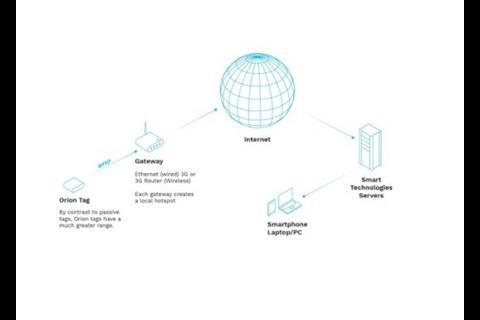
Smarter Technologies’ similarly claims superior benefits from its RFID technology. The UK-based company states it is able to offer RFID solutions (such as the Orion Data Network) that work efficiently over longer distances.
This facilitates the timely and accurate identification of thousands of different assets. The location and status of assets is achieved in real time, with messages and alerts sent to mobile devices, which can prove vital in the case of an emergency.
“The Smarter Technologies Orion Data Network uses radio spectrum to allow monitoring devices to be read at distance and the information is passed back via an internet connection to a device – tablet, mobile or desktop,” explains Matthew Margetts, Director - Sales & Marketing, Smarter Technologies.
“The client,” he elaborates, “can then use the data to make decisions or because the Orion network allows for two-way communication to make required changes.”
Asset tracking devices can be placed on cargo, containers, vehicles, forklift trucks and vessels. By keeping an eye on the location of each asset, ports can make sure that each of these is safe. It can warn the port operator if, for example, a cargo or cargo container is damaged or tampered with.
DRIVE FOR ECONOMIES AND EFFICIENCY
Margetts says that on large sites as exemplified by high capacity ports, the network is used to track and locate assets that because the size of the operation may be misplaced.
“Equally,” he says, “the network can be used to monitor the state and status of equipment to detect potential failure ahead of time. For example, a temperature monitor can be used to identify a faulty part as heat builds up allowing for an engineer to take corrective action before something turns critical.”
In the case of a lost or stolen asset, Smarter Technologies further points out that its hand-held readers can help locate these by tracking down their precise location – using the system of far-reaching radio waves.
System suppliers generally underline the increasing versatility of RFID technology in terms of scope of and range of application. R&D work is forecast to bring bigger and better benefits ultimately helping the ports sector in pursuit of new economies and levels of efficiency.
Encouraging Predictions for RFID Sector
While COVID-19 has affected – and continues to affect – businesses around the globe, a recent report from Technavio (September 2020) posted some encouraging predictions about the RFID sector.
The main talking point of the report, Global Radio Frequency Identification (RFID) Market 2020-2024, is a market growth prediction of more than nine per cent per annum during this period. This increase equates to a rise of around $11.26 billion in the noted time frame.
The report asserts that while the pandemic remains, and that some industries will be affected other industries will remain unaffected, realising the potential for ongoing growth.
Accordingly, the report suggests, vendors will be able to make the most of available potential by concentrating on opportunities in the faster-growing sectors while cementing positions in slower-growing areas.
One significant spur to growth cited is that RFID is a compulsory requirement in many locations. For example, at the Norfolk International and Virginia International terminals in Hampton Roads, Virginia, USA truckers are not permitted to proceed unless they have a valid reservation within PRO-PASS.
Likewise, at the Port of New York and New Jersey marine terminals all Class 8 drayage trucks entering these locations are required to have a valid RFID tag that is clearly mounted on each vehicle coming through. If a tag is not obtained for the vehicle, then the driver is denied entry. Similar rules apply at diverse other locations.