



Saigon Port runs with the big boys
Come 2010 a slew of new terminals should help Vietnam realise its exporting potential, writes Wing Kah-goh from Ho Chi Minh City
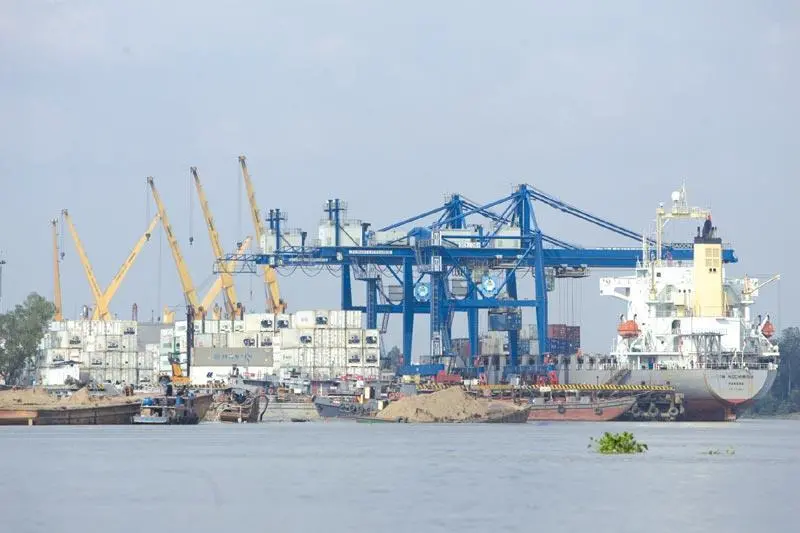
Container volumes in World Trade Organisation-rookie Vietnam have been growing 19% a year for the past decade, yet the ports along the 3,200 km coastline remain woefully inadequate.
However, all that is now changing with the biggest names in the terminal operating game piling into the former French colony over the past 18 months. Draft restrictions mean only nine of the country’s 266 seaports can be upgraded to handle 50,000 dwt cargo ships or 3,000 teu container ships.
The Asian Development Bank (ADB) suggests that booming emerging economies see container throughput at twice that of gross domestic product (GDP). GDP growth last year was 8.5%. Based on this calculation, the ADB reckons $5bn will be needed in Vietnamese port investment up to 2015.
Vietnamese ports handled 181m tonnes of merchandise last year, a figure estimated to rise to up to 250m in 2010 and to 550m-600m by 2020, according to maritime authorities. At the moment the exporting powerhouse in the making has to feeder almost all of its goods to Singapore or Hong Kong for onward destinations. Deepwater ports are urgently needed.
Wim van Sluis, chairman of the Rotterdam Port Promotion Council, said following a tour of the country in March that Vietnam’s weakest link is its lack of infrastructure. “The problem is that the ports are located in the cities,” he said. Downtown streets are often jammed with big trucks due to poor infrastructure, he noted.
Ho Chi Minh City currently accounts for 70% of the throughput. The congested central location and shallow drafts have finally forced authorities to move the port out of the city limits in part to nearby Cat Lai and Hiep Phuoc, and in part to the Cai Mep-Thi Vai port complex in neighbouring Ba Ria-Vung Tau province.
Saigon Port, Vietnam’s main port operator, has signed up for joint ventures with APM Terminals and Singapore’s PSA International. The ventures will beresponsible for building and operating container ports in the province of Ba Ria-Vung Tau, located on the coast of the country’s southern region about 78 miles from Ho Chi Minh City.
The joint venture with APM Terminals includes the construction of two berths with an annual capacity of 950,000 teu. Saigon Port said capital investment in the terminal project will be $187m.
The box terminal venture with PSA, known as SP-PSA International Port, is upstream from the Cai Mep International Container Port and comprises a four-berth terminal with an eventual annual container handling capacity of 2.2m teu. The first phase is well under construction and scheduled to begin operations in the second quarter of 2009. Saigon Port holds a 36% stake in SP-PSA with parent company Vinalines, Vietnam’s National Shipping Line holding 15% and PSA Vietnam 49%.
Eighteen months ago, Saigon Port signed another joint venture with SSA to develop the $160m Cai Mep International Container Terminal 120km south-east of Ho Chi Minh City. The terminal will have two berths totalling 600 metres capable of accommodating vessels of 50,000 dwt-80,000 dwt with a 1.35m teu annual capacity. It is scheduled to open in 2010.
In spring last year, Hutchison Port Holdings, meanwhile, signed a joint-venture with Saigon Port to build and operate a container terminal in Ba Ria-Vung Tau. The agreement will allow the companies to operate the terminal for 50 years beginning 2011. The facility is planned to have three berths with a total length of 700 meters and be capable of accommodating vessels of up to 60,000 tonnes. It is expected to have an annual throughput capacity of over 1m teu. Hanjin Shipping signed a similar agreement about a month later. Hanjin president and chief executive, JW Park noted at the time: “The MoU will help lay a firm foundation for investment in terminal business in the newly emerging market. The constant availability of berths is expected to help upgrade customer service with reduced logistics cost and improved schedule reliability.”
Saigon Port has bagged joint ventures with key big names – but other Vietnamese companies have their port intentions in the Ho Chi Minh City area – including the leading shipping line, Vinalines and the main logistics player Gemadept.
Related Articles
 NEWS
NEWS
 CONTAINER & CARGO HANDLING
 OPERATIONS