


THE FUTURE SEEMS RAIL-MOUNTED
The debate over the best pick of equipment with which to run a terminal yard – the straddle carrier, the rubber tyred gantry (RTG), or the rail mounted gantry (RMG) – has rumbled on for decades, and continues to, as Kevin Chinnery discovers.
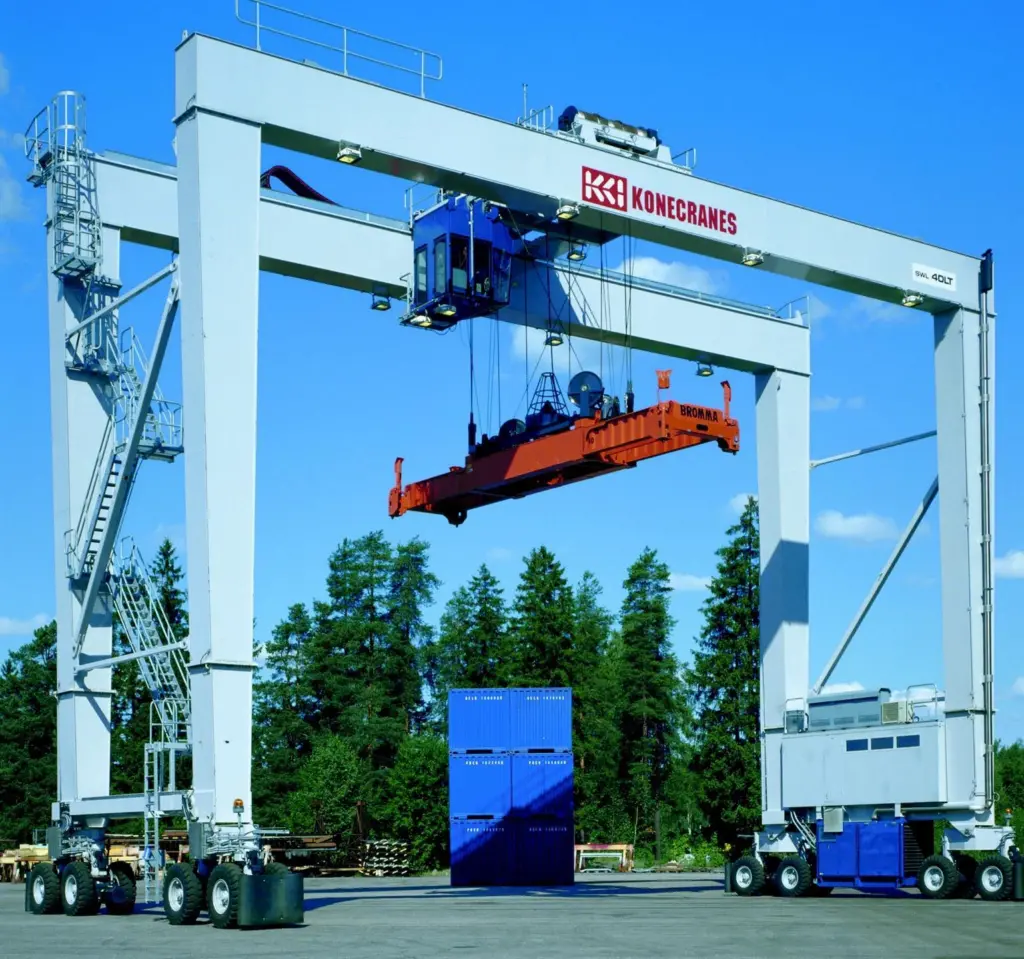
The choice has often been coloured by the personal experiences of the boards of directors who make these decisions. That has sometimes meant that the cheap and versatile straddle carrier has won out. But it is probably fair to say that straddles have increasingly battled against the odds. Most new terminal developments over the last ten years have opted for gantry cranes where they can: rising global throughputs mean that the volume thresholds for more expensive gantry technology is easier to meet, while the port land needed for running straddles is hardly getting easier to find.
The basic story between straddles, RTGs, and RMGs is that each can respectively handle a higher volume with more efficient use of land, but for a steadily rising purchase price and less and less flexibility once they have been installed.
Two Taiwanese researchers, Wen-Chih Huang and Chin-Yuan Chu, writing in the Journal of Marine Science and Technology in 2004* concluded that everybody that can, will install rail mounted gantries – especially as they are now reportedly getting cheaper to buy.
Huang and Chu’s paper describes succinctly the pros and cons of each system.
Straddle Carriers or ‘strads’, are flexible, and can move boxes either directly from the quay crane to road and rail transport, or by relaying boxes to a yard tractor, shuttle within the terminal. Generally speaking, the more moves that are required within a terminal, the more the flexibility of a straddle will score.
As well as being cheaper to buy, strads require more space but less investment under the wheels. The machines generally put only half the weight on the terminal surface that a rubber tyred gantry might and can run on asphalt, but they can’t stack more than three high. They need lots of space to drive around in, but they do allow a lot of flexibility in how the terminal is laid (or re-laid) out.
In terminals with a lot of land, such as Maersk/ETC in Rotterdam, SCT in Southampton, MTC in Giaio Tauro and Freeport Bahamas, they have all been recently deployed. Most Australian terminals are also straddle based operations – though with some interesting exceptions.
In a further refinement, Patrick’s Fisherman Islands terminal in Brisbane began the first operational use of robot Auto-strads last December. The machines were built by Patrick’s long-time supplier and technology partner, Kalmar.
RTGs can stack very much more densely, from one over four up to one over seven. Most of the world’s RTG fleet is capable of straddling at least six containers, and service a truck or rail lane down the side.
RTGs need heavy concrete paving under the wheels, and reinforced pads where they turn frequently next to stacking areas. But they are still lighter on their feet and more flexible in layout than an RMG. This makes them more suitable for terminals built on reclaimed land.
RMGs run on fixed tracks and can provide the best combination of storage and speed, with the largest often able to straddle 12 to 20 rows of boxes up to eight high, though the older machines which make up most of the global inventory are nowhere near this large. RMGs save the space otherwise needed for a separate interchange, with room for two to three truck lanes under the outer gantry arm. But they are not flexible once they are installed.
Most gantry systems comfortably exceed the 10-year life span of a strad, at 15 years for an RTG and 20 years for an RMG, say Huang and Chu.
David Griffin, a sales engineer at Liebherr Container Cranes in Ireland, further refines the choice between RTGs and RMGs.
The RTG is cheaper to buy, he says. It has the ability to move to other stacks. It is also possible to spin-turn the machine, which gives it more flexibility within the stack.
The RMG allows intensive utilisation of the stack. It can be operated at high travelling speeds, and it has a very broad reach – up to 20 rows of containers across is typical on new designs, says Griffin.
The choice therefore comes down to whether a terminal has, or expects, the volumes to justify the switch up to more expensive rubber tyred and eventually rail mounted gantries.
The impact can be dramatic in a place like Australia which is rapidly charging through the volume threshold between straddles and gantry cranes. The rising throughput in Australia has allowed both leading stevedores Patrick and P&O Ports to play the gantry technology card against plans by port authorities for new terminal land development – and potential competitor entries – that they would rather see put off.
Patrick is currently doubling the capacity of its Port Botany terminal to 1.3mTEUs (larger than the present throughput of the entire port) using five RMGs servicing both rail and road lanes, and a buffer yard inside the terminal where automated strads will pick up and drop off containers.
The Sydney Ports Corporation wants to reclaim another 60ha of space at Port Botany which it says will be needed to take the whole of both up to a target capacity of 3.2mTEUs around 2020.
But both stevedores say that new gantry technology makes this figure far too conservative with technically feasible throughputs – with or even without the new land reclamation – that overwhelm all foreseeable throughput demand in Sydney. P&O Ports told the state government inquiry into the expansion that with existing technology, an expanded Port Botany could handle 4.4mTEUs, and with automated RMGs, the port could do 6.4mTEUs – or double the port’s target.
Patrick goes even further saying that if the existing terminal operators were able to use all the available new space to deploy automated RMGs, Sydney could raise throughput (which stood at 1.2mTEUs in 2003/2004) to a staggering 8.5mTEUs, the stevedores’ point being that the SPC would not need to bring in a third operator, or indeed see container growth post-2020 move on to a competing port like Newcastle.
Not surprisingly, pictures of the 22 automated RMGs at HHLA’s Alternwerder terminal, with whom Patrick has struck up a technology-swapping relationship, are now a strong feature of Patrick’s presentations to government decision makers and its shareholders. Clearly there are more than just technology issues at stake in the choice of equipment!
P&O Ports is also planning to introduce driverless gantry technology at its largest Australian terminal at West Swanson Dock in Melbourne within the next five years, and is currently trying to assess the best software to model the development.
Senior Australian managers point out that there is another nontechnical issue in the choice of equipment: industrial relations. The more interfaces there are in a container operation, the more opportunities there are for foot-dragging or arguments from the workforce over work practices and processes, they say. “It’s far better to work on the ‘Keep It Simple, Stupid’ principle and run the most streamlined crane operation possible”, suggested one.
This explains why the P&O Ports operation in Port Botany, traditionally more militant than other Australian ports before the watershed industrial dispute of 1998, has always been an RTG operation.
The Patrick terminal in Port Botany converted to strads in the mid1990s, seen at the time as a brave move which certainly attracted its share of industrial problems. However, the Patrick terminal’s more recent problems have focused more on the lack of space to service the truck ranks in particular. The company is now transferring the manual strad fleet displaced by its new automated fleet in Brisbane, to its other terminals in order to beef up the straddle operations elsewhere.
Ilpo Hakala, director of harbour and shipyard cranes at Finland’s Konecranes, sums up a future increasingly geared to rail mounted cranes for their efficiency, despite the expense. In central Europe, and increasingly in the Americas and Asia, high traffic densities will mean that road transport will become less and less reliable.
More and more containers will be transported by rail and river, which means more investment in intermodal terminals with RMGs.
“Konecranes’ intention is to put more emphasis on RMG cranes in future”, says Hakala adding that the existing Konecranes RTG, with load control features such as sway prevention and horizontal fine positioning is an excellent platform from which to develop an RMG range.
“As the Alternwerder terminal seems to be successful, there is now a clear trend towards fully automating container terminals in areas where labour costs are high”, says Hakala.
* “A selection model for in-terminal container handling systems ” by Associate Professor Wen-Chih Huang of the National Taiwan Ocean University, and Chin-Yuan Chu of Taiwan’s Ministry of Transportation and Communication, in the Journal of Marine Science and Technology, Volume 12, Number 3, 2004.
Related Articles
 NEWS
NEWS
 CONTAINER & CARGO HANDLING
 OPERATIONS