


The right tools for the job
Terberg’s Ron van Arkel explains why safety-conscious operators should not compromise on equipment investment.
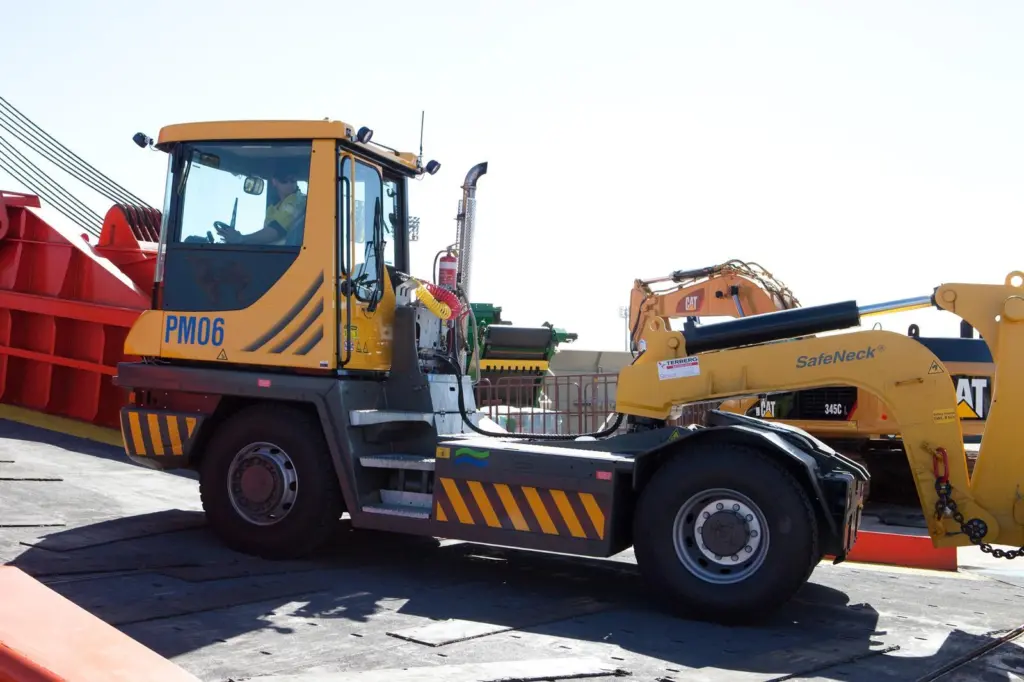
As Terberg expands in different territories in addition to its traditional European market, we are seeing different ways of handling cargo, specifically general cargo and breakbulk.
For decades, in Europe general cargo on roll trailers has been handled by dedicated ro-ro tractors which typically have 4-wheel drive, an elevating fifth wheel, rotating seat and a gooseneck attachment.
However, back in the early 2000s, Terberg developed a safer way of handling roll trailers in ro-ro operation called the SafeNeck. Instead of elevating the fifth wheel and gooseneck to move the roll trailer, the SafeNeck is equipped with a hydraulic cylinder and hinges to move the roll trailer, increasing stability and lowering the centre of gravity. The use of the SafeNeck can also, under certain conditions, increase the maximum allowable load deemed to safe by a factor of 2.5.
Terberg combines its SafeNeck with its RT283 or RT323 tractor, to offer good power and brake capabilities. As standard, these units come with a heavy-duty double jaw disc brake and powerful engine brake to navigate heavy loads on steep ro-ro slopes.
Terberg believes that the minimum requirement for operating heavy loads on a ro-ro vessel is a 4-wheel drive tractor with a rotating seat: 4-wheel drive to have the best possible traction and rotating seat or console to operate in the safest way, as operators always have the best control of the load when the load is above them on a ramp.
It is therefore surprising to see that some operators still use standard terminal tractors, which are not dedicated to or designed for ro-ro operation, to serve ro-ro vessels. These units are often slightly modified with a counterweight on the front axle to ensure that the front axle stays grounded to allow the unit to steer.
However, due to the lack of rotating seat the roll trailers are often driven up the ramp with the load below the tractor. This can cause a loss of traction or difficulty steering, making it very hard to control the trailer as often the tractor is seriously under powered in both brake, weight and engine capacity.
These risks are often underestimated and incidents can be more costly than investment in a dedicated ro-ro tractor. The operator should also consider the increased safety risk — if terminals have the safety and wellbeing of their employees as a top priority, there should be only one option to handle ro-ro vessels with roll trailers: a dedicated ro-ro tractor.
Related Articles
 PORT TALK
 PORT TALK
 PORT TALK