![PortStrategy[GreenPort]](https://www.portstrategy.com/wp-content/uploads/2026/09/PortStrategyGreenPort.svg)





A fragile peace in Uruguay
Rob Ward tracks developments between employers and workers in Montevideo, Uruguay, discovering that a fragile peace is now in place as the facility seeks to regain lost container traffic

An uneasy truce has broken out and it is now all quiet on the Uruguay front, or at least mostly quiet. No, it’s not a historical documentary about the Battle of the River Plate, and the aftermath of the sinking of the Graf Spey (a Germany WW2 submarine) but the battle between stevedores in Montevideo and the management of Terminal Cuenca del Plata (TCP), which is majority owned and operated by Belgian outfit Kateon Natie.
Problems started in October last year when TCP tried to get workers to use a new Navis port operating system that had already been implemented and was functioning but with a collective agreement that had expired. Dock workers, members of the Cuenca del Plata Terminal Union, said they would only continue to work on the system if TCP reduced the daily working hours from eight to six, while maintaining pay equivalent to eight hours – the equivalent of a 25% pay rise.
BATTLE RUMBLED ON
However, the battle between employer and employees really took off in January this year and rumbled on until July, and, having lost more than 30% of its regular annual throughput over the past three years, TCP (Katoen Natie) needs to be very careful that poor industrial relations do not lead to more losses, and more shipping lines culling calls. Montevideo has seen a fall of more than 24% since 2023, with 1.12 million TEU in 2024, and 857,491TEU in 2025, according to figures from the port authority, Administracion Nacional del Puertos (ANP). TCP handles 70% and Montecon handles the other 30%.
In terms of transshipment, the situation is even worse, with a 43.5% fall from 700,000TEU in 2023, most of it to/from Paraguay and fleeing to Exolgan in Buenos Aires. Figures are holding up this year with 439,464TEU during the first six months, about the same as last year.
Gonzalo Hontou, Commercial Manager, TCP, confirmed to Port Strategy that a total of 60 days has been affected by strike actions from the dockers but the heated exchanges had died down and operations were “back to normal” while further discussions continued.
Continued strike actions would be disastrous for TCP – which has a workforce of 550 – as it has haemorrhaged both transhipment and Paraguayan cargo over the past three years.
At the height of the labour dispute, in early July 2026, two regular deep-sea services skipped TCP and two more ended operations early to escape strike delays. In August 2026, MSC pulled another service from TCP citing “labour disputes”.
BACK TO NORMAL
“Between January and July 10th of this year we saw our workers take strike action on 60 days, but now we are back to normal,” said Hontou, who has held a management position with TCP for more than 15 years. “There have been one or two hours of stoppages since then, but only while negotiations were being held between the two parties.”
He added that some of the strikes at the beginning of the year were general strikes involving other sectors and unions. Sunca, the construction workers union, persuaded the government to reduce their average working week from 44 hours down to 40, and TCP’s labour union now seems to want something similar.
Hontou also said that the Paraguayan cargo was cyclical and would return eventually. “It is cyclical, the way it flips from Buenos Aires to us and then back to Buenos Aires again,” he added.
Several commentators told Port Strategy that since the left-wing Yamandu Orsi became President of Uruguay in March 2025, trades unions have become more militant and taken more strike actions than in previous years, perhaps hoping they can cash in on left-wing sympathies among the populace. This, however, makes it very difficult for Orsi’s government as 20% of the shares of TCP is owned by the government.
TCP is the only dedicated container terminal in Montevideo and handles 70% of all containers that pass through the Uruguayan capital, with Montecon, (which uses the public berths) dealing with the rest, as well as much of the breakbulk cargoes.
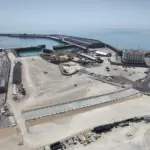
Four years ago, TCP signed an agreement with the Uruguayan government that meant its concession would be extended by 50 years in exchange for US$455 million worth of investment in a new quay, port equipment, and civil works. As part of the agreement, the government agreed to grant TCP monopoly status when it comes to the handling of containerised cargo, and Montecon would have to concentrate on breakbulk.
“We have had some delays with our works and expansion projects,” explained Hontou “Back in 2023 we thought that by this time, we would have completed the works of phase 1 and that today we would have the monopoly in place but now we expect that to happen by July of next year.”
Related Articles
 PORT & TERMINAL NEWS
 PORT & TERMINAL NEWS
 CONTAINER & CARGO HANDLING