


SOPHISTICATED SUPER TUGS SET NEW STANDARDS
More powerful, but compact and highly automated, the humble tug is growing ever more sophisticated, and assuming new roles that can help enhance ports balance sheets. David Foxwell reports.
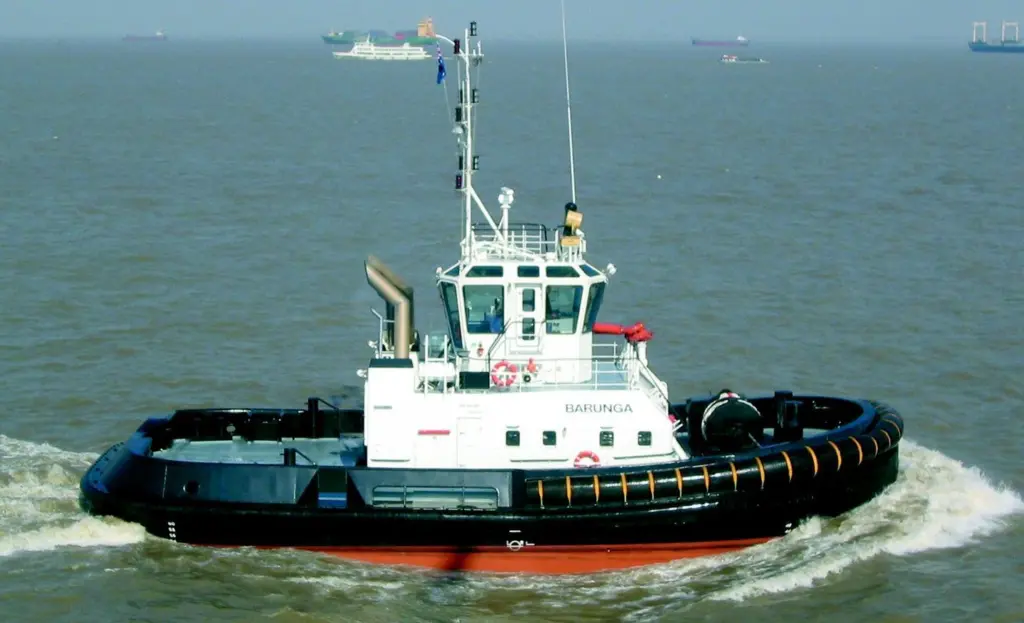
As Carl Johan Amundsen, founder and director of consulting naval architects and marine engineers Carl J Amundsen told PS, harbour tugs and escort tugs are certainly getting more powerful, but there is, he explained, also a growing demand for purpose-designed vessels – tugs that are intended to provide support for very specific vessel types – and for vessels with ‘value-added’ features.
Multipurpose vessels able to assume firefighting and pollution control duties when required can alleviate the need – and capital investment required – for dedicated pollution control or firefighting craft, he explained, and the more manoeuvrable and powerful the tug, and the greater the ‘add-on’ roles that they are able to assume, the greater the potential benefits – and cost savings – for the end user.
Sophisticated vessels like this do not come cheap, but offer the port authority willing to invest in purpose-designed tonnage throughlife costs savings, savings that are realised through their ability to carry out duties that would otherwise require larger numbers of tugs.
“If you need fewer tugs, and those tugs are more sophisticated and have a high level of automation, then the tugs can be operated by two or three crewmen rather than four – depending on the regulations in individual countries – and a further cost saving is also realised over the lifetime of the vessel, ” Amundsen told PS, a sentiment echoed by Frans Wouter, who works in the tug department at shipbuilder Damen in the Netherlands.
“There are two key trends as we see it, both of which can help to make port operations more efficient and cost-effective, ” Wouters explained. “These are that tugs are getting more powerful, whilst remaining compact, and that they are getting more and more manoeuvrable, ” says Wouters, highlighting as an example of this trend BARUNGA, a recent delivery by Damen which although only 24 metres in length is capable of a bollard pull of 70 tonnes. In keeping with the multiple roles of which modern tugs are capable, BARUNGA also boasts firefighting to FiFi Class 1 standard, he explained.
“More automation is important to port operators too, ” Wouters explains, “because if you have a high level of automation the tug can operate with an unmanned engine room, which further reduces the number of crew required on board.”
Most recently, Amundsen’s firm was involved in the project management of a new, highly sophisticated escort tug for Ostensjo Rederi in Norway, the AVT 37/65-E class escort tug VELOX, which was delivered by shipyard Astilleros Gondan in Spain. VELOX is the first of two tugs being built at Gondan to this new design, the design having been developed by Robert Allan Ltd (RAL) of Vancouver, British Columbia, working in close association with the Carl J Amundsen as Ostensjo’s technical representative, and propulsion systems specialist Voith Shiffstechnik of Heidenheim in Germany.
VELOX was designed specifically for use at Norsk Hydro’s oil terminal at Sture, Norway, in order to significantly upgrade the tanker escort capability for ships calling there. The tug is propelled by a pair of Rolls-Royce/Bergen Diesel C25:33L8P diesel engines, driving Voith Model 32R6-210-2 cycloidal propeller through a Voith Turbo coupling, a combination that delivers a bollard pull of 65 tonnes and provides a free running speed in excess of 14.5 knots.
As Amundsen explains, among the key features of VELOX are the fact that she provides up to 150 tonnes steering force in indirect mode when escorting at 10 knots; a specially developed hullform, which helps to achieve optimal steering forces; and a newly developed ‘turbo fin’ fitted at the skeg in order to increase steering force by 15-20%.
Like many of the more sophisticated tugs currently on order, VELOX is a multi-purpose vessels, and is also equipped with firefighting gear to FiFi class 1 standard, and with pollution control equipment in the form of 20m3 of dispersant and 20m3 of tanks for recovered oil.
RAL was also the designer of the first of a completely new class of tug, dubbed the Z-Tech class, the first example of which entered service last year, built by Cheoy Lee Shipbuilders Ltd of Hong Kong and christened Indee by Teekay Shipping in Australia. Although the new vessel was commissioned by PSA Marine (Pte) Ltd. of Singapore for their own operations, it was sold to Teekay about two months before completion in order to satisfy an urgent requirement for new tugs at the BHP Billiton bulk terminal operations in Port Hedland, in Northwest Australia.
The Z-Tech design was conceived and developed by RAL in response to the challenges posed by PSA Marine for a new and versatile class of tugboat for major port operations worldwide, and represents a unique development in harbour tug design, capturing the best operational advantages of Azimuthing Stern Drive (ASD) ‘Pusher’ configuration, and Z-drive ‘Tractor’ configuration.
For ‘sea-going’ operations, the Z-Tech tug works astern in tractor mode, so the shape of this part of the hull is more rounded in plan than would typically be seen in an ASD design. There is no appreciable loss of BP or speed in this direction of operation, however, and the increased flare and freeboard at the aft end is simply to ensure a drier operation when towing in this direction. Only one winch is required for both harbour and coastal towing operations, and when towing long distances, the tug will simply tow in tractor mode going astern.
Another key feature of the design is that the low sheer forward, coupled with the aft bias of the deckhouse and wheelhouse enable the Z-Tech design to work under large overhanging ship flares of the type which are found increasingly on modern vessels.
With a single control station serving both harbour ship-handling duties, (facing forward over the working deck), and transiting voyages, (facing astern), apart from the operational advantages described above, the Z-Tech design is quieter and experiences reduced levels of vibration compared with other tug types – which is particularly important on smaller, compact high-powered tugs.
The escort skeg performs a number of critical functions in the ZTech design, and enables the tug to work in the Z-drive tractor mode, much as a more conventional Z-tractor tug would. When the Z-Tech works as a ‘pusher’ or ASD tug, the skeg provides much enhanced astern directional stability, without impeding regular ahead performance in any way.
Damen in the Netherlands delivered its first ASD 3111 tug, PILBARA NEPTUNE, to Hamersley Iron Pty Ltd in Dampier in Western Australia, in January, PILBARA NEPTUNE being the first ASD tug of a series of three that will be used to assist large bulk carriers, up to 300,000 tonnes deadweight to berth and unberth at iron ore shiploader jetties.
The circumstances under which the tugs have to operate have been of great influence on the final design, and special air filters have been installed to cope with the dusty environment and special heavy duty coolers installed to cool the engines during the extremely hot summer weather in Dampier.
Related Articles
 OPERATIONS
 OPERATIONS
 PRODUCTS & SERVICES