



Buzz term or innovation?
Solvo’s Daniel Pershin asks whether the modern day port-centric logistics concept can deliver on its promises
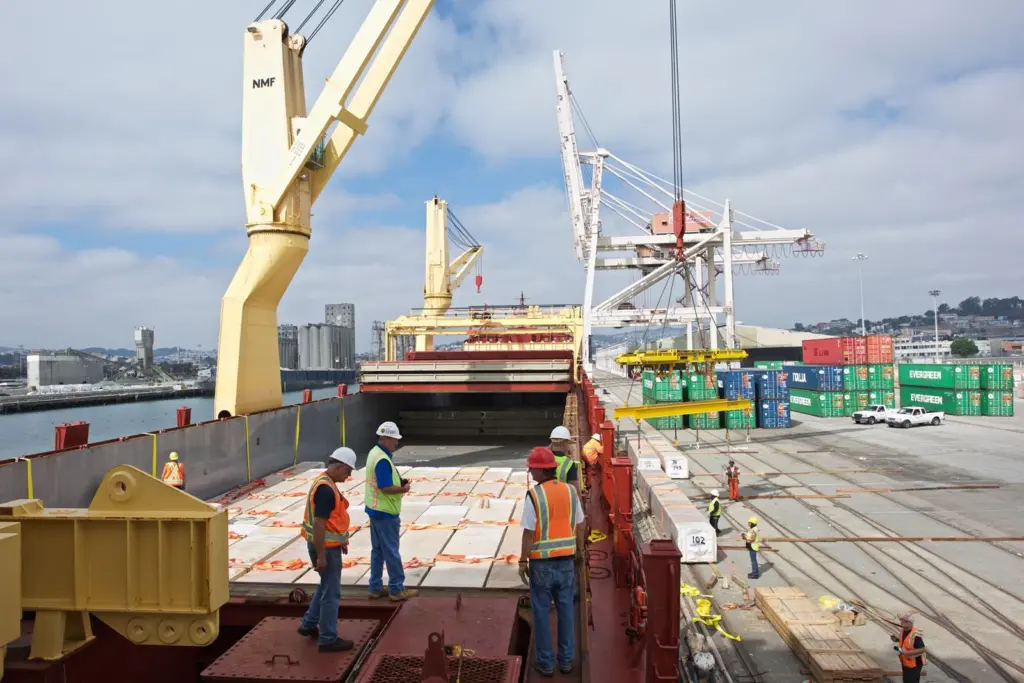
The term ‘port-centric logistics’, in our view, requires further clarification. In recent times, this term has been increasingly used at major international logistics events. It’s the concept of managing the supply chain, when loaded import containers do not leave the port after unloading and are not included in intermodal shipments within a country. Instead, containers are unstuffed in the port and their contents are processed, stored and moved, for example, to the warehouse for temporary storage.
Most industry experts would agree that the concept has long been in existence. However, it has been given a new spin as logistics operators and also manufacturers take advantage of this concept.
Today’s port-centric logistics concept requires a different approach from ports towards automation and IT development when it comes to transport processes. In the past, stevedores simply handled containers, whereas now the structure and scale of cargo processing has expanded rapidly.
For port-centric logistics to work the terminal needs to operates as a single mechanism, on the one side providing accounting and processing of import/export containers and subsequent operations involving their stuffing/unstuffing, weighing and return of empties; while on the other side, processing container contents, accounting for palletised, cartonised and even unitised cargo in real time, as well as billing clients.
The main goal of port-centric logistics is the ability to work with all basic types of cargo under one system: general cargo, bulk, breakbulk, containers, and ro-ro cargo. While each of these cargo types must have their own processing and record-keeping specificities and corresponding interfaces (screens, tabs and interfaces), it is important that all users have the ability to work within one system and database to prevent redundancy when inputting data and export/import identification.
A second goal is stuffing/unstuffing. Cargo unstuffed from a container or ro-ro must be received at the warehouse (as general cargo, bulk, or palletised, and so on) and remain in the system. It must then be received, allocated, stored, picked, and shipped based on specific rules and strategies available at the temporary storage warehouse. Similarly, during stuffing, cargo must be written off from the warehouse’s inventory and registered as inside the container.
System control
One of the most important factors to consider for effective management of port-centric logistics is the need for a two-level system: 1) management of the port/terminal as an enterprise (document flow, record-keeping, accountability, business analytics and planning); and 2) management of technological processes (process control system).
The technological level includes tasks for operative, or internal, planning and configuration with the application of various cargo identification and data capture technologies such as wi-fi, barcoding, RFID, and optical character recognition, for example, to read container or vehicle numbers; DGPS, and RTLS in real time; and technology for system access for stevedore company workers. All of these technologies make it possible to manage these processes in real time as well as providing complete traceability of cargo transformation monitoring along the entire goods distribution chain from producer to the store shelf. Today there are several solutions available for such ports.
Port-centric logistics is the combination of a variety of elements of the supply chain, centring round the territory of the port. Port-centric logistics strategies combine and augment port facilities with warehouse, distribution, assembly and manufacturing sites that can accommodate multiple types of transport including road, rail and sea.
Considering the current global economic uncertainty and falling commodity prices, it is not surprising that port operators are increasingly looking at the port-centric logistics model as a tool for disintermediation and thus, for boosting overall efficiency and reducing the costs of the supply chain from origin to destination.
With the confluence of various trends such as increasing containership size, market uncertainty, advances in IT technology, and increasing competitiveness, the port-centric logistics model is looking less like a buzz term and more like a sound strategy for many ports moving forward. Aided by ever-improving TOS systems and other technological advances in IT, this ‘old’ model is getting a new lease on life by presenting ports with greater control over the entire supply chain to increase overall competitiveness for today’s market.
Daniel Pershing is head of marketing at SOLVO.
Related Articles
 PORT TALK
 PORT TALK
 PORT TALK