![PortStrategy[GreenPort]](https://www.portstrategy.com/wp-content/uploads/2026/09/PortStrategyGreenPort.svg)





Introducing a Water and Energy Conservation Plan
In the March/April issue of GreenPort, the Port of Brisbane outlined its strategy of operating its port in a sustainable. In this issue, the Port explains how it is working to save water and reduce energy consumption
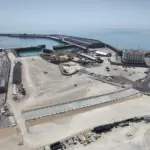
Australia is one of the driest countries in the world, and South East Queensland has recently been experiencing one of the worst periods of drought on record. Tough restrictions on water use are in place for both households and businesses. In response to this situation, the Port of Brisbane Corporation has reduced its potable water use by more than 75% since January 2005, and has developed a Water Strategy that seeks to go beyond the base level of compliance. Introducing a number of domestic water saving initiatives, including the installation of water tanks at its offices and using recycled water for irrigation, the Corporation has also developed a recycling system to reduce the amount of potable water used to cure the concrete in wharf construction. Water is captured from the first curing and pumped back into a tank before it is fed back onto the concrete surface. Combined with the use of seawater or recycled sewerage water, the Corporation has found alternative water for 95% of the construction activities around the port.
Energy saving
The Corporation recently undertook trials of an energy-saving device that should result in projected annual savings of up to 25% of energy use. The Australian-made “Light Save” device was installed on a light tower at the Brisbane Multimodal Terminal (BMT). The lamps on the tower draw 940 watts of power, which is typical of towers throughout the port. The light tower’s energy use was measured for one month with the device installed and then compared to one month without the device. There was no measurable change in light levels during the period. Pleased with a 25% saving without compromising or altering the light levels, the Corporation is currently trialling another nine light towers at the BMT. This larger trial will further evaluate the product, and any changes to light levels or lamp life. From just these nine devices, the Corporation hopes to reduce its greenhouse gas emissions by 100 tonnes every year, which is the same as removing 25 cars from the road.
Shorebird management plan
With up to 3500 resident and 40,000 migratory shorebirds visiting Moreton Bay every year, the Brisbane Port Corporation has constructed one of the largest dedicated shorebird roost sites along Australia’s east coast. Located next door to the port’s reclamation paddocks adjoining the Moreton Bay Marine Park, this 12-hectare site provides a roosting habitat for up to 15,000 migratory birds – making the port a significant roost site. An integral part of the Corporation’s Shorebird Management Plan, which provides for the continued monitoring of the shorebird population and ensures that port development activities do not adversely affect the port’s shorebird population, the roost site ensures that future of these amazing creatures is assured. Following the East Asian-Australasian Flyway, and navigating up to 11,000 kilometres from as far away as Russia, Siberia and Alaska, some of these birds, which weigh less than 15 grams, were tagged ten years ago in Moreton Bay and are still recorded as making this annual pilgrimage.
Visitor centre – with Eco Café!
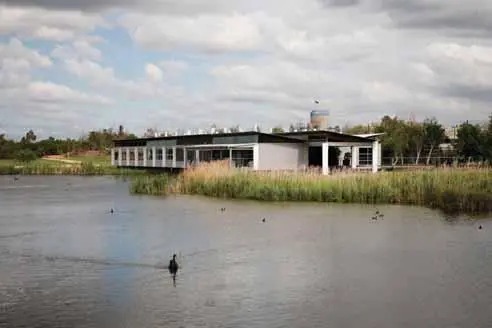
Built and operated by the Brisbane Port Corporation, the Visitors Centre is situated over a 4-hectare lake, and offers the community a number of unique experiences. Visitors can wander through the display area and learn about the operations of a working port, take a tour of the port, or simply enjoy a meal, coffee, or cake at the Eco Café or On the Lake Restaurant. The Centre offers conference and meeting facilities, and has a 100-seat auditorium with a large-screen projector system, ideal for presentations. In 2006/2007, 145 schools, with 4,832 students and teachers, participated in port tours, including eco workshops, and 374 free tours were provided to community groups. The lake is an important habitat for a variety of birds, as well as a settlement pond for stormwater run-off from adjacent hardstand areas, before it is discharged into the Moreton Bay Marine Park. The Centre incorporates a number of sustainable design features, including natural ventilation, solar hot-water heating systems, and energy-efficient lighting. Swales and surface-ponding areas are also incorporated into the landscaping around the Centre to capture stormwater run-off.
Related Articles
 AUSTRALASIA GREENPORT
 AUSTRALASIA GREENPORT
 AUSTRALASIA GREENPORT