

Port of Cork promotes short-sea shipping
Captain Michael McCarthy, Commercial Manager of the Port of Cork highlights the advantages of short-sea shipping – and the benefits to the environment
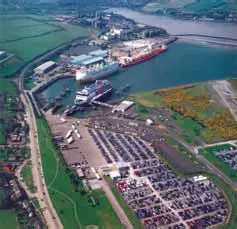
The Port of Cork, Ireland’s premier port on the south coast of Ireland offers sheltered deepwater facilities close to the main shipping lanes to Northern Europe, the Mediterranean and North America. The Port of Cork’s business model requires the expansion of its Ro-Ro capabilities to cater for modern day supply chain logistics as it offers the shortest sea passage to the West Coast of France and Spain/Portugal. This decision has been taken in light of the Port of Cork’s recent involvement in the EU “ATMOS” (Atlantic Motorways of the Sea) project developed in 2004-2007 and funded by INTERREG IIIB Atlantic Space. As well as ATMOS, the Port of Cork also continues to develop specific proposals for improving maritime links between Ireland, France and Spain through the WEST-MOS project (Western Europe Sea Transport & Motorways of the Sea) in 2006-2008 and the PROPOSSE project 2009-2011. The objective of the Port of Cork as Ireland’s closest port and sea route to Europe is to:
• Identify and support a new Ro-Ro service to Northern Europe by-passing the British land corridor.
• Identify and support a new Ro-Ro service to Spain by-passing both the U.K and France • Define the impacts on Road Transport Ireland-UK-France-Spain
• To quantify savings to Haulage Contractors and Logistic Suppliers.
• To quantify savings on Security within the Logistic Chain
• To quantify Savings from Tolls, Fines, EU Environmental Taxes and CO2 Emissions costs.
• To present a cost effective, energy efficient and climate-friendly alternative to extending motorway networks on land
The deployment of the Motorways of the Sea network would absorb a significant part of the current road freight traffic, plan for more sustainable routes when the current economic conditions turn around and improve the accessibility of peripheral and island regions like Ireland and reduce road congestion. As the location of the island of Ireland is peripheral to the EU, Irish goods will either need to make longer and costlier overland movements to reach an expanding Europe. Current Ro-Ro services using land bridge through the UK are likely to see significant increases in future costs and/or congestion levels along the key British land corridor and beyond on the mainland road network. This will encourage some traffic to switch to new MOS intermodal services. A significant part of the higher value trade between Ireland and nearby Europe passes overland by lorry through UK, roughly estimated at 100,000 vehicles per annum in each direction using the British land corridor, mainly down to the Kent ports and Channel Tunnel. There is also increased emphasis in the UK to ensure full compliance by foreign vehicles with UK regulations on driver’s hours, vehicle roadworthy condition, overloading of vehicles, etc. The British enforcement agency, VOSA, is currently intensifying its activities particularly in the south-east of England and introducing a series of graduated on-the-spot penalties for vehicles infringing regulations. This could have a significant impact on Irish transit traffic, given the high level of infringement among Irish hauliers indicated in the statistics from VOSA. At a higher level, the EU is increasing the pressure to take more coordinated and decisive actions across the EU to cut CO2 emissions across member states. This will result in likely future increases in road costs, though the exact form in which such cost increases would be applied has not yet been clarified. The long distance road movements between the island of Ireland and mainland Europe are exactly the types of movement that the EU wishes to encourage by carrot and stick to switch to more sustainable modes, so that significant cost increases for these movements would seem inevitable. What is uncertain as yet is: exactly when this would commence; how rapidly the cost would then be ramped up; and whether it is applied through some form of carbon tax on fuel, as part of an Emissions Trading Scheme and/or as a congestion or kilometer charge on vehicle movements. Through Motorways of the Seas, the Port of Cork has initiated discussions with major European Shipping Lines to examine new shipping routes to minimise the impacts on the economic competitiveness of firms on the island of Ireland and on the costs to final consumers. The primary response must be to lessen the distance of the total journey that takes place on road, while maximising the Direct Short Sea Shipping route. Unless technological or scientific breakthroughs change current perceptions of climate change dangers, the cost per kilometre faced by road vehicles is likely to increase significantly in future years across the EU, including the island of Ireland. Unless direct sea routes are established, this cost impact will bear most heavily on the longest distance road movements. This implies that European markets, especially those in the rapidly expanding eastern member states, will become relatively more expensive to serve from Ireland than from elsewhere. The Irish Minister of Transport Mr.Noel Dempsey in a recent document “Irish Department of Transport-2020-Vision- Sustainable Travel and Transport” sets out a vision for a sustainable transport future and states: “if we continue our present travel patterns, traffic congestion will increase, there will be a resulting loss in economic competitiveness, our quality of life and the quality of the natural environment will decline. We will not be able to meet our international obligations to reduce greenhouse gas emissions. In short, our travel trends are not sustainable.”
Related Articles
 ALTERNATIVE FUELS GREENPORT
 NEWS
NEWS