![PortStrategy[GreenPort]](https://www.portstrategy.com/wp-content/uploads/2026/09/PortStrategyGreenPort.svg)





Challenging times
More than 100 geeks and 24 hours of brainstorming. Felicity Landon reports on the World Port Hackathon
It’s generally established that the ports and shipping industry is conservative by nature – and to be fair, people immersed in any industry can struggle to re-boot and take a fresh look at the way things work.
So, it’s unsurprising that the suggestion of an Airbnb-style solution for berths is considered ‘out there’. Yet, this was named as the ‘most innovative and disruptive idea’ at the World Port Hackathon in Rotterdam in September, while the prize for the overall best idea went to ‘Blockchain for Customs’, a solution which uses blockchain technology to detect potential fraudulent actions in the supply chain.
The principle of the Hackathon event is simple: invite in more than 100 non-port geeks – computer programmers and others involved in software development – and throw some perennial port challenges at the teams. Participants at the World Port Hackathon in Rotterdam had the opportunity to ask questions of the experts to understand how things work now, what data is available and how the various parties work together.
“But the main point was – please don’t use that to restrict yourselves,” says Dennis Dortland, innovation consultant at Portbase, the Dutch port community system. “We are keen to find out from new companies, small companies, innovators, what their ideas are. We can imagine and do a lot of things ourselves but maybe we already have too much knowledge of what is going on to really look. We want to see how new people, not restricted by how we do stuff now, think about how to solve future types of problems. They have the outward-in view and often ask the unexpected questions.” Portbase was one of a number of companies supporting the Hackathon with its expertise and helping to judge the winning ideas.
Critical mass
“This year was the fourth edition of the World Port Hackathon,” says Léon Gommans, who founded the event. “I come from the world of open data and had already organised hackathons in other industries. I was not involved in ports at all until I approached Rotterdam – I was knocking on the door of the port and wanted data. I said, tell me about your infrastructure and ships, tell me about your planning. Yes, they were really conservative but eventually someone started to listen.”
Clearly the ports ‘bug’ caught him as he has since started his own company, Teqplay, focusing on optimising port calls and enabling collaboration in the logistics network.
The Port of Singapore has its own history of staging hackathons – last month it joined with Rotterdam as a ‘co-creation partner’ and brought its own challenges to the event. Workshops were organised in May with the industry to define the challenges to be set. “Forty to 50 people were involved in the process; we put all the challengers and experts on the stage, to make their knowledge available to the hackers,” says Mr Gommans. “Last year’s event was semi-international. This year almost half were international, including teams from Singapore, Canada, Ukraine, Poland and Germany.”
The profile of the participants is mixed – about 25-30% students, and the rest IT professionals. It’s an intense 24 hours, in which some grab a bit of sleep and some don’t.
“Definitely we get a new perspective in the answers and the questions,” he says. “It can change the game big time – often we hadn’t thought about an issue in a particular way, and it does open people’s eyes.”
Such has been the success of the Rotterdam event that Mr Gommans is looking to take it to the next level. “We are thinking about making it into a festival type event – a conference, festival and hackathon, combining knowledge transfer at the technical and IT level. We are setting up discussions with port authorities to see what this would look like; the idea is to see if we could, for example, link hackathons in different locations at the same time, with local and global representation, and sharing findings.”
He is already in talks with Los Angeles/Long Beach about setting up some kind of hackathon partnership. “The key thing is we need to have a mechanism to bring developments together.”
Tracking aid
AIS vessel tracking service provider MarineTraffic supported the World Port Hackathon for the second year running as a ‘co-creator partner’. Alex Charvalias, MarineTraffic’s product manager, data intelligence, says: “We were the sole AIS provider during the hackathon, and provided access to information such as vessel position and trucks. Also, I was part of the jury for assessing the relevance of the proposals by various teams, from the business and technology perspective.
“Our role as experts was to give participants the required support, including how to do tracking through AIS and how to utilise AIS data and extra value from it. As a company, we have been working with data and trying to extract additional value in some aspects – for example, in resolving port congestion – so I have first-hand experience of this.
“The teams included technology people with some experience, start-ups and people just out of university. Some arrive as teams, others come looking to make up a team. It is a good experience, particularly if you are young and just finished university and are interested in making a difference. You have this room full of experts from the industry available for your questions, you have the data, and it is a good ground to try things out and see how you stand up against other people. Even those who have not won anything have benefited from the experience – and each failure is a lesson for next time.”
As well as cash prizes, the winning teams can benefit from coaching and support, with some support on offer to help develop an idea further and possibly deliver proof of concept or a business case. While this was an intense, short burst of activity, Mr Charvalias says: “Bearing in mind how complex the industry is, some would benefit from a more extended time period, to give them sufficient time to really analyse issues.
“But what was, I think, interesting was that many of the winning solutions were basically transferring a way of thinking in other industries into the ports industry – for example, taking the Airbnb approach, utilising your assets and applying it to the ports industry, or taking the ‘Uber’ approach to what is happening.
“To my mind, that is an indication that there are still low-hanging fruits in using technology to make a difference to this industry. There is a lot more to do – you don’t need actual disruptive and huge innovation, but perhaps you need to transfer a way of thinking from other industries that have been more productive and open to change compared to the way in which the ports industry is perhaps seen.”
Three themes
The challenges set this year centred around three themes – infrastructure and logistics; energy and climate; and disrupt the port. The hackathon mainly revolves around open data, big data and technology, with a wide range of datasets provided by different stakeholders made available for teams to use.
De Delftse Delegatie team’s winning ‘Blockchain for Customs’ solution netted the team €1,500 in prize money. The team’s proposal adapts the blockchain technology that underpins the bitcoin currency to detect potential fraudulent actions in the supply chain.
In particular, Customs can detect and validate where an intervention has taken place in the supply chain – for example, where the contents of the container have been changed. “If implemented properly, shippers and other participants will not be held accountable for fraudulent actions they did not commit,” says Léon Gommans. “We are really interested to see if the team can now build a prototype, and if this idea could be feasible.”
Mr Dortland adds: “The block chain idea enables all the information around a specific set of cargo to be stored so that there is more data visibility and an unbroken audit trail. Therefore, if someone has tampered with a container, all the [innocent] parties are safeguarded because all the actions have been tracked. It is a really interesting concept of creating trust in the network.”
CONNECTING THE PORT DOTS
For Portbase, working with a wide swathe of partners is important, hence its support of the World Port Hackathon.
The company’s Dennis Dortland says: “For Portbase, working with all sorts of partners will be increasingly important for us. We have 4,000 customers here in the port and in the last couple of years we have helped to establish a paperless port. We had pictures before of people up to their ears in documents every day in their work, but now everything is digitalised.
“Our role is as a trusted and neutral party to enable those 4,000 companies to share data with a single connection. That is what we have established but there are many more challenges ahead with even more and faster data, which can help users to make better decisions and be better informed.”
Working in co-operation with all sorts of partners is important for Portbase because as a port community system it doesn’t necessarily want to develop every kind of service or application in-house, explains Mr Dortland. “However, we do want to offer the connectivity of the data, enabling partners to share and co-operate and creating supply chain visibility.
“I was presenting one of the challenges at the hackathon, of how to create real-time situation awareness, where you can see where everybody is going and find out if there is a free berthing slot to take.
“The hackathon provides an insight into technology used in other applications and what happens if you re-use that in maritime. There were a lot of people there with a lot of knowledge. And the results are as open as possible because we want to attract people and knowledge, and multiply that with what is already known.”
TURNING PORT THINKING ON ITS HEAD
World Port Hackathon founder Léon Gommans picks out two winners as his favourites: one being the overall best WPH idea and the second being a Port Innovation Lab Port Sensors and Data solution in which Team Appsilon focused on the smartest decisions that should be taken, when considering the information conveyed in sensor data.
“In particular, smart algorithms are trained based on the available sensor data and the subsequent decisions that are made. Once trained, the algorithms can be used to monitor the execution of the processes in the port.”
This solution would support ‘fact-based decision-making’, says Portbase’s Dennis Dortland. “For example, if you place sensors in the terminal and on trucks, you can store all kinds of processing times and delay times; based on this data, you can make better predictions in the future by using actual data around traffic congestion patterns, etc. Humans tend to be biased – we don’t really see all the patterns, but this solution allows decisions to be based on what the data actually says.”
Also in the Port Innovation category, Team imPORT developed a variable supply/demand matching algorithm to proactively model activities in the port. Based on these models, it will be possible to differentiate price structures – for example, by incentivising top port performers. Team OBILytics developed ‘From CO2 Emissions to the Greenest Port’, an idea based on peer-to-peer accurate, real-time information-sharing regarding CO2 emissions.
The most innovative and disruptive idea prize went to Team ForTheBrave, for its Airbnb for berths solution. The idea, in response to the constrained capacity of berths in the port, provides a marketplace where terminals can publish available berths and give ships the possibility to use their unused capacity. “This idea not only increases the available/used capacity in the port, but also helps to save emissions by reducing unnecessary movements of ships.’
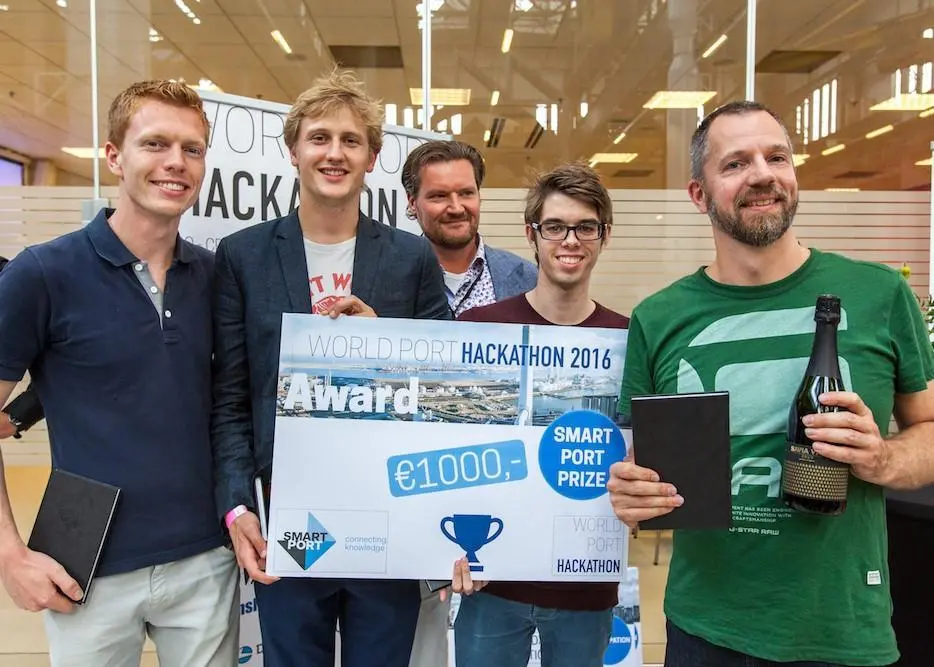
Meanwhile, a Smart Port Prize of €1,000 plus coaching and support went to Team Senfal for its Optimised Energy in the Port idea. This involves providing shore power to large cruise ships by implementing a smart grid solution, thereby avoiding costly investments to cope with peaks by providing cleaner power. “This idea looks promising and therefore Smart Port will support Team Senfal to take the next steps in developing their idea.”
Related Articles
 BULK HANDLING
 BULK HANDLING
 BULK HANDLING