![PortStrategy[GreenPort]](https://www.portstrategy.com/wp-content/uploads/2026/09/PortStrategyGreenPort.svg)






Port congestion risks rise
Rising port waiting times and vessel volumes are increasing congestion risks as terminals prioritise utilisation over supply chain resilience
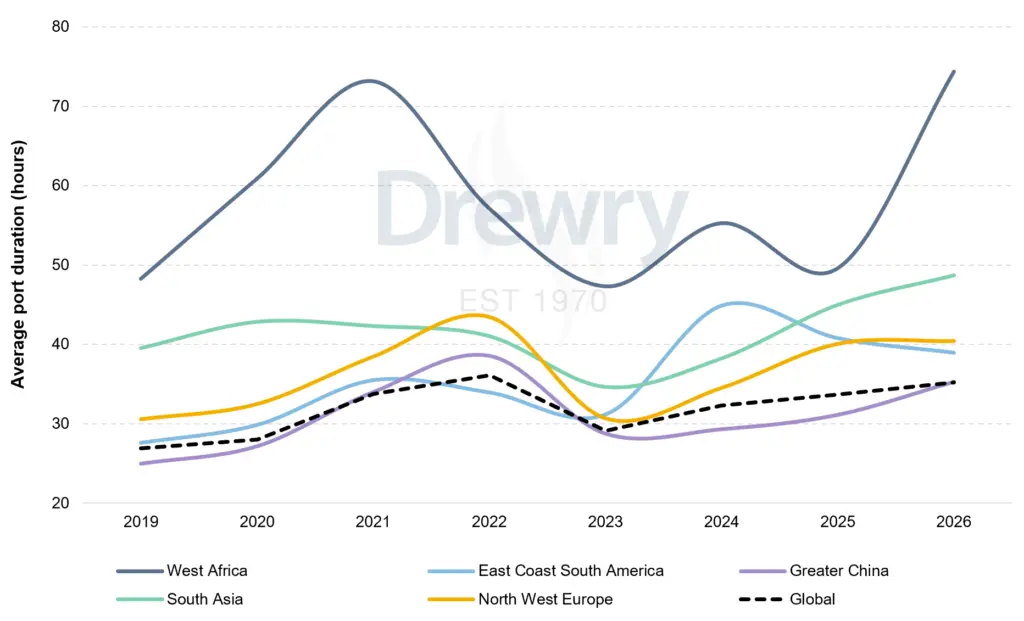
Port congestion risks are increasing across global shipping markets, with longer vessel waiting times and declining schedule reliability creating growing disruption for carriers and shippers, according to Drewry.
The consultancy’s latest market signals analysis shows global average waiting times have nearly doubled during the first seven months of 2026 compared with the same period in 2019. Average containership time spent in port has also risen by 31% over the period, with an increasing proportion of that time spent waiting for berths rather than being handled.
The deterioration has been particularly visible during periods of disruption. In early August, typhoons in China caused ships to wait an average of 3.6 days for a berth, according to Drewry’s Ports and Terminals Insight. However, the consultancy said congestion cannot be attributed solely to weather, pointing instead to structural pressures across the container shipping network.
Maersk chief executive Vincent Clerc recently highlighted insufficient port capacity in Europe, South America’s east coast, West Africa and the Middle East. “These growth and increasing trade imbalances come on the heels of about 15 years since the financial crisis, where investment into terminal capacity has lagged,” he said.
Drewry’s analysis indicates that capacity growth has lagged volume growth at several major ports. Across nine major container ports, terminal capacity increased by an average of 21% between 2019 and 2026, compared with a 28% increase in container volumes.
The consultancy cautioned against describing the situation as a straightforward global underinvestment problem. Private terminal operators have generally continued investing, but higher utilisation means there is less spare capacity to absorb disruption.
Drewry noted that a terminal operating at 90% berth utilisation can take around a week to recover from a one-day disruption, compared with two days for a terminal operating at 75%. High utilisation therefore increases vulnerability to delays.
Carrier strategies can also contribute to congestion. Blank sailings, ad hoc services and extra loaders can create sudden peaks in container volumes, placing additional pressure on terminal yards and berths.
Drewry expects terminal operators to continue expanding capacity but argues that they cannot finance significant buffer capacity alone. The consultancy concludes that the wider container shipping system remains primarily focused on cost and asset utilisation rather than resilience.
Related Articles
 PORT & TERMINAL NEWS
 PORT & TERMINAL NEWS
 CONTAINER & CARGO HANDLING