

AI commercial returns questioned…
The gap between adoption of AI and commercial returns for the port industry is widening according to new research from Boston Consulting Group (BCG) and the Terminal Industry Committee 4.0 (TIC4.0).
The Study was based on responses received from 103 industry experts on a global basis, with a range of interesting conclusions. These included 44% of companies confirmed undertaking developments in scaling AI applications and/or to more advanced deployment stages.
The results received generated a clear picture regarding whether this new technology is actually contributing to operational efficiency. Specifically, concerns over uncertain returns on investment were identified by 41% of respondents as the biggest obstacle to greater AI use, with worries about data quality recorded by 32% and questions relating to systems integration totalling 30%.
This Study did acknowledge that AI is already in deployment across terminal operations, citing popular areas as shipping document processing, predictive crane maintenance, cargo planning, and equipment dispatch. Here, 62% of companies replying confirmed use or exploration of AI to extract information from shipping documents and 48% for predictive maintenance applications.
Other notable commercial factors include greater use of AI by freight forwarders (cited by 61% of replies), followed by logistics service providers totalling 52%.
However, one notable conclusion drawn from the Study was that just 18% of respondents confirmed an improved customer experience, therefore suggesting that use of AI brings value primarily to internal operations.
…as China pushes the AI button
China has confirmed a new programme of 22 AI project applications across its port and maritime transport network.
The Ministry of Transport announced new priorities for AI deployment, with the initiative outlining nine applications having a safety focus, 10 plans for operational efficiency and three specifically targeting decarbonisation.
Beijing has also highlighted specific benefits across its ports using AI applications. The government claims that an AI logistics optimisation platform in Ningo-Zhoushan has reduced cargo preparation times for customers by 50%, order processing times are down by 66% and average transport costs realising a decrease of 6.7%.
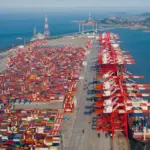
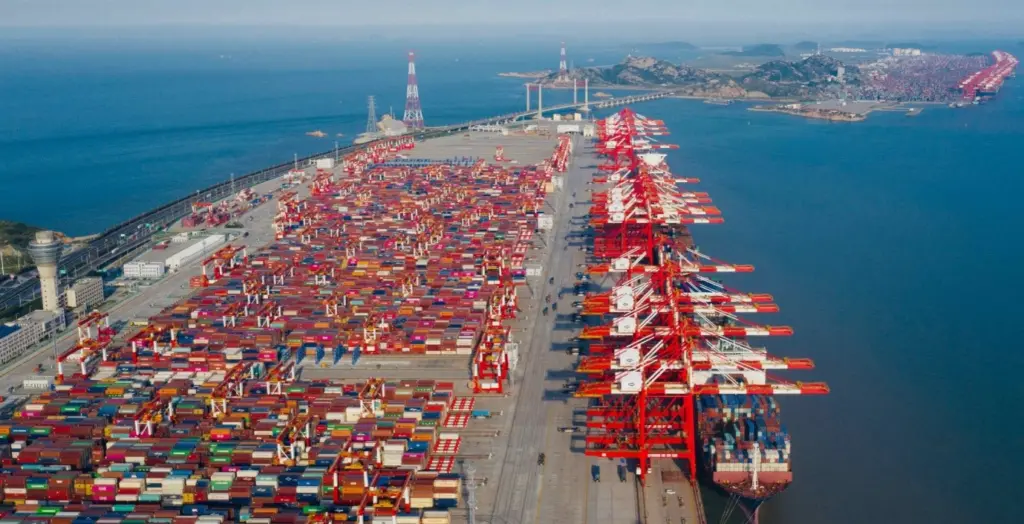
In Shanghai, operator Shanghai International Port Group (SIPG) has confirmed that significant productivity gains are being generated through deployment of AI activities, with equipment fault-finding resolution times falling by an average of 20%.
SIPG states that it has introduced AI-assisted systems across crane maintenance, container stowage planning, safety management, and operational reporting. Similar AI technology is planned for older terminals throughout the port.

Related Articles
 OTHER NEWS
 TERMINAL OPERATIONS
 EXPANSION & DEVELOPMENT