

Growth in challenging times
Two years ago, Port Strategy reported on port capacity concerns in Southeast Asia, but now the issues are congestion and vessel reliability. Dean Davison asks what has changed and what does the future hold for this key regional link in global liner trades?
In 2024, Port Strategy asked a simple question about the Southeast Asia regional transshipment port market – was there a danger of ports overdeveloping and generating too much capacity? Following recent congestion and poor vessel reliability, is this same question still valid? The answer, it seems, is yes and no.
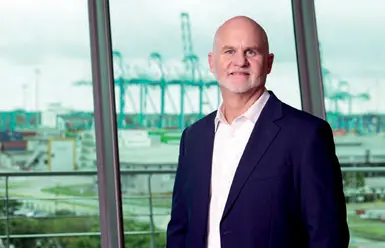
“The recent severe typhoon season in East Asia has affected vessel schedules across the industry, resulting in irregular arrival patterns and periods of vessel bunching. These disruptions have presented challenges to schedule reliability, with shipping lines having to adjust their vessel rotations and arrival schedules in response to weather-related conditions,” explains Mark Hardiman, Chief Executive Officer, Port of Tanjung Pelepas, before adding: ”Against the backdrop of evolving geopolitical tensions, disruptions to major shipping routes, shifting global trade dynamics and increasingly unpredictable weather conditions, operational resilience and close coordination with our customers remain essential to maintaining efficient and reliable terminal services.”
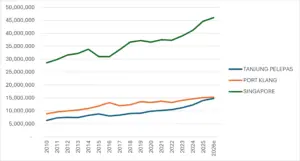
It is worthwhile putting container volume demand in the region into perspective as background to the position outlined by Hardiman. Figure 1 provides a long-term overview of port growth at the three main regional transshipment hubs of Singapore, Port Tanjung Pelepas and Port Klang.
Singapore remains the largest volume port, with the year-to-date August 2026 volumes of almost 30.7 million TEU reflecting growth of 4% over the 29.4 million TEU for the comparable period of 2025. On this basis, full-year 2026 throughput is estimated to be around 46 million TEU.
Likewise, the other two ports are also seeing continued increases, most notably at Tanjung Pelepas which is projected to see a total of 14.8 million TEU handled in 2026 and continuing the port’s 15-year average annual growth total of 5.5%. Port Klang generated just under 6.4 million TEU in the January to end of May 2026 period, up on the same five months in 2025 which recorded almost 6.1 million TEU. For all of 2026, 15.4 million TEU is anticipated at this facility.
Hardiman points to the ability to maintain “efficient and reliable terminal operations” despite the recent challenges faced by the industry. “In 2025, PTP handled a record 14,028,375 TEU, an increase of approximately 14.5% from 2024, becoming the first single container terminal in Malaysia to surpass 14 million TEUs. For 2026, PTP expects container volumes to continue growing, supported by on-going investments in infrastructure, equipment, and technology to maintain operational efficiency and service reliability.”
A PRUDENT DECISION
Clearly, all three of the container transshipment hub ports in Southeast Asia are seeing increased volumes for 2026, reflecting continued growth, notably at both Singapore and Tanjung Pelepas. On this basis alone, it creates a need to ensure capacity is developed.
Singapore moving to Tuas is more than just extra capacity, it’s a whole port shift and part of a bigger social and economic solution. “Tuas Port will be the nexus of a well-integrated Tuas ecosystem, covering the vibrant business and industrial districts in the Western region, such as the Jurong Lake District, the Jurong Innovation District, and the Tuas Industrial District. By co-locating complementary sectors that have high levels of interactions with the port, related industries can tap on Tuas Port’s global connectivity with greater ease and convenience, unlocking supply chain synergies and generating more efficient trade flows,” explains the Maritime and Port Authority of Singapore (MPA).
Tuas Port will occupy about 1337ha of land when completed, with 66 berths collectively offering 26km of quay. Port operations at Tuas Port Phase 1 commenced operations in Q3 2022 and will have 21 deep-water berths that can handle 20 million TEU annually during 2027. PSA is expecting to move its operations at Tanjong Pagar, Keppel, and Brani Terminals to Tuas Port by 2027, with the Pasir Panjang Terminal activity fully consolidated at Tuas Port by the 2040s.
With a population of only six million inhabitants, Singapore will remain a primary hub for regional cargo, aggregating containers from ASEAN countries, such as Vietnam and Indonesia, while also serving Australasia and the Intra-Asian trades. This is proven by over 85% of the incoming cargo to the port being destined for other ports – a trend expected to continue.
The plans for Tuas were set in motion back in 2012, two years after Singapore lost its number one container status to Shanghai. Building a mega port in anticipation of future demand in support of the future of Singapore is proving to be a prudent decision.
BERTH ZERO AT PTP
PTP, a joint venture between Malaysia-based MMC Group and Netherlands-based APM Terminals, is set to develop a new berth, named Berth Zero, as part of its expansion plan. The Berth Zero development was awarded to the joint venture of MMC Engineering Sdn. Bhd. and Antara Koh (M) Sdn. Bhd. (MMCE-AKSB JV) as an extension within PTP’s undeveloped land bank.
The project encompasses dredging, reclamation, and the construction of a 360-metre berth along PTP’s linear wharf, as Hardiman outlines: “PTP is undertaking a series of capacity expansion and operational improvement initiatives to support future growth, with a target to increase annual handling capacity to 16.3 million TEUs by 2029. These include the development of Berth Zero, featuring a new 360m berth planned to accommodate four quay cranes and a terminal yard designed for electric rubber-tyred gantry cranes (e-RTGs), integrating capacity expansion with sustainability considerations.”
PTP Chairman, Tan Sri Che Khalib Mohamad Noh offers additional strategic clarity: “PTP’s key expansion plan is centred on optimising our existing footprint, with the aim of increasing the terminal’s total handling capacity to approximately 16 million twenty-foot equivalent units (TEUs) over the next two and a half years,” he confirms, adding: “Demand in the maritime and port industry is strong and continuously growing. Berth Zero marks the next capacity unlock. We do not stop where we are; we constantly seek room for growth to fulfil our customer-centric philosophy, supporting the growing needs of our valued customers, whether to meet their reliability goals or to enhance their competitiveness, while preparing to capture opportunities from the growing intra-ASEAN trade that is shaping the future market, and further strengthening Johor’s and Malaysia’s position in global trade flows.”
While PTP has confirmed that it currently operates 67 quay cranes, 252 e-RTGs and a fleet of 668 prime movers (including 54 e-PMs), it has a continuing interest in leveraging technology and operational optimisation to support growing container volumes while maintaining terminal efficiency. “Various operational improvement initiatives are also being implemented to enhance equipment productivity and resource utilisation,” said Hardiman.
“Meanwhile, the e-PM proof-of-concept demonstrated 48% lower emissions and 57% lower monthly operating costs per unit compared with a conventional prime mover. These initiatives reflect PTP’s approach to capacity growth, where investments in equipment, technology and sustainability go hand in hand to improve productivity, optimise resources, and maintain reliable terminal operations,” he further explains.
PORT KLANG “GAME CHANGER” LATEST
Two years ago, Port Strategy reported about a proposed “game changer” for Port Klang, with the government of Malaysia developing a massive greenfield terminal on Carey Island as part of a US$5.9bn project expected to offer capacities of 30 million TEU and 20 million tonnes for conventional cargoes. This is in addition to a new 4.8km wharf at Westport in Port Klang for an extra 13 million TEU with this developed within 15 years.
So, just what is the status of this “game changer?”
In October 2026, the National Physical Planning Council (MPFN) confirmed it has given “in-principal approval” to the proposed development of the National Maritime Port City and Carey Island Port Special Economic Zone.
Nga Kor Ming, Minister for The Housing and Local Government Ministry, Malaysia, said the project was expected to create up to 115,000 new jobs and contribute RM4.7bn to the gross domestic product (GDP) by 2045, explaining: “The strategic development of Carey Island has the potential to strengthen Malaysia’s position as a regional maritime hub while stimulating economic growth and creating more job opportunities for the people.
The planned development covers a port area of 1012ha and is now expected to increase container handling capacity by 42 million TEU and 38 million tonnes of conventional cargo.
“With the development of the third terminal on Carey Island, the Madani government aims to further enhance the capacity, efficiency and competitiveness of the country’s ports, thereby strengthening Malaysia’s position as a leading global maritime hub,” the Minister said. The project could see initial construction work starting in early 2027.
NEW CAPACITY BUT CHALLENGING BACKDROP
So, there is clearly longer-term container capacity being developed at the three transshipment hub ports in Southeast Asia, but it is occurring against a current backdrop of challenging shipping line reliability and congestion issues at ports and terminals. Moreover, capacity takes time to be introduced and this port region has existing challenges to face now relating to vessel reliability and congestion.
Southeast Asia (and Asia overall) continues to see both congestion and falling vessel reliability, regardless of how shipping calls are packaged. Leading freight intelligence services provider, Xeneta, provided an update for September 2026, and it is not good reading for the maritime industry: “Global reliability fell for the fourth consecutive month down to 27% on-time, down 2% over August and now matching February’s position earlier in 2026. There is little prospect of any improvements in the short-term given continued deterioration on Asian trades following a number of powerful typhoons that occurred between July and September.
To put the position in Asia into perspective, and what the transshipment hubs in Southeast Asia are facing, Xeneta added that Asia-linked trades sit “at or near 12-month lows of on-time arrivals and 12-month highs on average delay.”
Indeed, Southeast Asian ports are seeing an average of two days of vessel wait, with the share of vessels waiting increasing, up to 23%. “Vessel queues in Singapore nearly doubled from 12 to 22 vessels per day at 29% and average wait spiked from 1.9 to 3.1 days as it continued to absorb downstream effects from Chinese port congestion,” the company explains.
NO RESPITE UNTIL 2027
Congestion at major Asian container ports is expected to continue into 2027, with a combination of weather disruptions and operational bottlenecks impacting shipping reliability and squeezing port capacity.
In early October 2026, Sea-Intelligence was estimating that delays are absorbing 8.5% of the global containership fleet, equivalent to around three million TEU of vessel capacity. Based on previous recovery patterns following the pandemic and the initial Red Sea disruption, the consultancy estimates that existing congestion could take six to eight months simply to return to conditions seen at the end of 2025, and 10 months to return to the much lower levels recorded in June 2025. This is notable because it is a timeframe that extends beyond Golden Week and potentially into the next major Asian shipping peak of Chinese new year on February 6, 2027, meaning the traditional pre-holiday cargo rush could arrive before networks have fully cleared existing disruption.
Ongoing challenges in Asian ports, especially in China, represent potential difficulties for transshipment hub ports in Southeast Asia. This is because congestion in China means late arriving vessels arrive together at subsequent calls, creating bunching and additional terminal pressure. Carriers may respond by omitting badly affected ports, but that can simply transfer containers and vessel calls to alternative gateways and transhipment hubs, but all this does is shift the pressure towards Southeast Asia.
“We continue to engage and work closely with our customers on vessel planning, scheduling and operational coordination, while respecting that individual shipping lines manage their own operational and scheduling arrangements,” concludes Hardiman.

Related Articles
 ASIA
 PORT & TERMINAL NEWS
 EXPANSION & DEVELOPMENT