
Albayrak: Falling short
Serious questions are being raised regarding the performance of Turkey’s Albayrak Group as a port investor, manager and operator
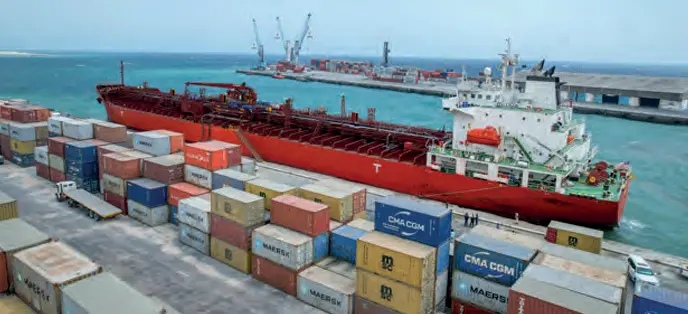
There is a growing chorus of voices expressing concern over the integrity of Turkey’s Albayrak Group in its dealings with African port concessions. Simply put, the main cause of concern, voiced by various parties, is that the company promises a lot when acquiring port assets but ultimately is lacking in delivery at a financial, investment, operational and other key levels.
The journey so far
Albayrak started in the construction sector in 1952 and entered the ports market in 2003, when it took a 30-year operating right over Trabzon on Turkey’s Black Sea coast. Since then, Africa has followed: Mogadishu in 2013–14, the conventional terminal at Conakry in 2018 and in Congo-Brazzaville in January 2024, Banjul in The Gambia in February 2025, and Malabo and Bata in Equatorial Guinea, signed in November 2024. With Alat in Azerbaijan, the group now has a portfolio of eight ports in seven countries under its ALPORT brand.
The early expansion tracked Turkish diplomacy closely. Mogadishu came in the wake of Ankara’s high-profile engagement in Somalia from 2011 and Conakry rode on ties between Presidents Erdoğan and Alpha Condé. Several of the awards were made by direct negotiation rather than open tender, pointing to political clout.
Mogadishu: First stop
Somalia’s federal government formally handed Mogadishu port to Albayrak in September 2014 on a 20-year term. Albayrak was the only bidder. In part or in total, the problems experienced here are strongly reflected elsewhere in the Group’s port portfolio.
Since 2014, Albyarak has unilaterally reduced the revenue share for the government and underinvested based on the original agreement. Legal disputes ensued. IMF stepped in and its 2019 Article IV consultation for Somalia listed further progress on renegotiating the Mogadishu port contract among the reforms tied to revenue mobilisation and the country’s path to HIPC debt relief.
A renegotiated 14-year concession was signed in October 2020. This was based on a 45% – 55% revenue sharing model but since then it is known that the Somalia Office of the Auditor General has struggled to receive timely audited financial reports in order to verify government revenue. Equally, Somalia’s Financial Governance Committee (FGC) has highlighted the issue of lack of transparency and on the service side the imposition of high port costs.
In June of this year Ahmed Guutaale, Somalia’s Auditor General met representatives of Mogadishu Al -Port Corporation to discuss the issue of financial compliance. In this meeting he stressed the importance of submitting audited financial reports on time highlighting also that it is important to achieve transparency, particularly given that Mogadishu Port is Somalia’s largest port and the federal government’s single biggest revenue source.
We shall see if transparency will indeed prevail. The Somalian Ports Minister, in February 2026, stated that feasibility studies were complete and the New Mogadishu Port Project had entered the tender phase. He invited investors to participate. However, we know from several port operators that no tender process has taken place. Instead, on 28 September 2026, Prime Minister Hamza Abdi Barre stated that an agreement with Turkish investors had been made for developing the new port, as well as a special economic zone and industrial developments. Amounts of up to USD 4 billion in investments were bandied about. PS believes this falls under Alport’s “very long-term project” while remaining in the existing port.
Promises beyond reality
Since Somalia, Albayrak has gone on to sign port contracts while promising billions of dollars of investments, way above what it can feasibly recoup. In 2018 Albayrak signed the Guinea Conakry 25-year concession over Conakry’s non-container terminal without a tender. This entailed a contract commitment of USD 500 million of investment. It remains to be seen how much of the USD 500 million commitment will be spent.
There are in fact a myriad of reported wrongs in conjunction with this latter project: lack of transparent legal procedures in setting up the concession; a highly unfavourable revenue split (described as “the rip off of the century),” staffing and labour problems, failure to meet new infrastructure commitments, severe port congestion and so on.
In 2024 Albayrak was on a roll, first signing up with the Government of the Gambia, this time through a formal tender supervised by the Dutch firm MTBS (Maritime & Transport Business Solutions). To the disbelief of Port Strategy at the time, Albayrak was chosen on the basis of expanding Banjul Port while building a new deep-water port at Sanyang. Investment amounts quoted were EUR 600 million and port operations would move to the new port within 6 years.
Lo and behold, the Sanyang project is not progressing and the Gambian port authority told the National Assembly it is renegotiating key terms – to the benefit of whom, it remains to be seen?
Also in 2024, Albayrak signed a 25-year concession to modernise and operate Pointe-Noire’s conventional cargo terminals in the Republic of Congo. And again, the company rolled out the big numbers with investment promises of EUR 400 million.
And it finished off 2024 with Equatorial Guinea where it is promising investments of EUR 300 million in a country of two million people.
It is hard to envisage the above investments being actively pursued at scale – it is clear many of these commitments extend beyond the business realities.

Related Articles
 EXPANSION & DEVELOPMENT
 PORT & TERMINAL NEWS
 EXPANSION & DEVELOPMENT