


As with most ports, Port of Bergen has during the last few years shifted its focus from being a mere port operator and landowner towards being an organisation with a sustainable focus, writes Even Husby, environmental advisor to Port of Bergen.
This is not to say that such perspectives are new to the port. The city law of 1276 included rules that prohibited throwing waste into the harbour basin. One of the prime reasons to establish the port administration in 1735 was to curb the increasing pollution and sedimentation in the harbour areas due to waste and sewage.
A range of different environmental laws and regulations affect how the port operates today. This combined with the role as a land and property owner, handling waste, removing dust, reducing energy consumption, buying green services and a range of other measures, means that environmental constraints and opportunities shape our daily work.
The challenge ahead is to anchor this perspective even stronger into the management process. The sustainability perspective should not just be a consequence of external factors but a means on its own for the organisation.
The foundation for sustainability lies in the UN’s Sustainability Development Goals. Two tools will play a key role in relation to how we report on sustainability topics:
- The reporting framework of the UN Global Compact (https://www.unglobalcompact.org) will be central in relation to sustainability reporting
- The EcoPort Environmental Management System from ESPO (http://www.ecoports.com) gives guidance on how we describe our environmental impact
Key environmental aspects
Port of Bergen’s list of important environmental aspects are the same as for other EU ports (ESPO dashboard for 2013). Among all aspects, air pollution and climate impact are the two topics of primary concern. The former one is a significant problem in Bergen in the winter season due to temperature inversion, a phenomenon that stops air circulation in the central city area, leading to increased concentration of air pollutants. The latter aspect, the climate impact, is a core challenge for all organisations globally.
An improvement depends a strong commitment from both ship owners, the authorities and the ports. As a port, we need to offer our pieces of the jigsaw. A thorough assessment of options surveyed by the EU regional cooperation (Interreg) project Clean North Sea Shipping (http://cnss.no), gives backing for our current strategy of supporting ships with onshore power supply (OPS) and LNG bunkering. There is also a development in relation to battery and hybrid ships (battery+conventional fuel) which we will consider supporting in the future, if in demand.
Cruise and offshore ships
Cruise ships and offshore supply vessels classes contribute to around 35% each of the NOx and CO2 footprint related to port activities. Other large ship emission sources, if we look beyond the city centre, are the activities related to two offshore supply bases and the Mongstad oil refinery.
Offshore vessels have access to LNG bunkering at the offshore supply bases. The port is monitoring the development for other classes of ships closely. The Fjord Line passenger ferries, the Norlines cargo ships and the forthcoming Aida Prima cruise ship are all potential candidates for LNG bunkering. The LNG provider Shell Gasnor considers bunkering ship to ship as a good solution, given there is enough volume.
The first OPS facility for offshore vessels was opened in June 2015. Further plans include a number of connection points for offshore, research and passenger vessels. Ideally, Port of Bergen would like to offer OPS for larger cruise ships too and we are seeking public support for the venture. This is unfortunately not a very good business case, given the lack of support from the cruise companies. Aida Cruises is a notable exception here, supporting OPS for Aida Sol and the forthcoming Aida Prima.
Other Carnival companies put priority on improved exhaust cleaning systems. If this solution fulfils its technical promises, it will be a good approach for reducing air pollution.
Sustainable cruise development
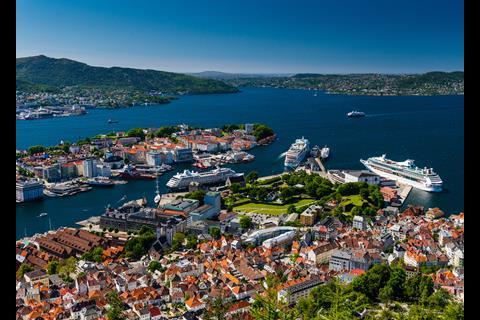
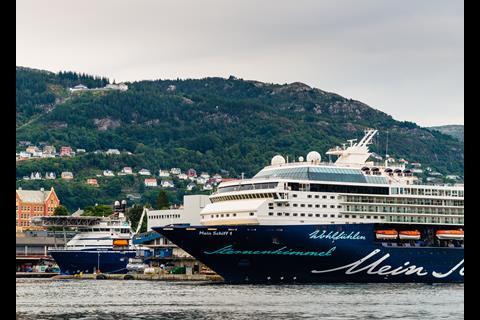
Bergen is a popular cruise destination and a leading cruise port in Norway, with over 300 cruise ship calls yearly bringing more than 450,000 cruise passengers to the city. A decline in the number of ship arrivals from 2014 to 2015 is compensated by increased ship size, leaving the number of visitors relatively stable.
Bergen welcomes the cruise ships. At the same time, the presence of the ships and passengers raises debate and represents a challenge in relation to environmental impact as well as “people pollution”. The port acknowledges responsibility for both the ships and for the local community affected and is looking for good strategies. Current initiatives include:
- Green shuttle bus services: Euro5 or better is a requirement
- Development of the main cruise quay in walking distance of city centre
- Onshore Power Supply (OPS) for cruise ships: A dialogue with public authorities is underway in order to allocate funding for an installation. The Municipality of Bergen and the County Council of Hordaland are supporting the activity, funding the initial preparation phase
- Implementation of differentiated harbour dues based on the Environmental Shipping Index (ESI). From 2016 onwards, arriving ships will receive a rebate of up to 50% on the harbour dues, based on their ESI rating. Ships using LNG as fuel while at quay or supporting OPS according to relevant international standards, will receive an additional discount.
Benefits of international cooperation
Sustainable development depends on know how related to a range of different areas. It is challenging to maintain a broad knowledge base, given Port of Bergen’s relatively small team. Networking through different national and international organisations such as the Norwegian Ports Association, ESPO, Cruise Norway and Cruise Europe is valuable in order to collaborate and learn from other partners.
One instrument that is particularly useful as a learning aid is the regional development programme of EU-Interreg. The port has been involved in the Clean North Sea Shipping (CNSS) project under the North Sea Region Programme until 2014 and is now applying for a new project, 'Green Cruise Port', within the Baltic Sea Region Programme.
The aim of CNSS has been to look into how to reduce emissions from shipping with an emphasis on ports. The project, coordinated by Hordaland County Council, brought together ports, municipalities and research institutions. Deliverables included practical tools as well as policy recommendations. The tools established include:
- Improved estimation functions for estimating emissions from different classes of ships at berth
- A unified approach for estimating emission from ships upon arrival / departure, while mooring and at berth, implemented as a generic tool and demonstrated by the Port of Antwerp
- An overview / guide regarding LNG bunkering for ports to include requirements, challenges, opportunities including a navigational study for Port of Hamburg and a description of a potential LNG terminal in Brünsbuttel
- The calculation of ship emission scenarios given different policy options.
Port of Bergen includes all of the tools and experiences from CNSS into its ongoing environmental planning process.
A new Interreg project is now on the horizon. As mentioned, the port is currently applying for a project named 'Green Cruise Port' as a member of a partnership coordinated by Port of Hamburg (HPA).
The focus of this project is on building up efficient and sustainable cruise port infrastructure accompanied by smart traffic solutions on landside (bicycle, rail, road/bus, airports), plus institutional capacity building.
We believe an involvement in such projects will be beneficial in terms of knowledge development. The value of improved networking is an additional boon, giving a platform for communication beyond the final date of the original project.
Quick facts
Bergen has been a port city since 1070. The port organisation was founded in 1735
Today’s port has around 54 employees and represents 11 municipalities in the Bergen region.
The total port area including private and public quays receives around 83,000 ship calls yearly and handles around 267 million GT
The quays in the city centre receive around 300 cruise ships yearly, encompassing around 450 000 passengers.

