


The Port of Barcelona has partnered with multiple stakeholders to pilot and measure the efficiency of LNG on land and at sea to try and reduce NOx, SO2 and PM emissions.
Introduced by the port authority as part of the Metropolitan region's Horizon 2020 action plan to improve air quality, the project will see the port partner with energy suppliers, ship owner-operators, port equipment manufacturers and technological innovators to use LNG and CNG throughout the ports nautical and intermodal chains for cargo ships, ferries and cruise ships.
"The Port of Barcelona's Air Quality Improvement Plan focuses mainly on measures to reduce emissions from vessels, wheeled traffic, machinery, bulk cargo operations and infrastructure works,” said Jordi Vila, environmental manager at the Port of Barcelona. “The plan also encourages rail and short sea alternatives to road cargo transport whilst improving sustainable mobility using either gas or electrification in the port.”
The plan is supported by the EU’s CEF programme and the port also has the advantage of ample availability of liquified natural gas (LNG) and compressed natural gas (CNG) due to Enagás’ regasification plant at the port.
Retrofitting truck
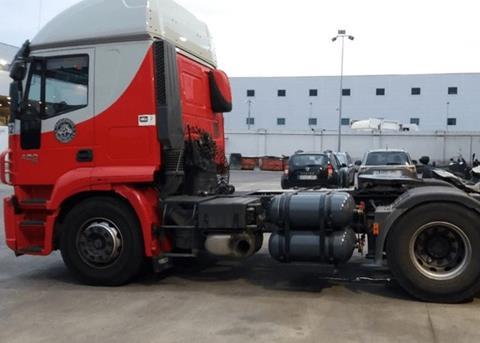
On land, with the REport project involving eleven partners, twenty-six trucks transporting containers between the port and the Metropolitan area have been converted to a dual-fuel system. Twenty-five of these can run on compressed natural gas (CNG) with one able to operate on liquified natural gas (LNG) by mid-June 2018.
A 12-month study was initiated last summer to monitor the positive impact this change has on emissions.
By November, more than 60 trucks operating locally were already being powered by natural gas, either with dedicated or dual fuel engines.
The port is also collaborating closely with Enagás, which is leading the CORE LNGas hive project. This project has 42 members, including several ports on the Iberian Peninsula.
With its partners APM Terminals, LNG services provider HAM, technology provider IDIADA and Naturgy Iberia, the Port of Barcelona has transformed a straddle carriers' two 150kW diesel-based motor engines to natural gas with the aim to keep the same level of performance. The straddle carrier will also be equipped with two 500 litre tanks for LNG supply to the motors. The pilot operation is scheduled for October.
LNG/CNG fuel station
In addition, and to supply these and other vehicles with alternative fuel, the Port of Barcelona, Spanish LNG services provider HAM and Portuguese energy player Galp opened the first natural gas supply station for vehicles in Spain's port system last November as an additional cHAMeleon project.
The new facility currently has two compressed natural gas (CNG) pumps for trucks and vehicles, two liquefied natural gas (LNG) pumps for trucks and a cryogenic LNG tank of 60 cubic metre capacity. There are plans to double this capacity moving forward.
A third CORE LNGas hive project involves the feasibility study and design of a tug boat, with a dual fuel engine capable of running on diesel and LNG, as well as using LNG as a fuel to generate independent on-board power supply for visiting ships berthed at the quayside.
Shore power
The Port of Barcelona estimates that 71% of total NOx emissions emanate from vessels whilst being moored alongside the quayside. To reduce this impact, a further CORE LNGas hive project involving HAM, Siemens, Suardiaz Group, Bureau Veritas and the ports of Barcelona, Vigo and Tenerife have teamed up to establish a pilot project to supply electricity autonomously to ships alongside. They have deployed two containers at the quayside: one which contains a regasification unit with two LNG tanks which provides gas to an 850kW generator set which runs on gas and is capable of generating electricity connected by special cable to the ship alongside.
The system has been tested successfully in the Port of Barcelona and in the Port of Vigo before undergoing a final test at the Port of Tenerife.

