


CENTRE OF THE WORLD
Shanghai is fast becoming the centre of the world, as far as the container shipping industry and the port companies which serve it are concerned. And the ports current work-in-progress, the leviathan Yangshan project, promises only to reinforce that. Gavin van Marle reports.
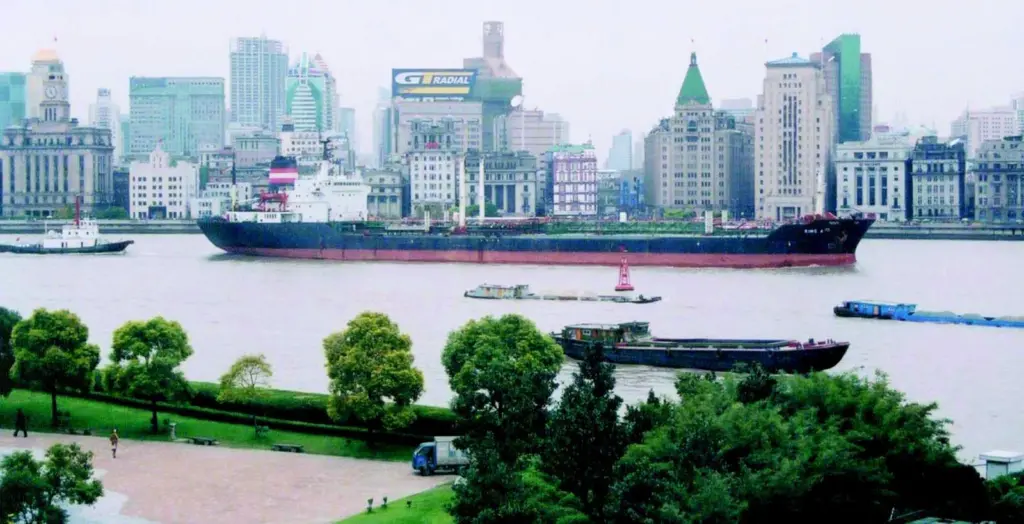
Everything about Shanghai, from construction to the concessioning of terminal operating agreements, promises to be headline news in the business press. However, while future throughputs look as if they will be staggeringly large, the project will inevitably place the port under other pressures.
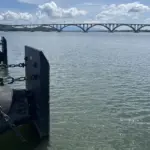
In the meantime, it is impossible to talk about Shanghai and somehow ignore Yangshan. It looms over the physical and mental landscape of this fast-growing port. According to port authority officials construction remains on schedule, while reportedly construction of a huge 31km, six-lane bridge linking the twin offshore islands with the city on the mainland is now expected to be completed ahead of schedule, and opened October next year according to a statement by Zhang Huimin, the VP of the Yangshan project.
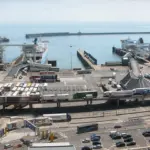
Part of the reason for the hurry is that Shanghai’s existing facilities are severely overworked. Last year the port’s various container facilities altogether recorded a throughput of 11.3m TEUs, growing by 2.7m TEUs in that year alone and making it the world’s third largest box port after Hong Kong and Singapore. The acceleration of growth has surprised everyone, not least Shanghai’s port planners who believed its current terminals would be able to handle traffic until Yangshan begins operations. However, some now reckon that these terminals are stretched to up to 35% above their nominal throughput capacity. And it has started this year in much the same way, recording a growth of 26.5% for the first quarter as throughput reached 3.1m TEUs, while over the second quarter volumes grew year-on-year to reach 6.75m Teus. The port is on target to reach 13.5m TEUs for 2004.
Meanwhile Huimin also admitted that costs of Yangshan have risen sharply, with the bridge now expected to cost some $350m more than was budgeted for due to problems with driving poles into the seabed. Originally, the first phase of Yangshan was in total set to cost $1.73 billion, of which the bridge was predicted to cost $750m. The five berths of the first phase, which are due to begin operations in early 2006, – obviously to coincide with the opening of the bridge – have been reserved for Shanghai Port Company, the newly corporatised version of the old Shanghai Port Authority.
However, with the recently relaxed laws on foreign ownership of mainland container terminals, it is understood foreign investors will be invited to apply for Yangshan’s second phase. Early this year Beijing declassified container port concerns as areas of strategic national interest thereby opening the way for non-Chinese companies to fully own operations. Huimin says that this second phase will be open in 2007 and tenders to operate parcels of it will be issued later this year.
However, what it will actually consist of is as yet unclear, perhaps because the port authority has yet to decide on that itself. All that observers have to go on at the moment is an unconfirmed list of terminal operators and shipping lines which have written to Shanghai expressing interest in operating some part of it. It is an unsurprising roll call of the top international players, so far including P&O Ports, Cosco Pacific, PSA Corp, APM Terminals, Modern Terminals Ltd (MTL), CSX World Terminals, China Shipping Group and Orient Overseas Container Line (OOCL). More will be added almost by the day.
The one notable absence from this list is Hutchison Port Holdings (HPH), although that is more do with the ‘fog of war’ than cold fact.
Shanghai authorities say that the world’s largest terminal operator has indeed been in touch and expressed interest, while HPH executives say they are watching ‘what goes on’, but in principle remains reluctant to participate in a project where carriers are also acting as service providers, pitching it into direct competition with its own customers.
POWER IN INTERNATIONAL CIRCLES Nevertheless, the excitement generated by Yangshan, combined with the ever-growing volumes that make it such an exciting prospect, has put Shanghai and its port authority in a unique position of power in international shipping circles. So much so that Shanghai’s mayor, Han Zheng, recently floated the idea of cooperating on the management level with Singapore. “We have just started to become a major port, and we hope we can carry out cooperation with Singapore in a concrete manner, ” Zheng told reporters after a meeting with visiting Singapore senior minister Lee Kuan Yew.
Only a few years ago this sort of proposal would have been scoffed at but with 52 berths on the drawing board, ambitions of handling 25m TEUs by 2020 and apparently the cargo to match, it is a proposal Singapore will take seriously. While questions of future overcapacity caused by such a flood of yard and quay space onto the market will inevitably arise, for the foreseeable future at least, Yangshan berths are likely to be quickly filled. Neil Davidson, director of Drewry Shipping Consultants, comments: “Overcapacity might be an issue five years down the line at the earliest, what with other expansion plans at Ningbo and some of the Yangtze delta ports, but at the moment the growth is so strong that for the next five years it’s just a question of catching up.”
Related Articles
 CONTAINER & CARGO HANDLING
 OPERATIONS
 OPERATIONS