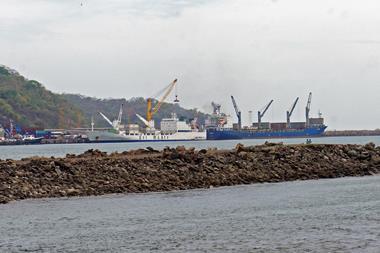

Gustavo Jáuregui, managing director of the National Chamber of Commerce of Bolivia, has stated that neither Bolivia nor Peru have yet made significant-enough progress to enable them to make public-private co-investment in the Port of Ilo, which is viewed as a genuine alternative to the Chilean Puerto de Arica for the landlocked state.
He said that the onus remains with the Peruvian government to generate the conditions to boost investments in the port and that this will involve getting the local business community on board. Currently, Bolivian import-export traffic, which mostly moves by Arica, is viewed as being under-represented at Ilo.
Bolivia’s national export association Cámara Nacional de Exportadores de Bolivia calculates that 95% of its export-import cargo is currently handled by Chilean ports.
In 2018, Bolivian overseas freight amounted to 5.1m tonnes, of which 4.1m tonnes used ports on the Pacific. Approximately 3.8m tonnes passed through Chilean ports, while the balance was barged down the Paraguay–Paraná inland waterway network to Atlantic ports.
According to Mr Jáuregui, the new Bolivian Puerto Busch river port is expected to play a major role in handling agribulk traffic.
Argentina has also made the free zone available at the Port of Rosario for Bolivian trade, although its city centre location creates certain logistics problems, said Mr Jáuregui.