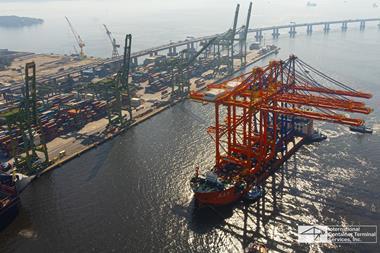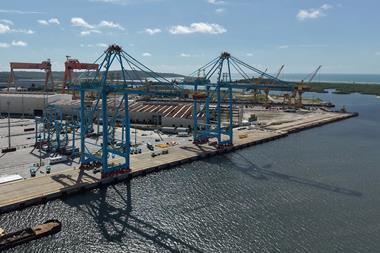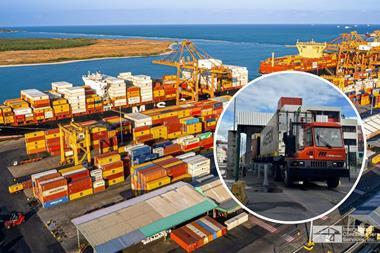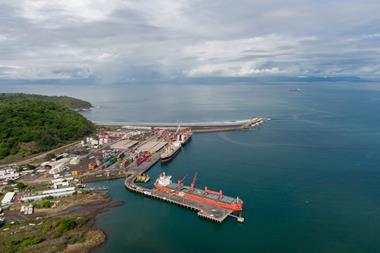
Despite the COVID-19 pandemic causing economic havoc globally, container terminals in Panama are posting healthy throughput increases in transshipment. Rob Ward looks at the pattern of events.
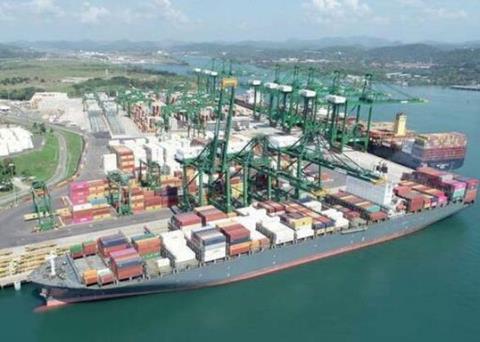
Most of the transshipment handling at ports in Panama, probably between 60-65 per cent, comes from the Asia to United States East Coast trade lane, with Europe (North Continent/UK and Mediterranean) to West Coast South America accounting for the rest.
The trans-Pacific liner trades have been booming for much of this year, posting record freight rates (and strong demand through ports such as Los Angeles and Long Beach). The subsequent shortages of space for shippers has had a knock-on effect for Panama’s five container handling terminals.
“UNIQUENESS OF THE COVID-19 CONSEQUENCES”
A number of shipping and port sources who contributed to this article attested to the “uniqueness of the COVID-19 consequences” and “complexity” of what has affected international cargo flows and kept Panama so buoyant, especially on the Pacific Coast side.
Antonio Dominguez, Managing Director for Central America and the Caribbean (including Venezuela and Colombia), Maersk Line, says that when the pandemic first started to emerge from China at the beginning of 2020 it was very difficult due to logistical uncertainties to work out what was happening with cargo flows.
Only after exhaustive talks with shippers did a clear outline emerge of what measures were taken and why. It began with the threat of Chinese ports and factories closing down and shippers just wanting their cargo “on the water as soon as possible” despite lockdowns starting up, from April in Latin American destinations (such as Peru, Colombia, Panama and Central America) where the containers were headed.
“Shippers basically got their cargo out of China in March and realised that there was nowhere for it go so sent it to Panama while they sought new markets,” said Dominguez from his Panama office.
He explains why this strategy worked; “Panama has very impressive transshipment networks, with connections to all corners of the globe, and plentiful storage facilities so that was the ideal resting place while the cargoes were stored before being re-designated or before being eventually dispatched to their original, but delayed, destinations.”
He added that boxes were stored on average for around 30 days – whereas the usual turnaround in Panama was about 48 hours – under a special “detention in transit” status, granted by the Panamanian authorities.
MANIC AFTER THE PANIC
Once the initial panic was over the effects of the pandemic calmed down, the demand for “almost everything” was extremely strong. Major USA retailers like Home Depot, Walmart and Target were supporting the American population who found itself working from home or furloughed and with time on its hands and nothing to spend money on due to widespread lockdown and travel restrictions. It was the same story in Europe too.
There also seemed to be a surge in demand for fresh fruit and protein (especially chicken, beef and pork), not only from Europe and the USA but also from China, which is now the biggest reefer importer in the world.
Such was the demand for transshipment and storage in Panama that freight rates on the main route into the country’s ports rocketed. Freight rate pricing index platform, Xeneta, reported that rates from China’s main ports “rocketed” this year from a low of US$1263 per dry FEU on June 13 to a high of US$5028 per dry FEU on September 16, an incredible increase of 291 per cent in just two months! The average for July was US$1481 per dry FEU, but for September was back around US$5000. In late November it had settled back at US$4841, according to Xeneta.
“The beginning of the year was crazy, it was a nightmare and everyone was rattled, but then things settled down when governments introduced furlough schemes and other support mechanisms and then shipments flourished,” Patrik Olstad Berglund, CEO of Xeneta told Port Strategy.
“In the USA there is now a severe shortage of empties so carriers no longer want to wait 20 days for empties in Asia to be loaded with cheap agricultural goods on the backhaul for US$500 to US$700 a box, they will just get them returned as soon as possible.”
Two additional sources said the current imbalance through Los Angeles and other USA ports was around 3:1 in favour of imports.
MIT LEADS BUT PSA GROWTH THE STRONGEST
Leading the way in Panama, in volume terms, is Manzanillo International Terminal (MIT), operated by Seattle-headquartered SSA Marine. The facility handled 1.9 million TEU during the first nine months of this year, up 4.9 per cent compared to the 1.85 million TEU for same period in 2019, and following on from the 14 per cent full-year growth enjoyed in 2019.
Figures from the United Nations Economic Commission for Latin America and the Caribbean (ECLAC, or CEPAL in Spanish) show that PSA Panama International Terminal (PPIT) on the Pacific Coast recorded the biggest percentage increase, up 31.3 per cent to 916,278TEU for the year to end of September.
Of the five Panama facilities, only Evergreen’s Colon Container Terminal (CCT), saw a decrease during the 2020 nine-month period, of just over 10 per cent (from 580,861TEU down to 521,910TEU).
The reason for CCT’s drop seems to have been the closure of the Colon Free Zone (CFZ) for four months from March. This was due to CCT focussing on intra-Americas cargoes (as opposed to Far East/USEC and WCSA/Europe trades), which were suffering due to the Pandemic spreading through various Latin American countries.
Interestingly, full containers handled at Panama’s Pacific ports increased by an average of 40,000TEU for every month in 2020 to September (compared to 2019), but on the Caribbean side, the increases, also of around 40,000TEU per month, were experienced only to June, before a significant slide resulted in just 360,000TEU handled in total in September, down by 90,000TEU compared to the same month in 2019. This was due to the rail bridge closure.
RE-HUBBING RELEVANT FOR PANAMA
One of the main reasons for the success of Panama’s hub ports at present is, according to Ricardo Sanchez, Senior Economic Affairs Officer of the International Trade and Integration Division of ECLAC, the subject of “re-hubbing.”
He explains that a number of ocean carriers have concentrated their transshipment operations into a smaller number of hub ports, with the biggest winners including facilities in Panama - MIT, the two Hutchison Ports operations, PPC Cristobal and PPC Balboa and PSA’s PPIT port.
“Re-hubbing is notorious in Latin America and the Caribbean, as we have so many hub ports, and so we see a lot of it as carriers change their strategies,” Sanchez confirmed in a telephone interview from his home office in Santiago de Chile.
He elaborates: “And this year it has gone crazy, but it has benefited all the Panamanian ports apart from Evergreen’s CCT, which showed a 10 per cent drop in full boxes. It has also been a strange year for foreign trade growth [in the container sector] with only three countries other than Panama [out of 46 ECLAC members] showing growth in container movements and they are the major reefer exporters of Argentina, Brazil and Ecuador (focussing, respectively, on beef, beef plus chicken and pork, and various fruits, namely bananas, in the case of Ecuador)."
Panama – by the numbers, but should have been higher
Overall Panama’s container handling (including both coasts) came to 5.7 million TEU for the January to end of September 2020 period – up by 5.4 per cent over the comparable 2019 period.
Volumes at Caribbean coast ports were up by just over 1.1 per cent to almost 3.3 million TEU, with the Pacific Coast terminals seeing a strong 10.3 per cent increase to over 2.3 million TEU.
Simon Heaney, at Drewry Shipping confirmed that of the total throughput, 89.6 per cent was transshipment activity in the nine-month period for 2020, up from 85 per cent recorded for the comparable months of 2019.
Dominguez added that the volumes through Panama could have been even more voluminous, if the railroad service connection – covering the 80 km between Pacific Panamanian ports and those in the Caribbean – had not been severed for four months, between June and the beginning of October, after, a vessel hit a rail bridge causing severe damage.
This development led to some shippers on the US East Coast switching from Panama to the Port of Los Angeles and then using the railroad and/or trucking for inland delivery. Consequently, Q3 2020 volumes in Panama dropped.