


Supply chain models and seaport infrastructure are changing as shippers must prove their sustainability credentials to stakeholders. Reducing reliance on road and air is a big part of the green movement in transport of cargo, and shipping is becoming more seaport-centric, as maritime shipping cuts costs and carbon emissions, says Bill Johnson, PortMiami Director.
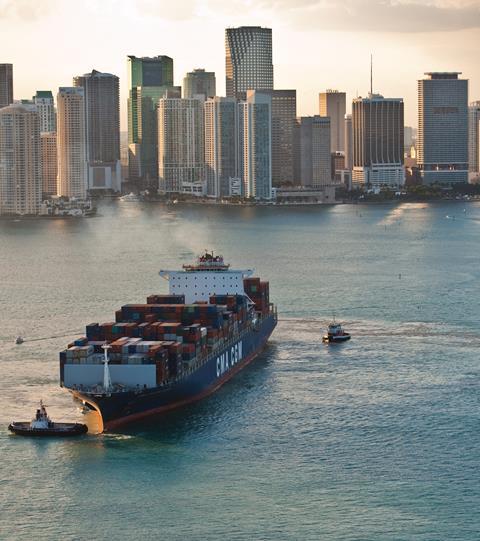
Whereas U.S. ports prepare for the arrival of larger post-Panamax ships that will traverse the expanded Panama Canal in 2015, infrastructure improvements also will accommodate shippers’ sustainability requirements. Emissions control has become a universal concern for the shipping industry, and for ports, “green” has become synonymous with efficiency and optimised speed-to-market. With high diesel fuel costs and continued political pressure, supply chain analysts are recognising opportunity in port-centric shipping models built on saving time, money and resources.
PortMiami expects to double its cargo trade in the first Panamax decade, and its trifecta of infrastructure improvements also promise to create a more sustainable low-emissions port.
Green Port Technology
Through public and private partnership funding, PortMiami is dredging its harbour to -50 ft., in order to berth larger post-Panamax vessels of 8,000 TEUs to 13,000 TEUs. As the only Atlantic U.S. port south of Norfolk, Va., with a deep enough harbour for post-Panamax ships in 2015, this will reduce fuel requirements in a North-South shipping model. Goods bound for Florida can be directly shipped to PortMiami. It also provides an alternative to other U.S. Southeast and Gulf Coast ports for the all-water route many shippers are taking from West to East, in order to reduce fuel costs. The Canal expansion will shift trade patterns, and PortMiami will receive increased cargo traffic from Asia.
PortMiami also has partnered with Florida East Coast Railway (FEC) to restore on-dock rail, and is constructing a port tunnel for vehicle access to and from the port. The port also purchased four new electric Panamax gantry cranes to off-load heavier cargo.
Rail puts sustainable shipping on the right track
Intermodal shipping plays a major role in today’s port productivity and sustainable practice. PortMiami is partnering with FEC to implement a 9,000 ft. on-dock rail for intermodal and transhipment services. Using this rail system, which connects to national Class 1 railroads, 3PLs and logistics strategists will cut carbon emissions and optimise speed-to-market. Rail is four times more fuel efficient than truck, and each train from the port eliminates approximately 80 trucks, translating into a reduction of about 60,000 trucks per year.
The trains will be one-half mile long so they can clear traffic lights quickly to further reduce congestion. In addition to reducing road congestion, FEC double-stack trains along its 351-mile network further promote sustainability, and they recently acquired 11 new fuel-efficient locomotives, which help reduce the carbon emissions of operations.
Port Tunnel reduces idling trucks and congested roadways
A tunnel will improve access to and from PortMiami, serving as a dedicated roadway connector linking port facilities with Florida’s Interstate Highway System. In addition to providing quicker access for port-bound trucks and automobiles, the Port Tunnel is designed to reduce traffic congestion on downtown Miami streets. The tunnel is comprised of two side-by-side tubes that will carry traffic underneath Biscayne Bay and has recently been named as one of the top 100 most innovative engineering projects in the world. Within 25 years, PortMiami plans to have more than 6 million trucks off the road, a reduction in fuel consumption by approximately 34 million gallons, and a reduction of CO2 emissions by approximately 200,000 tons.
In addition, a new Foreign Trade Zone status and the location of warehouses and distribution centres closer to the port, rather than in central locations, will further reduce trucking distances. The 2012 Jones Lang LaSalle Seaport Report named PortMiami in the top 10 best places for commercial real estate investment, making Miami even more attractive to investors looking to set up their warehouses and distribution centres in an area that can serve a large population of consumers.
Greening the supply chain – and cold chain
For perishable items, PortMiami has incorporated a new technology from U.S. Customs and Border Protection (CBP) called Enforcement Link to Mobile Operations (ELMO cargo). Using handheld devices, CBP and agriculture specialists inspect perishable imports in “real-time,” decreasing truck idle time by up to four hours, cutting carbon emissions and speeding cargo to market. The ELMO cargo project saves money and energy for shippers and ensures that perishable cargo remains fresh. Recently, CBP named PortMiami as a Centre for Excellence and Expertise in the area of agriculture and prepared products. The selection of PortMiami as a CEE highlights the inherent advantages in the Port’s location, being the closest U.S. East Coast port to producers of winter fruits and vegetables in Central and South America.
A new era in shipping
In 2007, the International Maritime Association noted that international shipping was responsible for about 2.7% of global emissions with risk of increasing emissions in future years. In response, United States ports like PortMiami have started taking steps to improve their emissions standards. In fact, nationally, the U.S. has tried to remain progressive on the forefront of sustainable shipping.
In 2012, the U.S. Environmental Protection Agency (EPA) began enforcing The North American Emission Control Area (ECA), a law requiring ships within 200 nautical miles of the non-Arctic U.S. and Canadian coast to use fuels with sulphur content less than 10,000 parts per million. Also, slow-steaming, when ships move at 15 knots or less, has become popular among shippers for the reduced fuel costs and carbon emissions.
While it is still unclear to industry analysts, major retailers and the World Shipping Council, to what extent the expansion of the Panama Canal is going to affect trade patterns, what we do know for sure is that the way shippers move their goods to market will be through more sustainable routes and to ports that have “greened” their infrastructure.
As director of PortMiami, I oversee one of the leading container ports in the U.S. Under his stewardship, PortMiami has maintained its leadership position as the busiest cruise port in the world. The Port has embarked on a major capital improvement program with more than $2 billion in infrastructure projects now underway.
PortMiami is among America's busiest ports and is recognised across the globe with the dual distinction of being the Cruise Capital of the World and the Cargo Gateway of the Americas. The Port contributes more than $18 billion annually to the South Florida economy and helps provide direct and indirect employment for more than 180,000.
For more information about PortMiami please visit: www.miamidade.gov/portofmiami or contact by phone: 305-347-4962.

