

Ports are taking up the green challenge, seeking out various ways of reducing both fuel consumption and engine emissions. Alex Hughes reports
From cold-ironing to regeneration innovations, ports around the world are trailing new ways to save money, power and crucially in today’s wannabe-green society, the environment.
Which of the solutions being trialled in the four corners of the globe will be taken up with gusto by those port operators yet to commit to the green way remains to be seen, but the array of projects out there confirms that ports are taking their responsibility seriously.
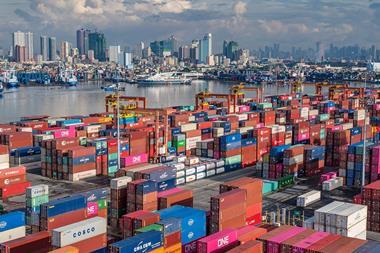
In its Manila terminal, ICTSI is undertaking a twomonth trial to assess the effectiveness of using a battery and electric-powered system on rubber-tyred gantries (RTGs) as a secondary source for powering up certain components within the cabin. The hope is that diesel fuel burn can be reduced when RTGs are in idling mode.
“When an RTG is idle, the engine remains running because the operator stays in the cabin.This means that gas is consumed even when the RTG is not active. The device introduced will allow the operator to stay in the cabin, even if the engine is off and the air conditioning is not functional, because the operator will be able to use the portable data device (LXE), radio, and newly installed fan and light,” explains project team member Ian Paradies.
Initially, the fuel saving device has been incorporated into a single RTG, whose performance is being closely compared with others running with standard equipment. The hope is that, in addition to reducing fuel consumption, the programme should also result in prolonged engine life since damage to engine components will be minimised during idling. An environmental spin-off should also see a reduction in hazardous emissions.
Billy Tandoc, the safety superintendent at MICT, is overseeing a linked programme, converting 46 previously petrol-operated forklift truck (FLT) engines to auto-gas or liquefied petroleum gas (LPG). FLTs working at both the Container Freight Stations and CY Marine are being adapted for use with LPG.
The programme has been deemed safe following extensive testing and is expected to cut fuel costs by almost 40%, with a concomitant overall reduction in terminal operating costs. Additionally, the decrease in exhaust emissions will help improve the operating environment of the terminal. According to ICTSI, compared with petrol, auto-gas produces 75% less carbon monoxide,85% fewer hydrocarbons,40% fewer oxides of nitrogen, 87% less ozone forming potential and 10% less carbon dioxide.
Even more crucially, LPG has also been credited in prolonging engine life, since its use does not result in the creation of carbon. It is also widely regarded as being better than petrol, because it reaches the engine in pure gas form, thereby resulting in more efficient combustion. Engine oil does not become diluted; hence a significant reduction in servicing costs is achieved.
Overall engine performance using LPG is comparable with that of petrol, but much safer because of its anti-detonating property. It is also considerably less expensive costing $0.3 less per litre than petrol.