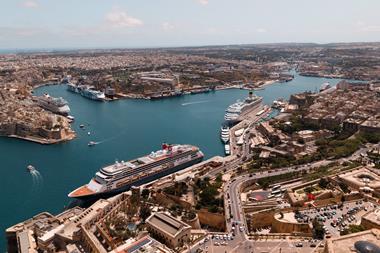


As a marquee port for multiple Mediterranean itineraries, Valletta Cruise Port is no stranger to recognition for the services it provides, whether awards from commendations by visitors or the industry in which it operates.
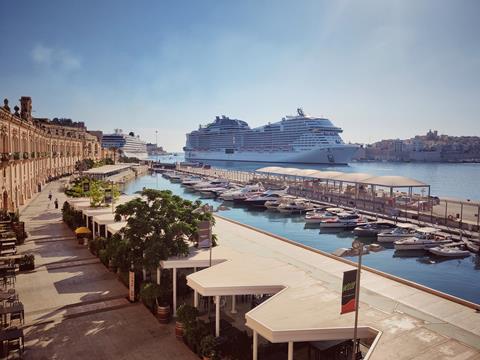
In November 2022, the port, which is a subsidiary of Global Ports Holdings, was named ‘World’s Best Cruise Terminal for Sustainability’ at the World Cruise Awards 2022.
And in January this year, the port was declared Best Port of Call Global by Spanish-speaking cruisers at FITUR Madrid 2023 in January – indicating that sustainability can go hand in hand with a top-class cruise experience for guests.
Stephen Xuereb, COO of Global Ports Holding and CEO of Valletta Cruise Port, says the port’s sustainability credentials rely on the four main pillars of sustainability: environmental, economic, social and human.
“At Valletta Cruise Port we are focused on continuous sustainable improvement, whilst striving to provide the best service to our guests and customers, and simultaneously innovating services in our ports and destinations in the process contributing to the communities we operate in.”
Measuring environmental risk
Valletta Cruise Port recently completed Phase 1 of an Environmental Risk Management System (ERMS) which will further help it meet its future green goals.
“This will help us to continue managing risk in a structured manner, better identifying, assessing and controlling risks that could impact the port and destination environment and communities within, whilst complying with our environmental duties and obligations and meeting community expectations,” says Mr Xuereb.
The ERMS requires the port to undertake tasks such as compiling an inventory of legal and regulatory interfaces; surveying of all port facilities; listing and evaluating suppliers; identifying key customer groups; compiling an initial ERMS and risk register; and creating an inventory of environmental aspects.
Building a group of dedicated people to implement the findings of Phase 1 is the next step, says Mr Xuereb.
“An Environmental Committee or ‘green team’ made up of leadership team members and employees will be established to assist and offer advice in support of the environmental direction of Valletta Cruise Port. We are now waiting to hear from the relevant authorities in order to move forward into the next phases.”
The ERMS complements Global Ports Holding’s existing environmental policy, which sets out its overarching approach to environmental awareness and practices. “It aims to ensure compliance with environment-related laws and regulations and ethical principles in the countries where we operate, as well as determining relevant internal responsibilities and rules,” says Mr Xuereb.
“The policy complies with ISO 14001:2015, which is a baseline requirement for almost all national and international ‘green port’ accreditations.”
Sustainability milestones
Valletta Cruise Port’s success in achieving key sustainability milestones is strongly linked to its ongoing focus on managing sustainable access to the port’s ancient city and the historical treasures within it and the surrounding region.
“At Valletta Cruise Port we usher thousands of passengers, crew members and tourists to Malta’s capital, with a combination of localised services, practical and versatile solutions,” says Mr Xuereb.
The port’s cruise terminals are housed in restored 18th century buildings located at the foot of the iconic Valletta bastions. “These buildings were all restored to blend the old and the new whilst respecting the historic fabric as envisioned by the Knights of Malta,” says Mr Xuereb.
“Valletta Cruise Port’s concession covers an area of nearly 5 hectares of land comprising nineteen beautifully restored Baroque 18th century warehouses and ancillary buildings, known as the Valletta Waterfront, an award-winning urban development destination in its own right.”
The considerable challenges of maintaining 21st-century facilities within buildings that are hundreds of years old are underpinned by the port’s commitment to UNWTO’s Global Code of Ethics for Tourism. The principles of this code provide the guidelines that allow it to continue in its mission to protects the environment, cultural heritage and communities that are so popular with visitors to Valletta.
“As a signatory of the UNWTO Global Code of Ethics for Tourism we commit to enact the Code’s 10 principles covering the economic, social, cultural and environmental components of tourism,” says Mr Xuereb.
“Valletta Cruise Port, also through the Valletta Waterfront destination, is committed to carrying out its activities responsibly, with the aim of leaving a positive impact on the local community. The port is actively involved in the community, and supports a number of causes, particularly those with a humanitarian and social impact, in the areas of art and culture, and the environment.”
Future development
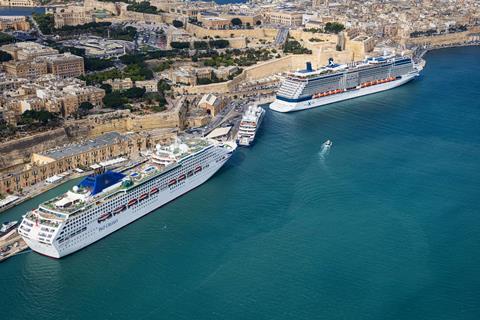
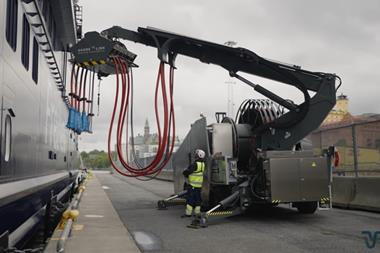
The modern face of sustainability is represented by significant investment in shore power facilities at the five main cruise ship quays in Valletta’s Grand Harbour.,
Valletta Cruise Port is supporting a €49.9 million initiative to develop shore-side electricity infrastructure as part of the Grand Harbour Clean Air Project led by the Ministry for Transport, Infrastructure and Capital Projects, Infrastructure Malta and Transport Malta
“The project includes a €37m investment to provide shore power on the five main cruise ship quays of Valletta’s Grand Harbour in 2023, resulting in major air quality improvements with drastic emission reduction,” says Mr Xuereb.
“This project will lead to major air quality improvement with a drastic reduction in emissions most notably SOx, NOx, CO2 and PM emissions. By switching off their engines during their stay in Malta and switching to shore power, ships will be able to decrease considerable noise pollution and related vibrations, contributing to an enhanced quality of life in this region. Meanwhile the project will help safeguard numerous historical buildings and fortifications surrounding the Grand Harbour.”
In its management of cruise facilities, parent company Global Ports Holding works with all stakeholders to integrate the port into the destination and manage the impact of cruise tourism on the destination and local environment.
“This includes managing passenger flows into and out of the destination, managing transportation from the port to the city and promoting a range of attractions in the destination to disembarking passengers and offering them appropriate transportation from the port to these attractions,” says Mr Xuereb. In this way, wider distribution of the economic benefits within the destination can be achieved.
Future development plans for the port integrate sustainability at all levels.
“Today we talk about sustainability also in terms of passenger flows, traffic management and avoiding congestion in the key places of interest. We were at the forefront of that in the sense that we try and promote different solutions in terms of excursions. Some years back, for example, at Valletta Cruise Port we teamed up with a young company to encourage greener, zero-emission eco-tours around Malta – a fun, environmentally-friendly option which is both comfortable and affordable.”
Technology and the IOT are also providing new opportunities to encourage sustainable cruise tourism. “As Global Ports Holding, we are also developing a Cruise Genie App, which is an Artificial Intelligence App to assist cruise passengers whilst visiting our destinations in order to use their time as sustainably as possible.”
Users can input their interests and preferences, and the app will guide them to the closest fit in terms of places of interest.
“More importantly, this app has been also a welcome innovation by the municipalities, because through the app, we can influence crowd management,” says Mr Xuereb.
“For example, in Spain, in Barcelona, everyone wants to go to the Sagrada Familia, likewise in Malta everyone wants to visit St. John’s Cathedral. If you’re using the app, and it is 10am and you want to go to St. John, the app will tell you: there is a two-hour queue; would you like to book a ticket for 3pm instead? And then you can book a ticket for 3pm and you will find fewer queues. That is part of sustainability as well plus it positively impacts the customer experience. It is a win-win situation for all parties: the site operators, the passengers and the local communities.”