



Finding the polluter
Finding that the final inspection of a new or modified container terminal fails due to lack of noise relating considerations isn’t just annoying, it also usually results in expensive amendments. Sven Mattheis describes a tool developed by ISL and ted GmbH that helps to avoid this situation.
The continually growing exchange of goods is going to reach the limit for each element of the supply chain. Extending – and rebuilding – handling facilities often has considerable environmental impacts. In particular, noise pollution becomes a more and more important issue because many ports are close to residential areas.
While simulation technology itself is an approved method when planning a container terminal to get selection and rating of the equipment, the linking between planning and answering ecological questions isn’t yet addressed.
However, using an accepted simulation tool for container terminals we can add a component for calculating noise propagation. The mapping of processes on the terminal for the simulation can be extended to the noise emission of the equipment and singular events (eg, dropping off a container). Using algorithms for noise distribution the immission in the environment can be calculated, which makes this component useful especially in an early phase of the terminal planning process.
Simulation systems for planning container terminals
The use of simulation programs as assistance for new planning of container terminals or redesigning existing terminals is seen today as state of the art.
Due to the demand for high productivity and automation as well as increasing vessel size, special computer systems for simulation and emulation have been developed for container terminals. The whole planning, developing and installation process nowadays is accompanied by simulation. In the case of reorganising complex systems it provides the opportunity to improve planning procedures.
The system ‘container terminal’ is relatively complex. It is characterised by numerous parameters and interactions between technical, operational and economical components. Furthermore, some of the influencing quantities have a random character, eg, arrival times, daily number of boxes, loading and discharging times of vessels, container movements and crane time.
With the aid of simulation technology it is possible to reproduce the system ‘container terminal’ as a virtual system in order to analyse an existing or planned terminal in detail.
A simulation model is a computer-based system, the real system ‘container terminal’ has to be represented in such a way that an equivalent mathematical model can be constructed which then reproduces the processes – including fortuitous events – in a realistic way.
The simulation system SCUSY was developed in the early 1990s by ISL. Meanwhile, more than 20 ports worldwide were using this system for their own projects. In addition, the ISL uses SCUSY within consulting projects and extends the system to new demands. The simulation system in figure 1 examines the processes on the terminal like loading and unloading of a vessel, the horizontal transportation, the storage on the yard and the landside delivery via train, truck or feeder. It is used for determination of the optimal layout, the devices (technical parameters and quantity) and the strategy being used. The main target is to increase the productivity of the whole terminal. An integrated cost calculation allows a monetary comparison between different alternatives.
Acoustical examination in the planning system SCUSY
The aim of including an acoustical part into the simulation system SCUSY is to provide the planner of a container terminal with noise-relating evaluations. It is important that the planner still works within the same environment using his well-known tools and that any noise-relating facts are reduced to a minimum.
Emission means the power of acoustic noise which is send out by a source Transmission is the propagation of noise considering physical influences Immission describes the impact from noise to a target, measured as noise pressure
Generating sound emission
Inside the simulation system all devices used are included with their technical parameters, as far as they are required for the task of productivity and cost-evaluation. Some of these parameters are acceleration and speed values, pick-up and drop-off times, as well as fixed and variable cost-parameters.
A database was created containing known devices and their noise values for different states of operation (driving fast, driving slowly, pick-up, drop-off, lift, lower etc.). Afterward these values will be used to calculate the emission of the terminal by allocating these devices with the devices being used in the simulation.
Noise emission is created when a device moves around, is in an operating state or even when it is standing still with a running engine. The first step to get emission values is to find out where the device operates. Although the simulation knows on which location the device is working on, collecting values relating to the whole terminal would be too undifferentiated. To get more differentiated values the terminal (figure 2) is divided into sectors using a fixed raster value of 50 metres. Each action generated by the simulation will be recorded in a given time pattern (1 hour) and assigned to the corresponding sector(s). After the simulation is finished there will be information for each sector on which device type worked in each time slot, how long and in which operating state.
The project EPSIC
The tool described in this article is the result of a research project called EPSIC, and as a cooperative project between the ISL and the ted GmbH founded by the local organization BIS (www.bis-bremerhaven.de). Part of the ISL was the extension of SCUSY (to produce sector and time-relevant simulation data) and the programming of the tool. The acoustic knowledge and the formulas implemented in the tool where delivered by the ted GmbH.
Noise transmission
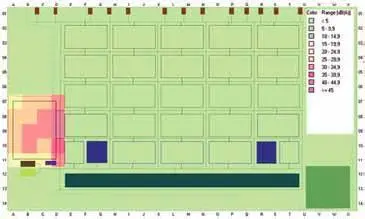
While generating the emission values is part of the SCUSY main module, the noise propagation calculation is part of an additional module. The formulae being used correspond to the norm DIN ISO 9613-2. While some formulae are used to calculate the emission per sector, others are used to calculate the propagation of noise. Meteorological impacts are considered in the formulae by using the temperature and humidity- depending absorption coefficient. The calculated emission values can be shown as one overall value and as a value for each sector. Figure 3 shows the graphical output which allows a fast overview.
Noise immission
Defining measuring points is done inside the additional module. In reality these points comply, i.e., with the position of the residential areas. One result of the transmission calculation is the noise impact put down to the whole terminal emission on each measuring point. Because the terminal is divided into smaller sectors, the influence of each sector to one measuring point can be shown. This could be used, for example, to show that the cargo handling in the train area has the biggest influence on the noise impact at that location (figure 4). Using the device-related evaluation shows the impact that one device kind has to a specific measuring point (relating the whole terminal) or which impact each device kind inside one sector has to a specific measuring point. Figure 5 shows the result after selecting the device kind fork lift truck. The area on the left is the empty stack which is the only area this kind of device is working on. A planner using these diagrams can see noise sources that have a great impact on the target locations and is able to modify the planning. Relocating areas with a strong noise impact or implementing noise protection packages may help to reduce the noise impact at the target location. This tool gives the planner the possibility to make noise-relating decisions at a point in time long before the beginning of the licensing procedure, which may avoid long and therefore expensive amendments.
Conclusion
The objective of the project is to provide a tool to the planner of container terminals, which will extend his planning – normally focused on terminal productivity – with noise-relating considerations. The growing sensitisation of environment-related aspects in licensing procedures demands an earlier inclusion of these aspects in the planning phase.
By using a planning tool which is accepted in the planning sector and the allocation of a database containing emission data for typical container terminal devices the planner can implement this new task into his working area without the need to build up specialised knowledge.
About ted GmbH
ted GmbH, founded in 1998 and located in Bremerhaven, Germany, is one of the leading providers in the area of acoustic planning for maritime container terminals.
www.tedgmbh.de
About ISL
The Institute of Shipping Economics and Logistics (ISL) was founded 1954 in Bremen, Germany. Combining tradition with modern research, it is positioned as one of the Europe-wide leading institutes in maritime research, consultancy and knowhow transfer. With locations in Bremen, Bremerhaven and Luebeck, about 50 employees work in interdisciplinary teams on projects from all over the world.
www.isl.org
About the author
* Sven Mattheis has 10 years experience as a scientist at the ISL inside the department Information Logistics. His areas of expertise are simulation, emulation and optimisation of (container) terminals as well as developing management systems for smaller terminals.
mattheis@isl.org
Related Articles
 ALTERNATIVE FUELS GREENPORT