


The Taiwan International Port Corporation (TIPC) Greening the Ports action plan integrates environmental protection into its operating philosophy, with as goal to enhance the competitiveness and promote green port policies.
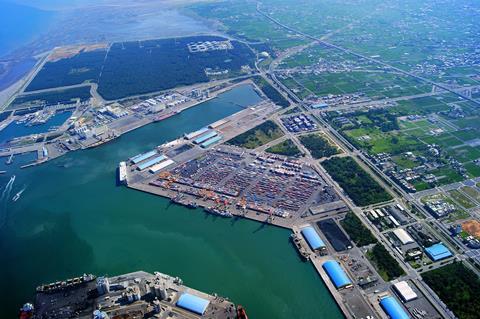
The Greening the Ports Action Plan is leading the company to go beyond compliance and pursue sustainability. Furthermore, TIPC initiated several programs that focus on its cargo operation, cruise terminal, environmental quality and community outreach.
For cargo operations, measures that facilitate operational efficiency as well as reduce emission are being implemented in all Taiwan ports. For example, the automatic-gate project, which will equip all truck lanes with advanced OCR and RFID technology to facilitate quick vehicle transit and container clearance, is now being implemented in Keelung, Taichung, Hualien, Kaohsiung and Taipei ports. In addition, a new closed stevedoring facility (for coal) at terminal 104 at Taichung port began to operate in the beginning of this year. Furthermore, two land-based shore power systems (AMP) are fully operational at Kaohsiung Container Terminal 6, berth 108 and 109. Additional AMPs will be installed at berths 115-117 at Kaohsiung port.
TIPC is also integrating environmental friendly designs into its new Kaohsiung Cruise Terminal and new Keelung Harbour Service building. The new facilities are expected to offer quality facilities and infrastructures for a growing cruise tourism business. The 6-level Kaohsiung Cruise Terminal with 15-level Port Service Centre project will be approved as a green building and become a magnificent architectural icon in Kaohsiung.
The Greening the Ports Action Plan is implemented in four fields: tourism, cargo shipping, harbour environment and city/local community development. Before the plan officially started, TIPC had already achieved remarkable performances in these fields.
Tourism
TIPC has been actively encouraging the shipping companies to conduct waste sorting and reduction. The port of Taichung, for example, had collected 1,300kg recycled waste products. In the port of Hualien, shipping companies were greatly supporting waste reduction that the waste decreased from 124,830kg in 2009 to 64,810 kg in 2012. Moreover, the design of new Keelung Harbour Service building and the new Kaohsiung Port Terminal will integrate green building concepts and aim to get the green building certification.
Cargo shipping
TIPC’s harbour crafts are using low sulphur fuel and shore power, which greatly improve the air quality around the port areas. In the port of Taipei and Keelung, harbour crafts are all using shore power system; while the port of Su-ao is improving the port infrastructure, which aims to provide shore power in the future. The port of Kaohsiung has installed two AMP in Terminal 108 and 109 and is now constructing additional shore power system at 3 terminals, and the construction is expected to be finished in December 2014. Once completed, it will be able to supply shore power to container ships with up to 12,500 TEU.
Harbour environment
TIPC endeavours to bring the harmony between port operation and the environment. The Port Company has been examining the water quality in the port area, moreover, the site environmental management plan includes a twice-a-year water quality monitoring. In addition, TIPC has been taking initiates to improve internal environmental policies in the Harbour Service buildings, in the whole port area and wherever possible. It installed rainwater collection systems to decrease tap water usage, and the collected water can also be used in the sprinkle water systems, which helps to reduce particulate matter pollution. Finally, in order to save energy, in the port of Kaohsiung LED lighting has been taken into use, and we are confident that other ports will follow this strategy in the long-term.
City/local community development
In order to increase connections with nearby communities, TIPC puts emphasis on developing the mutual understandings with the interested parties. The interaction is starting from the development of a waterfront area and a greenbelt around the port area. TIPC invites, therefore, the public to get close to the harbour and experience the port environment. Like the port of Hualien, it hosted a beach cleaning activity in 2013, which attracted more than 180 people, including port staff and citizens. In addition, TIPC has continuously collaborated with universities and research institutes on environmental projects to get innovation ideas and improve the port qualities in every aspect.
Green port strategies
TIPC is continuously improving the port environment. Currently, it is actively promoting the green port activities to increase its visibility in the world. Being recognised by the European Sea Ports Organisation (ESPO), the port of Kaohsiung has passed the first stage of EcoPorts in November 2013. In the future, the port of Kaohsiung will aim to obtain the second stage certification of the Port Environmental Review System (PERS), while other ports will attempt to earn EcoPorts certifications as well. Furthermore, the voluntary vessel speed reduction program that keeps vessels to a 12-knot speed limit within 20 miles of the port will be introduced in the next years.
TIPC is positive that the green port strategies will promote Taiwan’s port status in the globe. By continuously improving the four aspects and executing “Taiwan Greening the Ports Action Plan,” TIPC hopes that the future green port performances will be not only in line with international trend, but also demonstrate the uniqueness of Taiwan’s green ports.
The Taiwan International Port Corporation (TIPC) was established in March 2012, in response to the reorganisation of the central government. For many years, the public authority and business management were merged under the Ministry of Transportation and Communications. However, after considering the increasing flexibility and responsiveness to the market changes, the two units were separated. The Maritime and Port Bureau (MPB) is assigned to act as part of the government body. Being in charge of the maritime and port-related public administration, TIPC, which was corporatised, is now an independent company that is managing seven Taiwan international commercial ports: Keelung, Taichung, Kaohsiung, Hualien, Taipei, Su-ao and Anping.
TheTIPC headquarter is located in Kaohsiung, and its four subsidiaries are respectively located in Keelung, Taichung, Kaohsiung and Hualien. While aiming to increase the profitability after the reformation, TIPC is also contributing to create environmentally friendly port areas.
Muhan Cheng, coordinator of the Green Ports programme at TIPC.

