Instantly recognisable for its harbour bridge and opera house, Sydney is also home to a multifacetted deep-water port operation, catering for a wide range of import-dominated commercial cargoes and cruise shipping callers.
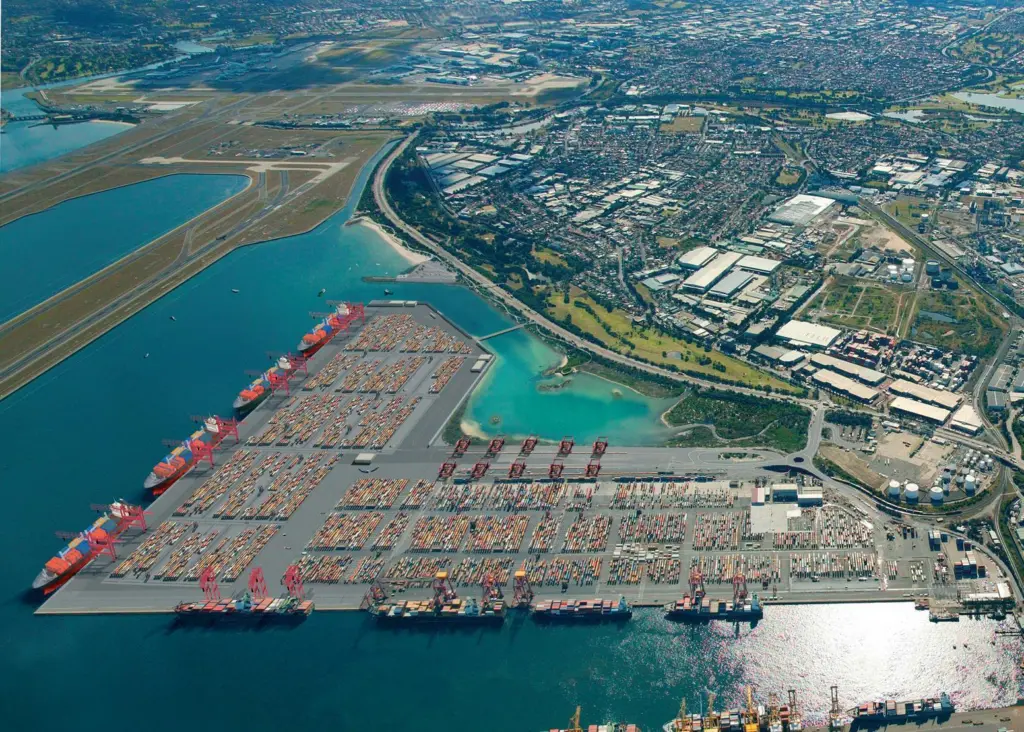
About 70% of Sydney Ports Corporation’s business takes place at its Port Botany facility, located about 12 nautical miles south of the entrance to Sydney Harbour. Well serviced by road and rail networks, this 210- hectare site includes two container terminals, six containership berths, container support businesses, a bulk liquids berth and bulk liquid storage facilities.
Weekly container services currently calling at Sydney Ports include AAS (Japan, Korea, China, Hong Kong and Taiwan), SAS (China and Hong Kong), ANZL (Hong Kong and United States West Coast) and AU3 (Tanjung Pelepas and via relay to Europe).In addition to NEMO (Europe via South East Asia and Suez Canal),OC1 (United States East Coast and via relay to Europe) and Trident (United States East Coast and Europe).
Within Sydney Harbour itself, the port handles dry bulk, bulk liquids, motor vehicles and general cargo on 15 berths spread over 62 hectares of Darling Harbour, Glebe Island and White Bay facilities. Sydney is also the only port in Australia to have two dedicated cruise berths:Darling Harbour and the Circular Quay Overseas Passenger Terminal.
Sydney Ports corporate affairs senior manager Kamini Parashar says ongoing commercial demand saw her port handle a record 26.7m tonnes of trade in its 2005-2006 financial year.
“Representing a 3.1% growth in total trade on the previous year, this strong performance also compared favourably with the average annual growth of total trade in mass tonnes for the past five years of 2.4%,” says Ms Parashar.
“Container throughput has grown from about 175,000 teu in 1970 to approximately 1.6m teu in 2007. Growth has been particularly strong over the last six years, going from 1m teu in 2001 to approximately 1.6m teu in 2007.” Total import cargoes, which represent 75.5% of the port’s business, rose 1.8% during the recent financial year, with overall export cargoes returning a 8% increase.
In the first 10 months of its current financial year, the port’s total trade has risen 5.7% to 23.15m tonnes. “Containerised trade has exceeded expectations, reaching 1,355,886 teu – an unprecedented 13% growth on the same period last year,”says Ms Parashar.
“A 9.2% increase in full export containers compared to the same 10 months of last year contributed to this growth, with the total number reaching 307,546 teu. Increases [were seen] in exports of commodities such as machinery,paper products,miscellaneous manufactures and iron and steel.
“Container imports grew by 11.7% in the same period, reaching 686,914 teu. Commodities such as textile fabrics, iron and steel and prepared food contributed to this increase.”
However, Ms Parashar is mindful of the challenge of matching capacity with future growth. “Productivity will continue to improve, but to meet rapidly-growing trade demands – which will translate to a trade throughput of over three million teu by 2025 – port facilities need to be expanded.” In this vein, Sydney Ports expects to complete a project to expand container terminal and bulk liquids handling facilities adjacent to its existing Botany Bay development,by 2011.
Features of the development include:
● 1,850 metres of additional wharf face for five shipping berths;
● deep water berths with draught up to 17 metres;
● reclamation of 60 hectares of land;
● dredging of about 7.5m cu m of fill material to create channels and berth boxes;
● dedicated road access to the new terminal area;
● additional rail sidings to provide rail access to the new terminal area;
● additional tug berths and facilities. The port also has plans to develop an intermodal logistics centre (ILC) on the 60-hectare Enfield site located 18 kilometres from Port Botany. “This proposal has been developed in line with a strategy to manage the growth of containers through Port Botany, which includes a target of moving 40% of containers by rail.
“The proposed ILC site is within close proximity of its catchment markets, located on and accessible from arterial roads, connected by a dedicated freight line to Port Botany and large enough to deliver an integrated freight solution comprising intermodal terminal capacity for 300,000 teu per annum, empty container storage and warehousing.”