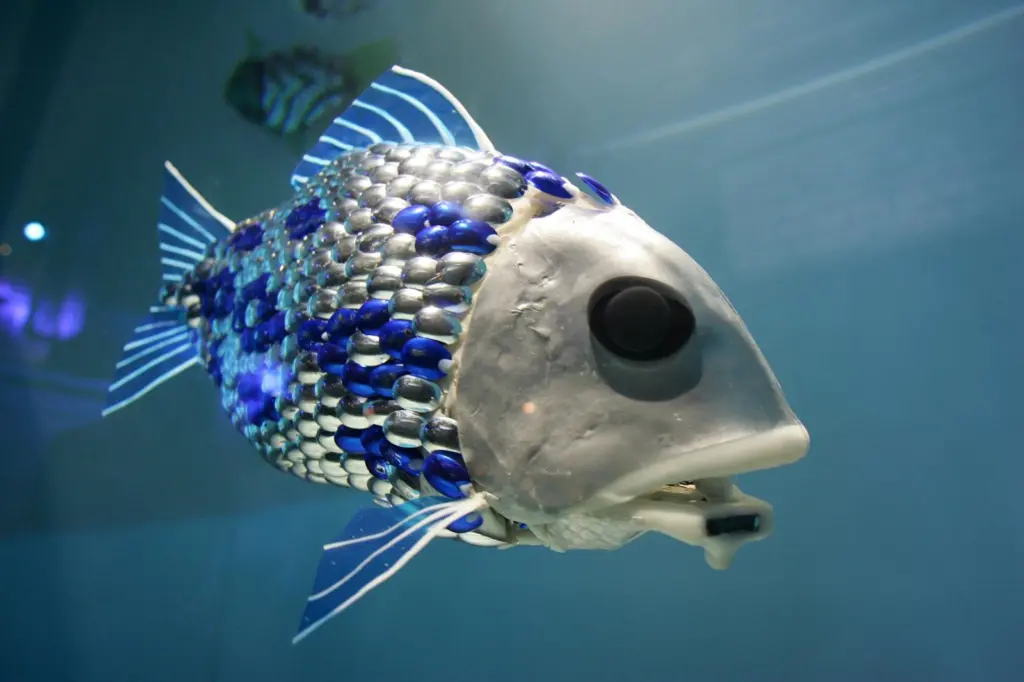
The hope is that since they will be able to detect quite small quantities of dissolved pollutants the fish, (which can work together to share information and recharge themselves from a hub), will be able to alert the port and other authorities to things like fuel pipeline or ship leaks before a more dramatic problem arises.
But AI, or artificial intelligence, has now been around for a while and it may be the way that different ‘green efficiencies’ get linked together.
For instance, integrated management systems save more than money, Harvey Bauer of Tideworks points out, because effective streamlining and automation of port structures such as terminal gates help minimise the amount of time trucks spend idling in queues – and therefore burning fuel. He goes on to say that systems that automatically push instructions to operators distribute workloads better than phone or paper, especially when matched with optical character recognition (OCR) or Radio Frequency ID (RFID) markers.
Linking new management systems and clean power is the very first battery operated automated vehicle (AV) just starting trials at HHLA Container Terminal Altenwerder. A joint step between HHLA and Gottwald, it is not just a solution for operations in built up areas, but it is also a long-term strategy for saving money.
As Captain Heinrich Goller, managing director of HHLA CT, says, not only will operators in future be “expected to take a more responsible stance in regard to the environment”, but that terminals “also need to employ highly efficient and economical technology in view of the overall difficult economic situation and increasing fuel costs predicted long term”.
This packaging of ‘green’ and efficiency makes sense, especially when initiatives can bring in hitherto ignored local resources – which ports often have aplenty. For example, Wallenius Wilhelmsen Logistics (WWL) is not only looking at solar and wind electricity generation for some of its centres, its WWL Zülpich facility in Germany is making the most of its proximity to farming by investigating the use of biogas made from agricultural waste for heating.
But going further than most is manufacturer Linde, who developed the first hydrogen-powered forklifts in 2000. Its offshoot, the Kion Group, has since gone on to develope hydrogen fuel cells. These are already on the prototype E30 electric forklift truck which has a rated capacity of 3,000 kg. The model also has an advantage when it comes to battery recharging – you don’t. Instead, it only takes around five minutes to fill the tanks with pressurised hydrogen which can then be stored.
Interestingly, hydrogen-fuelled vehicles can be powered by an inexhaustible reservoir of ‘green’ energy sources, such as sun, water, wind or biomass as well as industrially generated gas, a point which leads many technologists to see hydrogen, with its clean by-product of water, as the fuel of the future.
In a recent, stunningly broad call for green technology, the ports of Long Beach and Los Angeles joined forces with the Alameda Corridor Transportation Authority to ask for innovative solutions aimed at a zero-emission container mover system (ZECMS).
This could potentially eliminate thousands of short-haul diesel truck trips between terminals and local rail yard each day. Art Wong of Long Beach says that proposed technologies could span everything and anything from electric guideways to zero-emission trucks or electrified rail.
One of the most interesting possibilities comes from a magnetic suspension system, which allows vehicles to float without an energy source. Once floating, the LevX system allows several thousand pounds of payload to be accelerated and propelled utilising a small (less than one horsepower) electric motor.
Jo Klinski of Magna Force explains: “One huge cost advantage of the LevX system is that it provides the benefits of a magnetically levitated transport system without the need to connect the system to the local power grid.” What is more the room-temperature magnets are steady-state, eliminating the health issues associated with electromagnetic fields.
Coming (literally) back to earth, cold ironing – or shore-based ship power – is an option for regular callers as it reduces pollution by 90% even at the generation plant. But it leaves something to be desired for vessels that are not so regular. This is because both the vessels and the ports have to undergo a fairly hefty modification (the ITS terminal at Long Beach recently paid $8m for the wharf and electric substation).
So, ACTI has developed what has colloquially become known as ‘the sock on the stack’, (properly referred to as the Advanced Maritime Emissions Control System – AMECS). The ‘capture’ application is a bonnet on the ship’s stack, while the treatment system has a cloud-chamber scrubber for removal of sulfur dioxide (SOx), particulate matter and hydrocarbons plus a selective catalytic reduction reactor for the removal of oxides of nitrogen (NOx).
The AMECS system being tested at the Port of Long Beach (PLB) is at present on the dock, but PLB’s John Pope says the eventual idea is to mount the system on to a barge that can be moored alongside any ship needing it.
So it seems the long-term goal of a brighter, greener future need not be sacrificied on the alter of medium term efficency.