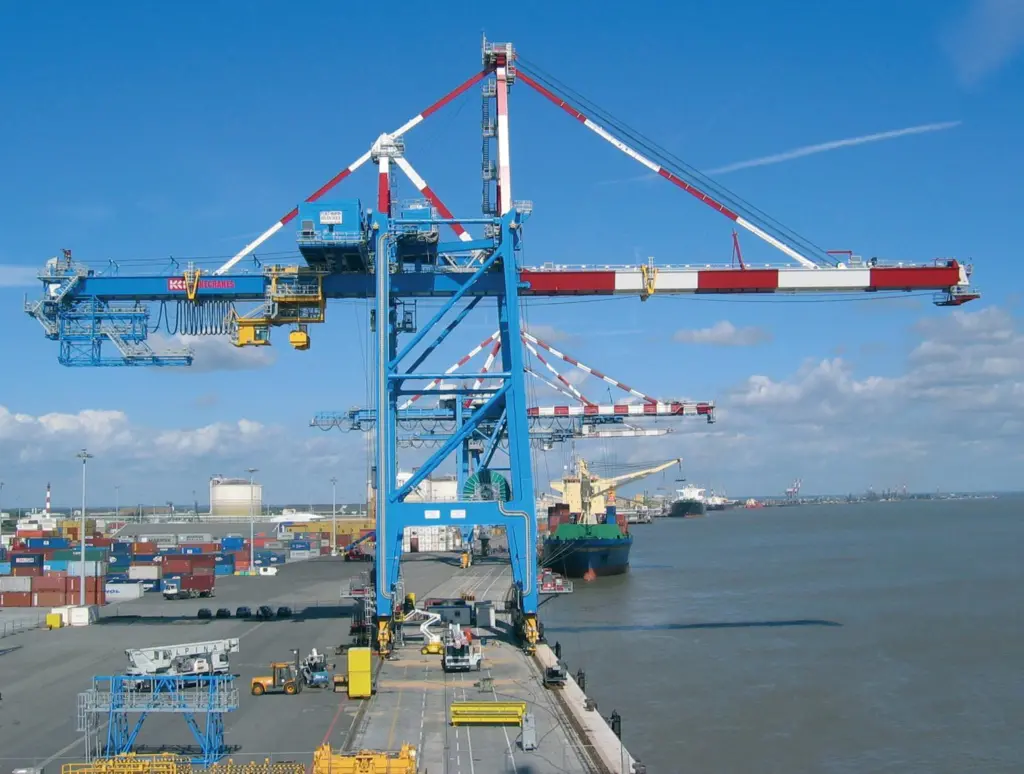
One of the best ways of reducing the fear factor associated with using a real dockside crane for the first time is to make the operator undergo good quality training well before they sit in the cab. Clyde Stauffer, vice president of US-based simulator developer GlobalSim, says that while in his view 25%- 30% of the necessary training could be undertaken using only a software program on a personal computer, in order to correctly model the overall experience of working a crane, a simulator is a must.
“Simulators can recreate 70%-80% of what an operator will encounter the first time they take control of a real crane. What a software program cannot recreate, but which is a simulator can, is the sheer number of distractions that there are on the quayside. These are things like people moving about around the vessels, trucks and other vehicles passing by and even the crane, itself, swaying during loading and unloading operations,”says Mr Stauffer.
Global-Sim provides a whole range of crane simulators, including those for container gantry cranes. Requests from customers have also resulted in two bulk unloader simulators being delivered. One involves Gottwald mobile harbour cranes equipped with a clamshell grab, the other a grab-equipped Potain slewing jib crane.
“It is much harder to accurately build a simulator for dry bulk operations than it is for container handling. This is because each dry bulk material is different and handles differently when in the grab,” explains Mr Stauffer.
Despite this, Global-Sim remains a customer-driven company and actively invites bespoke requests from operators. Mr Stauffer explains that for each new simulator produced, systems developed for previous simulators are routinely re-used as a means of keeping costs down.
However, the company is willing and able to model entirely new applications, although Mr Stauffer cautions that one-of-a-kind developments are not cheap to produce. In this respect, he reveals that GlobalSim is currently modelling a simulator based on a dry bulk ship loader, rather than a grab loader, following interest from a customer.
“As a developer of simulators, we target expensive, dangerous and complex pieces of equipment to operate. This is because when all three factors are present,it makes good sense to first get your operators trained on a simulator before letting them loose on the real thing.Not only will they be able to start real bulk handling operations more confidently, start up productivity will also be higher.
Furthermore, there will be less chance of damage occurring, while experience tells us there will be fewer accidents too,”says Mr Stauffer Indeed, so convinced is GlobalSim of the overall benefits to ports using simulators that it has put together an economic model involving certain variables,which will give a good indication in what time period a port could expect to get a return on investment. Conservatively, it should be able to recoup its money within 12-24 months, says Mr Stauffer, although GlobalSim does know of examples where ports have seen a return within three to four months.Significantly,the overall training time can be cut by 25%, if a new crane operator is introduced to their equipment via a simulator.
“Most of our equipment is bought by the ports, while some shipping companies are also showing interest.However,we are now seeing the emergence of third party training companies. This is because many ports use pool labour, which makes it difficult for a terminal operator to justify investment in a simulator to train people who may very well be working for the competition the following week! In these cases, sending port labour to an external service trainer makes sense, since the overall skill level of the port employees increases, without individual terminals having to pick up the cost,”says Mr Stauffer.
In order to ensure that training programmes undertaken by these external companies are correctly implemented, GlobalSim has ensured that the simulator/trainer interface on the simulator is as simple as possible, while the number of training scenarios incorporated into the start-up software can be adapted to serve a variety of possible operations.