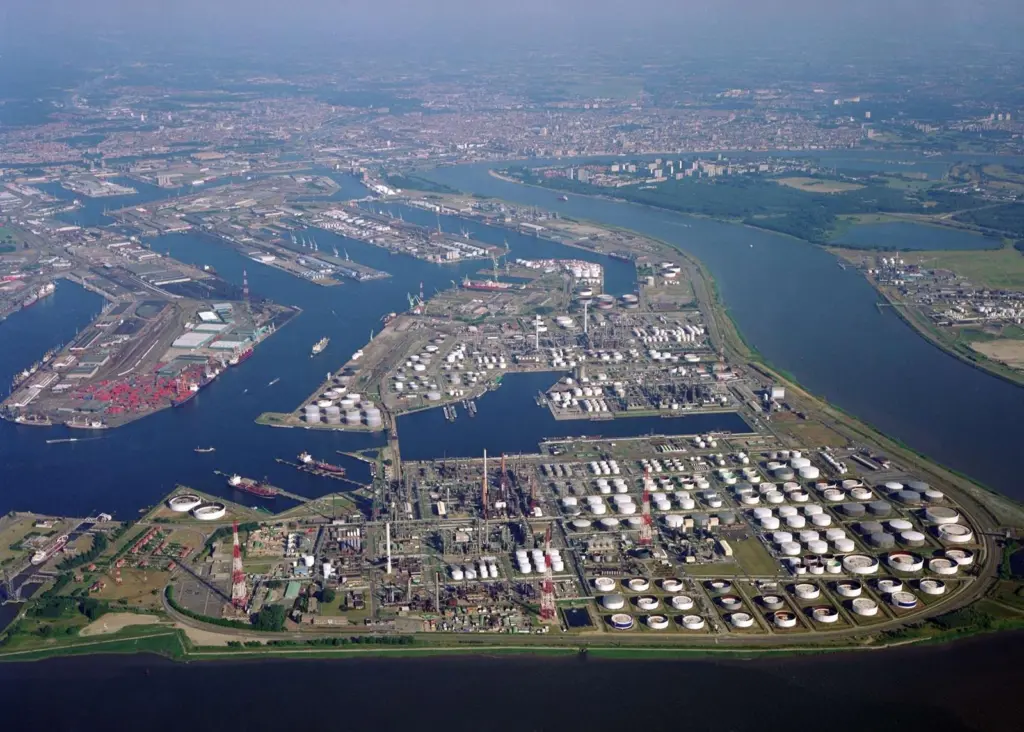
Antwerp is embedded in the middle of the Belgian countryside – that perhaps more than any other factor has led the port to think somewhat differently about its trade.
Unlike sea ports, which traditionally have had the luxury of ‘thinking inside the gates’, Antwerp has focused squarely on the supply chain, knowing full well that lacking a direct sea entrance and till recently suffering from rather restricted draft, the port has had to sell itself as a link in an overall sequence. “Decisions on the route by which freight is sent depends not on the choice of a particular port but on the most efficient chain,” says the port’s chief executive, Eddy Bruyninckx.
Witness to this approach is the port’s stake in the Beverdonk Container Terminal, a 70,000 teu capacity, open-access facility along the bank of the Albert canal in Grobbendonk which gives a place for trucked cargo to be transferred to barge. And working even further afield is its subsidiary, Port of Antwerp International, which looks at developing solid, profitable relationships with emerging market projects like the Port of Vitória, Espírito Santo.
So, has the tide really now turned in favour of joined up thinking? Well, possibly. The point is that although some people think that a lot of the routes into Europe are pretty much interchangeable, it all depends what you are looking for. Certainly, despite all the challenges of being a river port, Antwerp is big. “We do offer economies of scale,” says Mr Bruyninckx. In 2010 the port handled around 178m tonnes of freight, mainly due to a post-downturn resurgence of box traffic.
Further, says Mr Bruyninckx, shippers these days are very eager to show their global chain has a lower carbon footprint. Making a virtue out of necessity, he says: “In this sense, I think in theory we have an almost perfect position. It is not just geographical, our postion can also be translated into Euros, emissions and carbon targets.” However, this ‘perfect position’ has certainly been helped by the newly deepened Scheldt navigation channel which means Antwerp has a bit more room to breathe, as carriers with drafts of up to 15 metres can now get in and out.
Efficiency initiatives, too, are growing – and being tweaked. Besides some rearranging to the Premium Barge Service which shuttles goods between the newer left and more established right banks, there is a very new terminal shunting and rail feeder service, providing a competitive second partner for the ‘last mile’ service within the port.
Further, under the heading ‘never waste a good crisis’, the port took the opportunity lent by the doldrums of the economic dip to develop its plans and to re-engineer the way it faced the world. One objective was to give a new boost to collaboration between all interested parties, closing the gap between the actual facility with its transhipment activities, the logistics sector, and the industry sitting inside the port gates.
Another was to rationalise a number of fragmented IT systems. Interestingly, Antwerp didn’t originally go about constructing one big system: “We took a long hard look at the port from the users side, and rationalised procedures like customs, food agency and B2B processes,” explains Mr Bruyninckx. “The port simply took pragmatic steps, but when it was all brought into line, we found that we had everything required to tie things together with a portal.” And so the Antwerp Port Community System (APCS) was born.
Mr Bruyninckx notes that since the recent European Transport White Paper lays out the requirement for governments to commmit themselves to a transparent, efficient network which includes a National Single Window approach, public finance should be more forthcoming. “It is always easier to aquire funding if you can first reach out to people with ideas,” he says.
If there is a gripe with the European Union, it is that there is a perception that big ports like Antwerp, Rotterdam and Hamburg, are treated badly in comparison to ports further south, which “gain subsidies to support freight corridors specifically challenging northwestern dominance”.
“Yes, we do transport cargo that is destined for southern or eastern Europe, but it sometimes appears that just because we are efficient we don’t get applauded, we get challenged,” says Mr Bruyninckx. “Ports in the south simply have to become more efficient.”