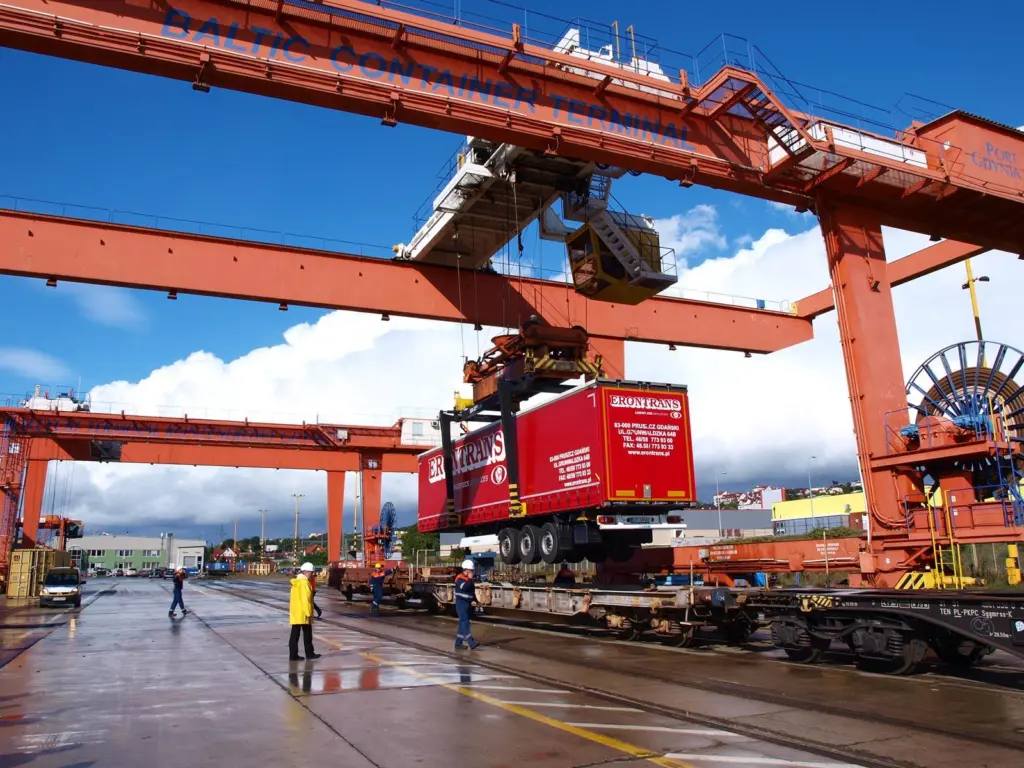
In May this year, the Polish port of Gdynia will celebrate ten years since it took its first steps into privatisation. In 2003, the Philippines-based port operator ICTSI won a 20-year concession to run the Baltic Container Terminal and, since then, the port authority has gone on to privatise its grain and bulk terminals.
The multipurpose general cargo terminal is expected to be privatised before the end of the year. “We have five potential players that have submitted an interest,” says Janusz Jarosinski, president, Port of Gdynia Authority. “The concession will be for 20 or 30 years.”
Meanwhile, the port authority, BCT and ICTSI are working together on ambitious plans for growth which involve both sea and rail.
Two years ago the port’s waterways were dredged to 13.5 metres and the port entrance was widened to 98 metres – enabling Gdynia to handle containerships up to 6,000 teu. But that, says Mr Jarosinski is not enough – the continued rise in average vessel capacity and growing market demand has seen to that.
Going deeper
The port authority is now embarking on a major programme of investment that will include deepening to 15.5 metres and creating a much larger turning circle – something that requires the purchase of a shipyard pier in order to demolish it.
BCT, meanwhile, is to invest €50m over the next three years in quay cranes and other equipment.
The aim is that, when complete, the works will enable the port to handle ships up to 12,000 teu.
Gdynia has a number of reasons for expecting higher container volumes in the next few years – not the least of which is the current relatively low level of containerisation in Poland. On top of that, as well as handling 45% of Polish container operations and other Polish cargoes, the port is crucial for import and export of goods for the Czech Republic, Slovakia and Hungary. Cross-border traffic is becoming increasing important.
Finally, significant amounts of Polish exports are being moved by road to go out through the ports of Hamburg and Rotterdam. Krzysztof Szymborski, chief executive of Baltic Container Terminal, says that being able to handle larger vessels will make it easier to snatch back market share of both rail and maritime modes.
“Why larger ships? The Polish market is increasing – it has been very positive even with Europe’s problems,” says Hans-Ole Madsen, senior vice president, EME Region, ICTSI. “We are also handling a lot of Russian cargo transhipment in the Baltic ports, so that is driving shipping lines to get bigger ships into the region, for the Baltic States but also to cater for the Russian market. We are working together to make sure in Poland we get our piece of the cake.”
Rail plan
However, the port and ICTSI are not only looking out to sea for their expansion – they are also looking to gain from a rail corridor stretching all the way to the Adriatic, which they believe provides Polish ports with another way of competing effectively with northern European ports.
The Baltic-Adriatic Corridor concept was first put forward by diplomats from Poland, the Czech Republic and Slovakia in 1999 and it has been on the priority projects of the Trans-European Transport Network (TEN-T) for nearly a decade.
The concept is particularly interesting for ICTSI, which has interests at both ends – as a terminal operator at the Croatian port of Rijeka as well as Gdynia.
The Polish port will in any case benefit from the national government’s huge investments in north-south rail and road links.
“Rail is growing fast for BCT,” says Mr Szymborski. “Last year we achieved a split of 42% by rail. Our rail extension project will allow us to accommodate even larger volumes. The large shippers – Bosch, Ikea, the automotive manufacturers – don’t ask about trucking, they only expect rail.”
The EU is heavily promoting modal switch in Europe and BCT’s investment and the Baltic-Adriatic Corridor both fit in with this, points out Mr Madsen. “That is for environmental reasons, yes. But also it is because existing rail networks in Germany, the Netherlands, etc., are already pretty full. So if you want to continue to promote this concept of intermodality in the EU, you have to open new routes.”