“Besides the omnipresent requirement to increase productivity, ports are further challenged by environmental regulations,” says Liebherr. “Productivity and eco-friendliness also represent two main subjects port equipment manufacturers are intensely working on. As a result, numerous innovative tools have already been implemented to improve performance and reduce emissions, such as the Pactronic® hybrid drive which was designed with both productivity and eco-friendliness in mind. The system boosts performance and reduces emissions at the same time, each in the range of 30%, depending on operation.”
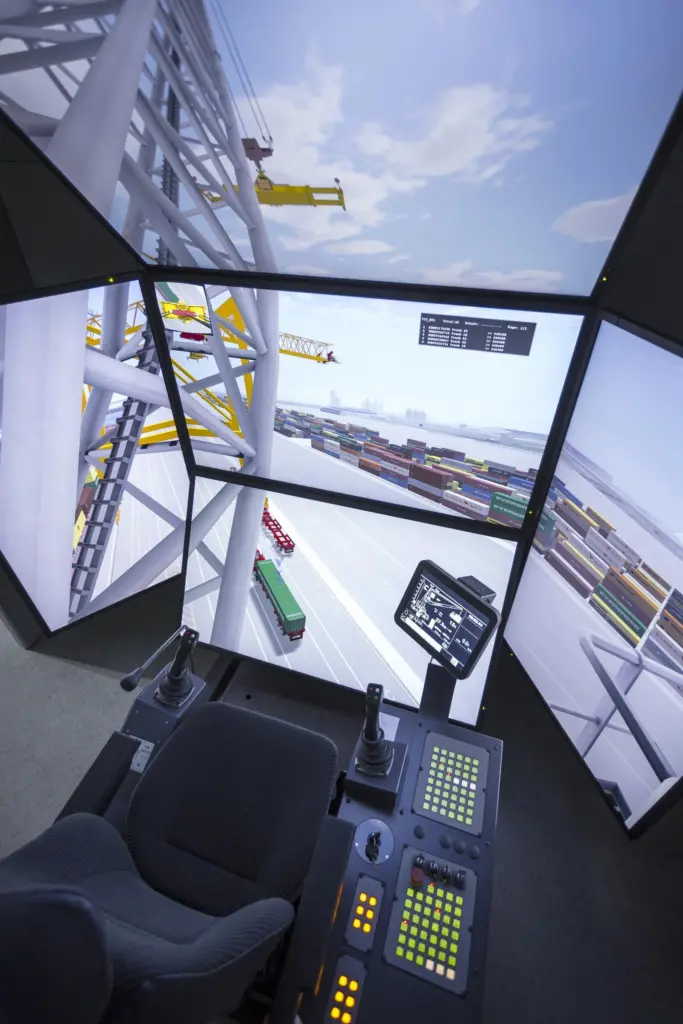
Liebherr’s recent range of maritime crane simulators has helped to boost productivity. “Efficiency, safety and costs are three key factors in modern crane operator training. One major benefit of simulator training is the ability to simulate user-defined environmental conditions. This allows both experienced operators and trainees to gain valuable experience operating under challenging conditions in a safe virtual environment. The resulting increase in operator skills allows for safe and productive crane operation in the real world and naturally boosts productivity.”
Chuck Schneider says that Kalmar’s recent products have been a mix of those that build on existing equipment and innovative new systems: “The improvements of existing equipment range from the improvement of the ergonomics (seating, handling, vision from the operator cabin), the introduction of fuel-efficient or zero-emission propulsion (hybrid and battery driven vehicles), to automated versions of existing equipment (the AutoStrad and AutoShuttle, even the AGV, which is an automated version of the terminal tractor). The introduction of new systems range from equipment (Automated Stacking Cranes, Automated Lashing Platform) to systems (technologies to automatically ID arriving containers and trucks, or improve the safety of the operations).”