
As Psion Teklogix puts it, ports and container yards “aren’t for the faint hearted”.
Freight arriving 24/7 on ever-larger container ships. Huge cargo being shifted overhead. Customers frantically chasing deliveries. And this is when a port is running smoothly.”
Add in the tough, exposed conditions of your average port, and the challenges are many.
But in many cases, ports and terminals have gone for standard off-the-shelf products for their Wi-fi infrastructure and systems – and paid the price, says Thomas Müller, managing director of umc.global (Universal Marine Communication).
“They have chosen off-the-shelf products that are designed and developed for use in offices or in industrial areas like plants. However, the environmental conditions in ports and terminals and on vessels are so different, so harsh, that most off-the-shelf products do not provide a reliable solution.
“Also very important is that the RF (radio frequency) environment in ports, terminals and vessels is full of heavy interferences from radar, VHF, UHF, AIS (Automatic Identification System), satellite and hundreds of uncontrolled Wi-fi access points, so that this alone causes huge issues with reliability, availability and robustness for the port and terminal infrastructure.”
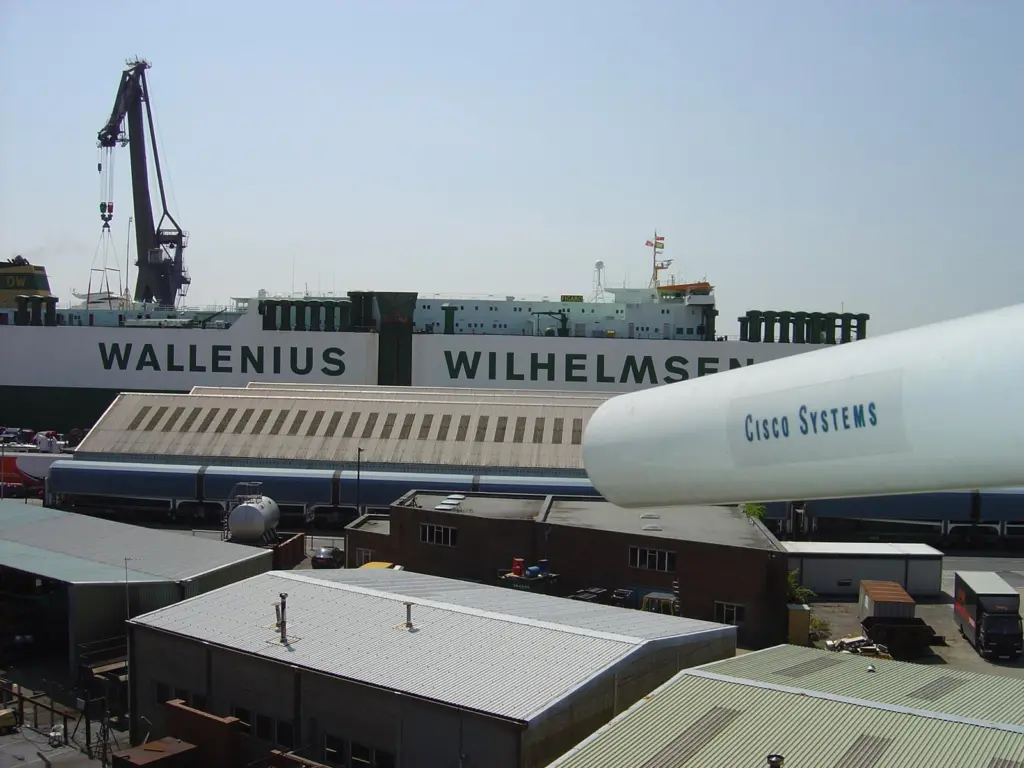
Mr Müller highlights the case of HHLA’s CTT Terminal in Hamburg, recently fitted out with umc.connect portnet Wi-fi technology and Cisco 802.11b/g wireless access points.
“They previously used standard off-the-shelf products and this resulted in about 5,000 connection drops per day on their terminal tractors and reachstackers. After we had refined the entire infrastructure with our umc@port antenna and umc@port interference eliminator as well the umc@port coverage enhancer, HHLA CTT measured an average of ten connection drops per day and a perfect availability and robustness.”
In many cases, the layout of the yard and the positioning and type of antennas are not properly taken into account when Wi-fi infrastructure is being planned, he adds; umc.global draws up a detailed plan on where to position what type of antennas, based on a one-day site survey to measure RF measurement throughout the site.
“Issues such as connection drops, general availability and reliability problems up to an entire Wi-fi network collapse will lead to significant problems with the overall terminal performance and, in the worse case, to a complete stop of the terminal operation,” says umc.global.
In many cases, however, ports and terminals actually use twice as many access points as necessary, says Mr Müller.
Psion Teklogix also highlights the need for site surveys to investigate and analyse the usage of wireless systems in ports and container yards. “The most important factor is to look at the infrastructure available on the port yard,” says spokesman Todd Boone. “Access points and their antennas are usually installed on light poles, so there should be enough of these available on the yard to ensure proper radio coverage, and overlap.
“The type of cargo is important as well, as it might influence the radio signals. Today’s Wi-fi systems have mechanisms such as antenna diversity to overcome the negative effects from the goods stored and manipulated on the yard.”
Ports should consider Wi-fi for their data network and see what other technologies can be integrated on the same infrastructure, in order to maximise the benefits of their investment, says Frans Kok, vice president AMEA (Asia, Middle East, Australia) at LXE, which has been installing Wi-fi in container terminals since 1997.
“Other technologies that can use the same Wi-fi infrastructure are CCTV cameras (security), voice systems (walkie talkies), connecting remote buildings in the yard, crane diagnostics and positioning equipment.
“Pitfalls are coverage issues, so you have to design a system with the right amount of access point, or transceivers, and the right antennas. The coverage of a single access point is determined by the height of mounting it – the higher the better, the height of the container stacks or other materials in the yard, the yard layout, and buildings that might obstruct the signal.”
umc.global, for its part, offers its umc@port wireless broadband infrastructure to serve the needs of the entire port cluster, terminal operator, vessel, terminal operation and seafarers, says the company’s Thomas Müller.
“umc.global provides ports and terminals with a free-of-charge wireless broadband for ship-to-shore communication; the vessel crews can use this wireless broadband for unlimited access to the Internet and its services, and the vessel operation can use it for their business processes and communication, planned maintenance etc., streamlining business between all parties in the port cluster.
“With more than 45 ports and terminals contracted globally, we are looking forward to installing some 50-plus ports with this platform.” umc.global has already converged Wi-fi, WiMax and 3G technology in one solution, says Mr Müller. “So ports and terminals in many cases could use 3G services instead of Wi-fi service with ease and gain better coverage, even outside the yard and terminal, but remain connected within their corporate network environment via the umc.global network VPN services.
“In addition, our mobile mesh unit is a full scada and telemetry device that can help to improve the efficiency of the vehicles dramatically. Using just a touch screen, cloud-based software can run, for example, for dispatching, instant messaging, telephony, etc., within the same unit. “The next trend is getting away from so-called silo applications with their own infrastructure towards using a universal communication infrastructure that is provided as an open standard being able to integrate all different types of systems, automation, service and applications.”