
“Put simply, the trend for spreader use in container terminals, now and forever, has been to lift more boxes faster and have less breakdowns.”
So says Cameron Hay, Head of Sales & Marketing, RAM Spreaders, in outlining the major crane spreader industry trend and one which holds true for all container terminals around the world. Yet he adds that greater capabilities are being introduced to meet modern requirements of container handling, resulting in a number of additional recent trends can be seen – all of which help boost reliability, easy maintenance and lifting of heavier weights.
One notable trend is the progression of single to twin and now to tandem spreader. The tandem spreader allows for a number of benefits in container handling, especially greater speeds in loading and unloading multiple containers simultaneously from large scale vessels. “All major ports will operate tandem in five years,” says Cameron Hay. “The technology is mature, and the flexibility of the RAM design means we have now 150 units delivered or in production.”
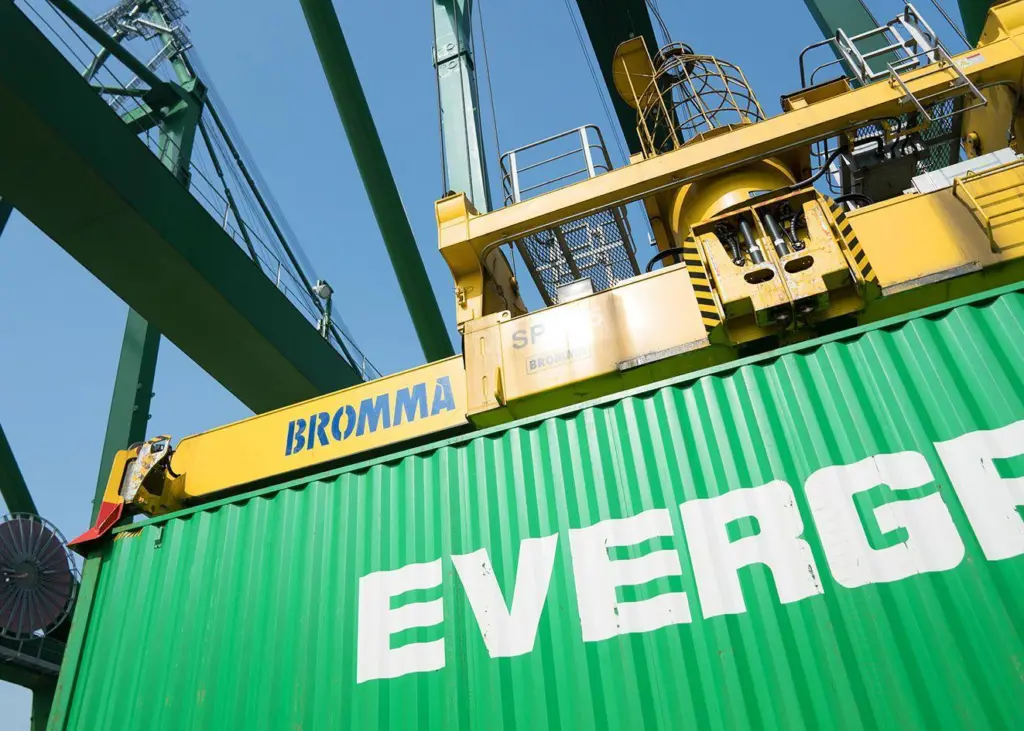
Bromma’s Tandem telescopic 40’/45′ spreader is also capable of handling different kinds of container sizes. It can twin lift 20´, 40´ or 45 ´ containers side by side in tandem mode, without having to change.
Potential Savings
BLOK Container Systems’ spreader works on the same principle, with the ability to lift and transport four empty shipping containers as a single block. As Selwyn Rowley, BLOK’s director of sales and marketing explained, this spreader hastens the container handling process while reducing congestion and emissions – and saving money. “Ports around the world handle 679 million containers annually of which around 24% are handled empty. Container terminals charge at least £100 and often much more per lift, so the potential savings created by being able to move four at a time rather than one unit can run into the billions.”
Bromma introduced its new Spreader Monitoring System, SMS at TOC Europe in June 2019. “Bromma SMS is a Cloud-based application that helps the terminal operators to understand the health of each spreader in their fleet,” explains Lars Meurling, Vice-President, Marketing, Bromma. “Monitoring fleet data, analysing performance and providing real-time dashboards with detailed information to operations and maintenance functions in the container terminal. The first commercial agreement is signed and a terminal in Europe is now starting to see the power and the benefits with the system.”
Elsewhere, Swedish Spreader manufacturer ELME Spreader launched 817 INNOVATION, its New Generation Spreader for laden container handling. The new design implies a lighter spreader with enhanced durability, increased life expectancy for structural parts, optimized hydraulic system and numerous other improvements. With the unique combination of 16% reduced weight and increased structural strength the spreader is estimated to have an increased life expectancy of 30 %.
Niklas Lefévre, Head of Sales and Marketing at ELME explained, “In general 817 INNOVATION is a stronger spreader when it comes to torsional stiffness. When we say we have a 30 % increased life expectancy, we relate that to fatigue resistance in standard load case conditions.”
Lefévre outlines further. “The reduced weight also enables opportunities for the reach stacker. One possibility is to increase the lifting capacity in second and third row and another to keep the same capacity but reduce the counter-weight and enable reduced axle load, tyre wear, fuel consumption and lower strain on the chassis.”
The spreader also brings forth another innovative item because 817 INNOVATION is equipped with lubrication free twist locks – a solution that will reduce the need for, and time spent on, maintenance.
Need to be Ready for the Rough
Increases in container weight, crane hoist speed and acceleration can all affect spreader usage. Pieter Verdonschot, Product Manager, Spreaders, VDL Container Systems, comments: “The spreader is one of the most vulnerable parts of the crane and is also the most heavily abused parts. This is not a good combination. However, our customers are aware of this and act accordingly. The robustness of the spreader is a heavily rated spreader topic.”
“The environment for port lifting equipment is getting rougher,” says Lars Meurling, adding, “Over the past 10 years, the average weight of a container has increased at the same time as crane hoisting speed and acceleration. This results in extra forces and strain on the equipment and especially on the spreader. Bromma continuously monitors and checks lifting classifications, given any new circumstance.”
RAM has come up with a solution to combat the heavy impact that the spreader is subjected to with its RAM ShockAbsorb product. This is an Impact Suppression System that prevents spreader damage, increases the longevity of the spreader, and reduces impact noise.
Higher Levels of Weight
Modern spreaders are designed to accommodate higher levels of weight. Modulift’s adjustable lifting/spreader beam has the ability to lift up to 27 tonnes. This includes a new clamp system which allows for lifting from different points, as well as a redesigned safety mechanism that makes it simpler for one person to perform the job and to slide and safely lock into place.
The right choice of spreader can make all the difference to crane operations. Selecting a cheaper spreader may save money in the short-term, but in the long run, it ends up costing far more. A sub-par spreader could potentially result in damage to the crane – causing a far heftier bill for either repairs or investment in a new model. As well as this, it is important to spend the money on maintaining the spreader. Cutting corners with spreader investment and maintenance results in far more problems. Bromma clearly understands the financial implications.
Lars Meurling says that the cost of a spreader is less than 2% of a quay crane, but the impact of a sub-standard spreader can be dramatic. “A common figure used is that 30-50% of quay crane downtime is related to the spreader. An investment in a high-quality spreader may be one of the most important decisions to take when investing in crane equipment.”
Cameron Hay concurs, explaining that the cost of a spreader is a tiny fraction of the cost of a crane breakdown and lost revenue and productivity. “Yet many terminal operators will opt for low cost spreader specifications or choose to not maintain them to the required standards.”
Hay says that this is counter-productive, and the breakdown of a crane will be detrimental to a port’s productivity, leading to a loss of revenue. “Though it is essential that ports maintain their cranes, they do overshadow a key ally to the container handling operation. A reliable and robust spreader is important for any port operation. If anything goes wrong with the machinery, this will inevitably cause a chain reaction that slows down operations.”
Interest in Hybrid Piggyback Spreaders
Spreader demand continues to grow for global container handling. Last year, VDL Container Systems supplied a hybrid piggyback spreader, which “combines the advantages of a fully electric spreader with the possibility of handling trailers.”
“Only when the spreader is in piggyback mode (handling trailers), then the powerpack is active,” explains Pieter Verdonschot. “When in Twist lock mode, the spreaders are operating fully electric, resulting in less energy consumption as well as less maintenance costs on the spreader.”
Bromma reports a sales and order intake increase from 2018 to 2019. Lars Meurling says that orders for crane spreaders grew by 32% and sales growth was even higher at 41%. “The magnitude of the growth is higher than market growth in general, which means that market share has increased.”
During the second half of 2019, Bromma won five large orders for green-field or capacity expansion projects. Meurling explains that each of these orders has been for between 10 and 30 all-electric YSX40E or YSX45E single-lift yard crane spreaders.
In addition, two major orders for respectively 10 and 12 STS45 quay crane spreaders were received for new capacity projects. In December 2019, Bromma received a major replacement spreader order of a total of 46 spreaders from a terminal in North America.
BLOK has continued to see demand for its products this year, with more trials for its spreader at a London container terminal. The BLOK spreader will be used to double the speed of loading and unloading the terminal’s empty containers.
Future is Remote Diagnosis
With regards to the future, Pieter Verdonschot says that remote diagnosis will become more and more important in order to monitor the status of the spreader continuously. “This will enable doing predictive maintenance in time and will reduce downtime.”
“Developments in the spreader market over the years has seen the progression from the standard single lift spreader, to the twin lift spreaders of today,” concludes Cameron Hay. “With the introduction of the tandem headblock, it represents one of the biggest developments in container handling since the introduction of the twin lift spreader.”
He concludes, “The natural progression is that within 10 years, all cranes in big terminals will be tandem as standard. We have seen the benefits of introducing tandem as part of our product portfolio, with a large number of units in operation and on the order books.”