The expression “safe harbour” is one that has taken a new meaning in recent months as the International Maritime Organisation (IMO) debates ‘safe harbours’ for ships in distress following the environmental catastrophe that occurred when the tanker PRESTIGE sank.
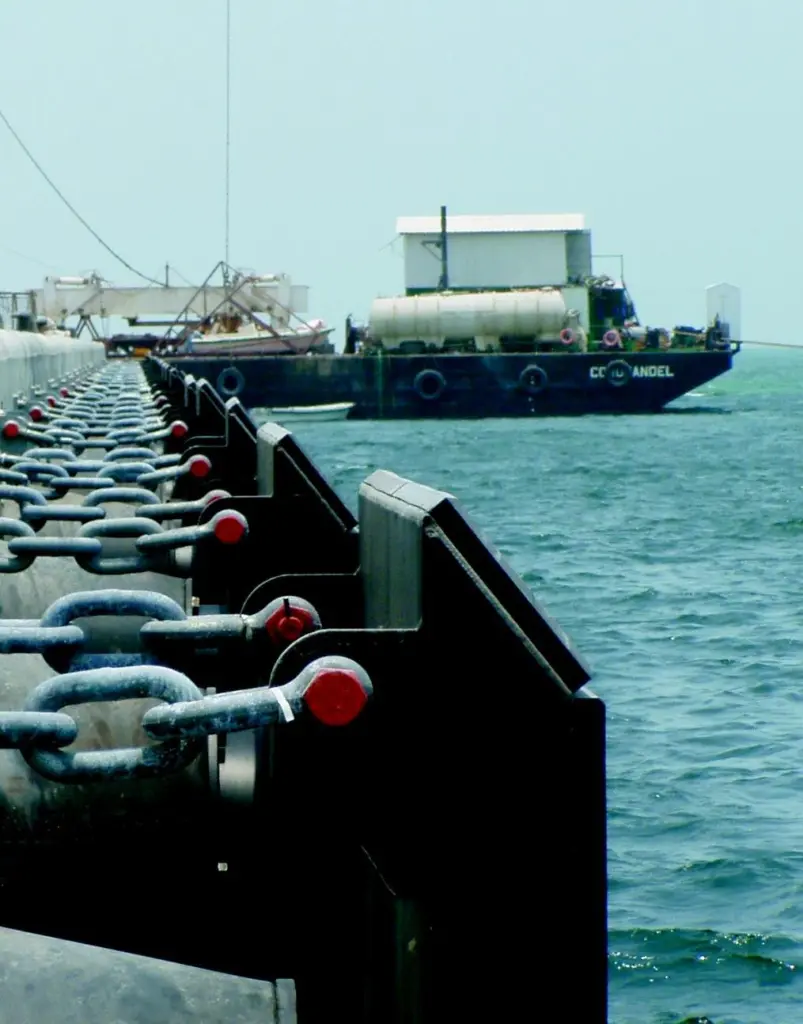
Of course, shipowners and operators need to know that a port or harbour is safe to use on a daily basis – not just in an emergency, and the fendering – which protects dock and ship alike from damage when coming to a berth – is a key part of a safe and efficient port.
Imagine a post-Panamax boxship or a VLCC coming alongside a berth – an effective fendering system has to absorb an enormous amount of energy, at the same time ensuring that only very low levels of pressure are exerted on the ship and the quayside. Then consider the range of ship types that the fender needs to protect – in many cases, a berth may be assigned exclusively to the use of one or two ship types, but in many cases, the fender system has to deal with ships of all types, and all shapes and sizes.
There is, then, much more to fender design than might meet the eye, and much that can go wrong if a fender system is poorly designed. Imagine the cost of an incident involving damage to a large vessel – or the downtime, and the cost to your operation if a berth is put out of action.
Fortunately, for a couple of years now, ports and harbours and fender manufacturers have had recommendations from the Permanent Association of International Navigation Congresses (PIANC) available to them, and a new ASTM standard is being put into practice in the US.
The fender business is notorious for ‘copy fenders’, poorly produced, badly manufactured copies of correctly designed fenders, so it pays to acquire a fendering system from a manufacturer that has invested time and money in developing fenders for specific applications, and one that is aware of the standards, and what they entail.
Even so, say manufacturers, although ports and harbours are increasingly aware of the difference between good and bad fender design, and the implications of getting it wrong, the temptation is always there to save money and acquire an off-the-shelf fender.
“Bad move, ” says Mike Harrison. Harrison is paid to sell fenders, and works for one of the leading fender companies, Fentek, which is part of the Trelleborg group, but an increasing number of ports seem to agree with him, and with representatives of the other major manufacturers, all of whom report that customers are increasingly interested not just in how much a fender system may cost to build and install, but what it’s likely to cost over its operating life, which could be 20-25 years, if well designed.
John Benson, UK sales manager at the Trellex fender division of Metso Minerals, says that, in his views, ports need to bear in mind that as the ships they handle evolve, so too should the design and construction of the fenders they use to handle them, a view Mike Harrison agrees with wholeheartedly.
PUSHING FOR PIANC STANDARD “Three or four years ago, Fentek was one of the companies pushing for the PIANC standard, ” Harrison told PS. “Its importance has been that, whereas as in the past port engineers who were specifying fenders and some of the companies that were manufacturing them, were falling down on the job, now it is harder to do so. Anyone can make a bit of rubber and call it a fender, but what needs to be borne in mind is that the design and construction of the steel panel to which it’s attached is every bit as important as the properties of the rubber.”
Fender companies like Fentek and Trellex/Metso like to talk about ‘fender systems’, and with good reason because a fender is a ‘system, ‘ and without due attention to issues such as corrosion margins for steel plates – which varies in different climates – an otherwise acceptable fender can fail quite quickly.
“There are still loopholes that a manufacturer can exploit if he wants to, to produce a copy fender, but if a port engineer makes himself aware of the PIANC guidelines and the ATSM standard, and other standards such as British Standard BS6349 (Part 4 of which covers design and construction of fendering), and cross-references those standards, he’ll be on the way to specifying a product that will last.”
John Classey, a sales engineer at Bridgestone Industrial’s UK headquarters, told PS that, apart from enhanced performance, ports and harbours are also looking for more durable fender systems, and increasingly, are considering the through-life costs of fender systems, as well as acquisition costs.
“More consideration is being given to the total cost of a fender system over its operational life, ” Classey explained. “Ports that are planning to operate a berth for 10-20 years will want to know how much fendering is going to cost them over that period” – in terms of maintenance, replacing components, costs associated with protective coatings for steel, for instance – “and they want to know that they are buying a durable fender with a long service life, rather than using cheaper, but less durable, fenders that, no doubt, will need replacing.”
In order to meet ports’ requirements for long-life fenders, says Classey, Bridgestone has developed a range of cell, cone and arch fenders which disperse the stresses throughout the fender by eliminating stress concentrations. This leads to greater durability and longer life. In addition, says Classey, fixing bolts are located away from the fender body, outside of the buckling zone, so that when the fender is compressed, the bolts cannot come into contact with – or damage – the fender. Moreover, he explained, the design of the fender is such that it provide a high level of energy absorption and low reaction force, whatever the ambient conditions, and whether the fender is being used in a hot climate or a cold one.
Fender design and construction may be a much more technical business than ports might credit, but this doesn’t mean that buying an expensive product is the only strategy that works – ask Port of Vancouver, the recipient of a recent award from the American Association of Port Authorities (AAPA).
The port was recently honored by the American Association of Port Authorities (AAPA) with an inaugural Facilities Engineering Award for the Small Project Category under $1m. The competition has been developed over the past two years by the AAPA’s Facilities Engineering Committee to recognize excellence, innovation and performance by port engineering professionals.
In October of last year Vancouver was recognised by the AAPA for the development and installation of a new cross-linked, ultra-high molecular weight polyethylene (UHMWPE) fender system designed not by a fender manufacturer, but by port staff and contractors.
Said to be the first fender of its type in the Canadian northwest, the project was recognised for “synergy between theoretical design and operational reality.”
Vancouver may have been taking a gamble deciding to design and build the fenders itself, but the gamble paid off – the performance of the fenders has been described as “outstanding” by the shipping companies that rely on it, and the project came in under budget and on time. Originally an experiment to test a different form of lower cost fender system, the UHMWPE design has proven to be both durable and affordable.
Part of a larger project, the aim of which was to upgrade Terminal 2 at the port, the cost of installing a replacement fender system was originally estimated to be in the order of (US)$374,000 to $1.5m.
The fenders the port was planning to replace were of a type that typically lasts 10-15 years – not long enough by port standards, so port engineers set about designing a new fender system that would withstand its intended use for much longer, and do so within a budget of around $262,000.
Working with consultants from KPFF Consulting Engineers, Berger ABAM, Advanced American Diving Services and Hickey Marine, Vancouver’s engineers chose UHMWPE for the face of the fender because it was the toughest material available. The strips of UHMWPE used in the design are moulded into ‘half-rounds’ and maintain the smooth edge of the pilings so that ships slide easily along the dock without damage. Typical flat wear strips have straight corners that scrape against ship hulls as they move back and forth along the docks.
Port of Vancouver’s director of facilities Ted Coleman said the port had been using the UMHW strips for some time, and they had proved to be a cost-effective method of protecting the docks. So pleased is Todd Coleman that the port now plans to use the fenders on all upgrades.