
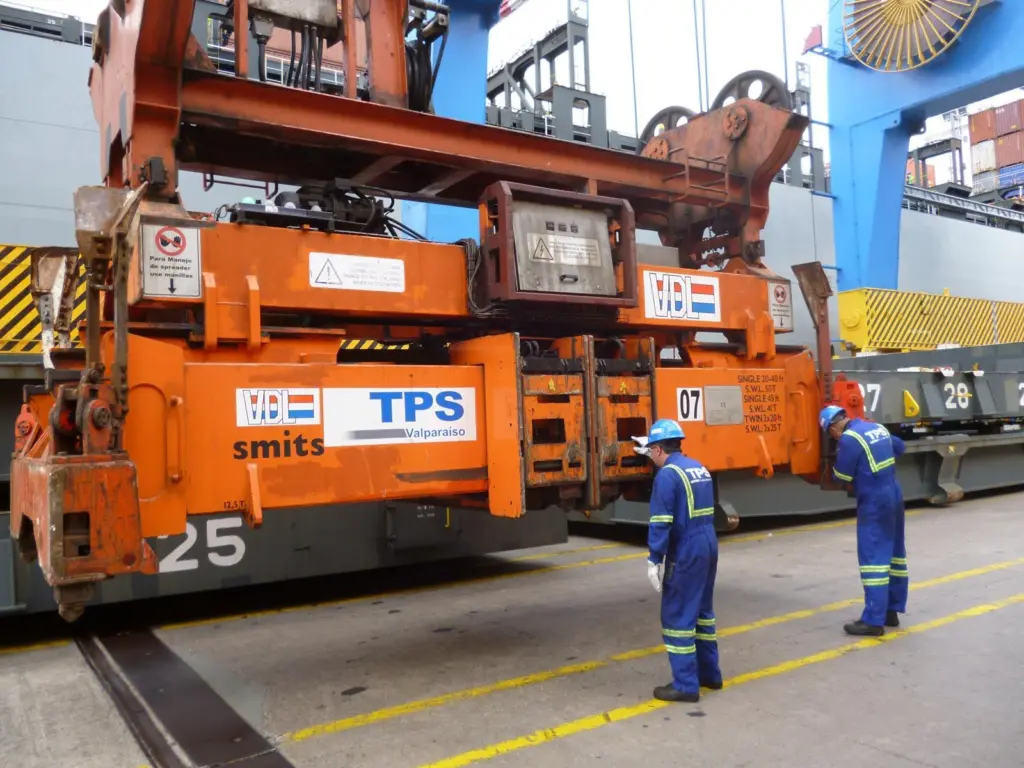
If a terminal has enough free time to repair faults or has sufficient back-up equipment so that operations are not prejudiced, then he says basic spreaders are OK.
However, if quick decisions need to be made to maintain continuity of handling, more sophisticated spreaders are called for that can locate faulty elements and communicate these to maintenance personnel, so they can be either fixed as quickly as possible in situ or replaced by a back up unit to ensure vessel operations are not negatively impacted.
“I don’t believe that a more sophisticated spreader results in more problems. It’s really a question of training personnel to operate it correctly,” he says. As for what exactly is nowadays on offer from spreader manufacturers, Mr Cisternas says that, in Chile, they still prefer to market a basic unit, allowing the customer to then choose ‘added extras’.
“However, if you look at the options they offer you, in reality, they are a necessary part of the whole, for example, height sensors and detectors for 20′ and 40′ containers. The ‘basic package’ therefore has to include these and they do add to the price,” he says, adding that it is also paramount to swap experiences with other ports to ensure the right spreader is bought.
Asked whether there is still a niche for a company offering only a basic spreader, Mr Cisternas says there is, although the potential customer base is eroding, since the so-called options are ever more necessary to ensure worker safety and also that of the cargo, thereby meeting shipping line expectations.
“It is possible to make a fast return on investment from a basic spreader model, but if that return is made at the expense of safety, it isn’t worth it. Furthermore, sophisticated spreaders incorporating the latest technology help decisions to be made much more quickly while downtime is reduced, which results in a better return on investment.”
Mr Cisternas notes that around 90% of crane downtime in the industry is a direct result of spreader failure. However, TPS has been able to achieve equipment availability in the region of 97%, with investment in self-diagnostic technology and in the better training of maintenance personnel.
“In my opinion, all spreader manufacturers selling into the quality market have similar levels of both technology and pricing. However, you can still get reasonably priced spreaders that offer high safety standards and good operational availability,” he says, adding that terminals shouldn’t shy away from technology, as long as it is well known and tested.