Heavy duty reachstackers have been sold into intermodal terminals often without too much thought as to how efficiently they work or how economically they perform, but how often are light weight straddle carriers a better, longer term financial consideration?
“Intermodal terminals, unlike box terminals in major ports, are competing at lower returns per containers; it is therefore essential to reduce the overall cost per container handled,” says business development manager, Eric Ronco, of Australian manufacturer Isoloader. He says this cannot in general be achieved with reachstackers.
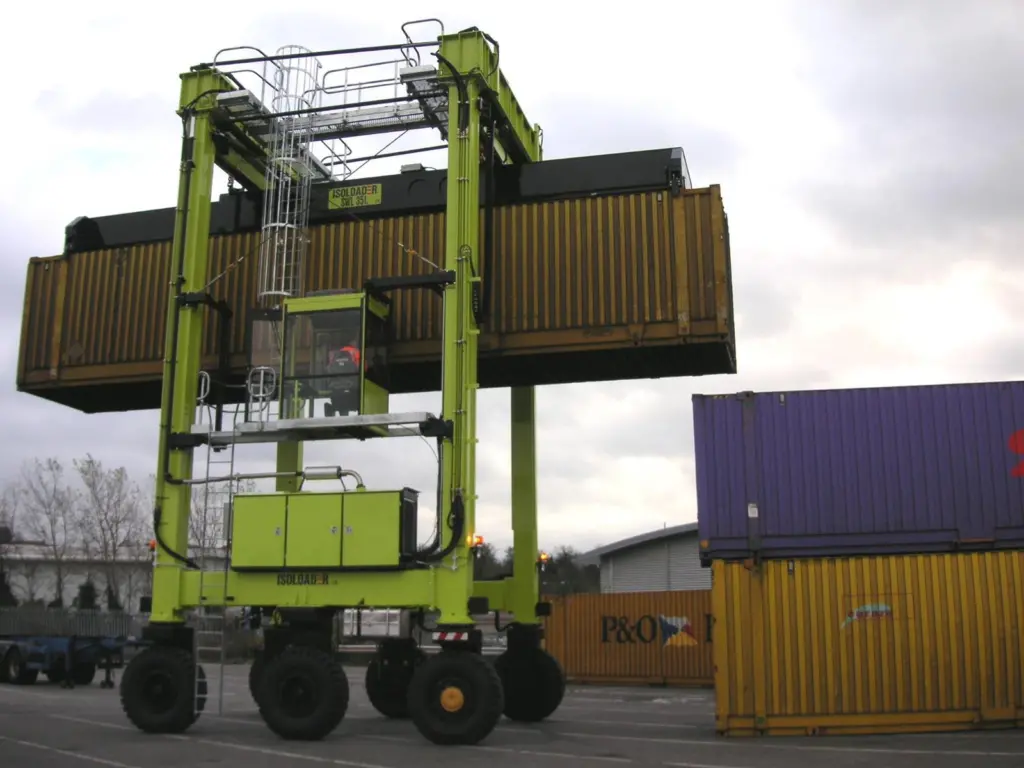
Isoloader’s last remaining reachstacker model is really a niche product. Its reduced wheel loading capability makes it ideal to actually work on board moored barges, or even operate from a rail wagon. While Ronco concurs that this model is suitable for very specific applications, he says it should not nowadays be viewed as reflecting Isoloader’s central philosophy of providing equipment to the intermodal market, where straddle carriers appear to be the perfect fit.
However, there is no such thing as a straddle carrier adapted to operate in all terminal environments, he says. Most manufacturers nevertheless concentrate on designing machines suitable for large container handling environments. Isoloader, in contrast, has looked elsewhere.
“We have concentrated on providing solutions for smaller volume businesses, such as river ports, dry ports, transport yards and warehouses, where operating economies are absolutely crucial,” says Mr Ronco.
The company’s largest straddle carrier has been designed to operate up to 20% more efficiently, because its structure is lighter and power output less. It achieves this by having a hydrostatic drive through hydraulic wheel motors. By avoiding direct drive of the diesel engine to increase power, fuel consumption is less and CO² emissions is reduced.
The light weight nature of the machines means they do virtually no damage to the paving over which they run, even where it is just compacted ground. This is crucial since one of the major costs faced by all terminals is in the installation of good quality pavement in the stacking area. In contrast, reachstackers generate high wheel loads and this can have a negative impact on the surfaces over which they run.
“Our straddle carriers can be an effective alternative to most reachstackers, because they generate a wheel load of no more than 15 tonnes even when transporting loads of up to 35 tonnes. This compares to a minimum wheel loading of 50 tonnes for a 35-tonne reach stacker,” says Mr Ronco.
He claims that an Isoloader straddle carrier capable of stacking two boxes high will therefore generate just two-thirds of the running and maintenance costs of a comparable reachstacker, while also being able to store 30% more containers.
Mr Ronco argues that, if intermodal terminals still want to operate reachstackers, then they are faced with three alternatives: invest in very solid pavement, which implies a ¢30 ($43.4) per square metre price premium compared with pavements adapted for lower wheel loads; be faced with ongoing repairs to their pavement; or continue to partially operate on a poor pavement, with all the negative implications this has for increasing equipment life cycle costs.
Reachstacker drivers also have a reputation for engaging full power virtually all the time to get jobs done as fast as possible. Straddle carrier drivers, in contrast, are taught to drive smoothly and manoeuvre with precision. This leads to a more comfortable drive, lower fuel consumption and a reduction in the number of incidents that take place.
Overall, there is little difference between the average life of an Isoloader straddle carrier and that of a conventional straddle carrier. However, because these larger machines are designed to work up to 30% more intensively, lighter weight straddle carriers compare favourably in terms of capital outlay, running costs and maintenance costs. This makes them a much better bet for lower volume operators, where intensive handling is not a necessity, but cost is an issue.
“After sales support is provided by local companies that we train and supervise. Unlike other manufacturers, we do provide the customer with a full list of spare parts for the machine, which allows them to source these quite independently if they want. We earn our money on machine sales not on spare parts,” says Mr Ronco.