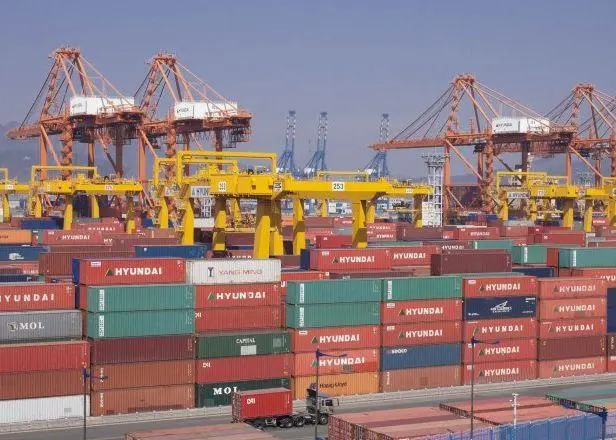
A newly-released Study* identifies the primary areas where key performance indicators (KPIs) can be applied with ship-to-shore (STS) container crane operations in order to optimise performance and reduce costs.
The Study – has been co-authored by Jung-Hyun J (Department of Maintenance and Repair, Hutchison Port Busan) and Sihyun Kim (Department of Logistics, Korea Maritime and Ocean University) and was released in December 2020.
APPROACH, DATA AND FOCUS
Data was collected from 14 STS cranes located at Hutchison Korea Terminals (HKT) between 2013 and 2018. It was then collated into 19 different crane performance calculations and applicable key measures such as total time for preventative maintenance, emergency maintenance, time taken for twistlock activities, hoist/trolley actions and all other elements of the container-handling cycle by an STS unit.
This information enabled key outputs of the actual time worked by each crane. Allied to this was the man-hour component, namely the amount of work performed by the average worker in one hour, which, in turn, allowed the calculation for an estimation of the total amount of uninterrupted labour required to perform a task. Man-hours excluded the breaks that a crane operator takes such as rest, refreshment, etc.
The content and conclusions of this Study are focused in two key areas – what the authors regard as the “Representative and the most import indicators for container terminals,” namely:
1. MTTR – Mean Time to Repair – this KPI indicates the efforts by the engineering department at a container terminal to reduce this element. The Study authors underline that this requires technical workers to have the requisite expertise and skills, and general grasp of the characteristics of the equipment on a crane in ongoing use.
2. MMBF – Mean Movements Between Failure – this KPI measures how much time and resource the engineering department invests in preventative maintenance.
MAN-HOURS AND MAINTENANCE RISING
The authors note that a key industry-wide trend is an increase in the maintenance requirement and man hours spent in conjunction with STS cranes. This is attributed to a combination of a rise in heavy load operations and increased volume/throughput at terminals.
In terms of the assessment approach, the Study explains that it undertakes a calculation of both MTTR and MMBF based on hours accumulated through the motion of a crane, without the “intervention of humans” which it then says allows a better understanding of the time spent on equipment maintenance.
POTENTIAL BENEFITS – COST SAVINGS
In terms of the potential benefits that can be derived as a result of applying the KPIs, the Study concludes that these are obtainable on an individual container terminal basis. “If each container terminal produces results on a monthly basis by setting target figures for MMBF and MTTR, it could identify from month to month decreases in MMBF based on actions taken.
“MTTR would identify which areas have experienced multiple failures and this allows corrective action to be taken so that there will be no disruption to the vessel operation and the intended productivity of the vessel operation,” explain the authors.
In addition, it is pointed out that appropriate placement of manpower can ultimately lead to cost-savings. They underline: “MMBF and MTTR are directly related to manhours. Dispatching manpower to the right place where preventative and/or emergency maintenance is required, backed by data analysis correctly predicting resource requirements, ultimately facilitates cost savings.”
Increased output as a result of increased crane reliability due to effective maintenance represent a winning combination for terminal operators.
Citation: Jo, J.-H.; Kim, S. *Key Performance Indicator Development for Ship-to-Shore Crane Performance Assessment in Container Terminal Operations. J. Mar. Sci. Eng. 2020