
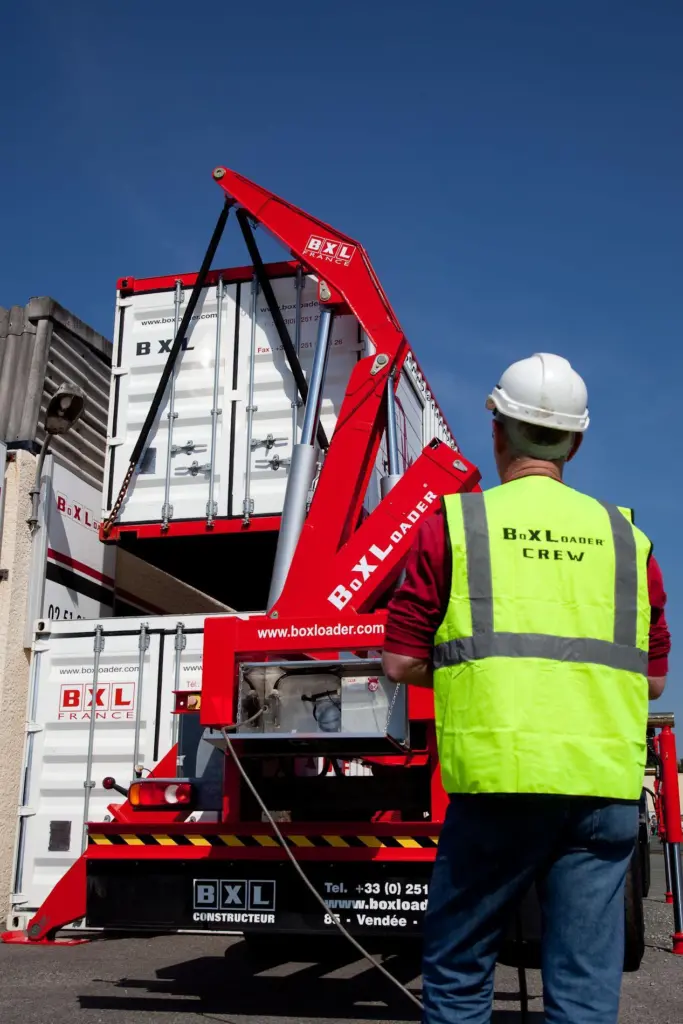
Sidelifters are certainly viewed as a niche product when compared with traditional kit such as rubber-tyred gantry cranes, reachstackers or straddle carriers. But according to manufacturers, there are a growing number of niche opportunities for sidelifters – providing a cheaper alternative to more mainstream equipment for very small operations, or complementing that equipment in larger ports.
“Sidelifters have seen a huge success in the port/terminal environment,” says Susan Tattersall, marketing coordinator at New Zealand’s Steelbro. “There are significant benefits to shippers, when packing containers safely at ground level, as well as huge benefits for the container terminal operator who often needs to switch from one mode of transport to another economically.”
A sidelifter is defined as a purpose-built semi-trailer on which a specially designed set of cranes are mounted, to lift and transport containers. Sidelifter cranes can also be mounted on a truck deck for handling 20ft containers.
Steelbro has 3,000 sidelifters in operation in more than 100 countries and Ms Tattersall says sidelifters have changed the way containers are being handled in the port environment.
“This technology is providing the user with massive savings, efficiencies and added flexibility to port terminal operations,” she says. “The equipment can be used to support a number of different operations. Shipping containers can be rapidly transferred from one terminal to another, using a truck and sidelifter. The truck is quicker than traditional container handling equipment such as reachstackers and forklifts and is compulsory if the road between terminals is a public road. When the port is congested, the sidelifter can be used to manage the dry port outside the port, loading and unloading skeletal trailers.”
Sidelifters can also be used to transfer containers between train and quay, across the port, or inside a warehouse, adds Ms Tattersall. “The sidelifter will also handle the lifting, loading and delivery of oversize loads on a flat rack container.”
Hauliers who arrive at the port with a sidelifter can lift on or off their own container without the need for port equipment; some ports even have their own dedicated sidelifter delivery area, she adds.
“The benefit to the haulier is much faster vehicle turnaround time – avoiding the queues and time waiting to be serviced by a straddle carrier or reachstacker.”
Emmanuel Fafournoux, sales and marketing manager for the French manufacturer Boxloader, agrees: “Although sidelifters are not widely used in terminals and ports when compared to RTGs, reachstackers and straddle carriers, they can find their place as a complementary tool allowing transport companies to drop/pick up containers in dedicated areas,” he says. “This is already the case in some Scandinavian ports such as Oslo or Gothenburg, or in the French West Indies, for example. This reduces the waiting time for transport companies that generally depend on the availability of the cargo handling equipment.
“The cost is very competitive – about one-third of the cost of a reachstacker,” he adds. “The space is more or less the space of the cargo itself, plus the tractor truck, and no special ground reinforcement is required.”
Smaller ports, especially on some of the smaller islands, find that a sidelifter can handle container throughput without the use of other equipment, says Ms Tattersall. “Traditional container handling equipment can prove to be too expensive to purchase, set up, operate and maintain. In some cases, the reachstacker can’t actually do the job – this is often the case when the ground is not concreted or not stable enough to accommodate the very heavy reachstacker. A large expanse of reinforced concrete is required [for traditional kit], which is a major consideration. The sidelifter, however, is capable of operating directly on uneven ground which hasn’t been concreted.”
Mr Fafournoux adds: “For small ports with not intensive operations, a sidelifter could be used. It would be interesting to equip it with a toplift spreader. However, if space limits require three-high stacking or more, then the sidelifter is out.”
A good example of this kind of use is the way that Consolidated Fisheries Ltd (CFL) operates two Boxloader units with spreader for moving containers in Port Stanley in the Falkland Islands, he says. Another example is Arianespace in French Guyana, where a Boxloader handles the containerised cargo which arrives on the specialist vessel Kourou. “The port is made only to receive these operations, with all other cargo coming to Cayenne, the territory’s main port.”
Sideloaders could also be used when a Customs visit has to be carried out in a special yard which is not suitable for a reachstacker, adds Mr Fafournoux. And they would be particularly useful in small dryport operations such as privately managed yards.
“Customers from rail forwarders to trucking fleet operators and logistics companies are realising the practical and economic advantages of sidelifter technology,” says Ms Tattersall. “Since containers can also be placed anywhere the sidelifter unit can access, the sidelifter unit will operate in any port environment – whether a small emerging port in the developing world or more established ports in the more developed economies.”
She adds: “In medium or large-size ports, the sidelifter is unlikely to completely replace the reachstacker or straddle carrier but supplement that equipment and help with other jobs in the port area.”
Mr Fafournoux says that while sideloaders are gaining in popularity as a complementary too, this is still a niche market, with around 500 units being sold each year, and the concept still not very well known. “Moreover, it is not an obvious choice for an inexperienced operator,” he says. The main demand is in Australia, Scandinavia, Africa and island territories.