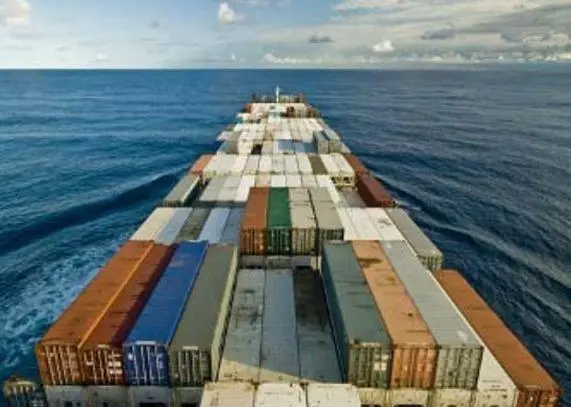
With the fallout from COVID-19 really now hurting the container liner industry, including substantial blanked sailings for the short-term, at least, the option of sailing from Asia to Europe via the Cape of Good Hope may suddenly look like an attractive option – but why is this?
In the early weeks of April, the Shanghai Shipping Exchange confirmed that container ship utilisation rates from Asia to North America and North Europe were running at around 85%, a decrease of around 10% from the position just a week or two earlier.
The extent of the issue is clear to see. In recent weeks, THE Alliance announced additional Asia-Europe blank sailings, bringing total cancellations in April and the start of May to seven (of a planned 25 sailings) and eight for Asia – Mediterranean (of a planned 15), which was soon followed by temporarily merging the Asia – North Europe services FE2 and FE4 into a single loop (FE2) for the entirety of both May and June.
Similarly, the 2M Alliance has suspended its Asia – North Europe AE-2/Swan service and Asia – Mediterranean AE-20/ Dragon string for all of the second quarter.
So, any ability to deploy ships rather than lay-up is to be welcomed, as Associate Director at WSP, Steve Wray confirmed. “These are exceptional times and it is a matter of looking at every conceivable option to get through the challenging, short-term difficulties,” he stated.
VIA THE CAPE OF GOOD HOPE IS NOT NEW
The idea of sailing via the Cape of Good Hope is not new, but it has occurred on regular occasions in the past. Notably, it happened in the past when a raft of extra tonnage of ships were introduced and were difficult to place, albeit that was in 2016 and not since and before that in 2012 when a similar issue occurred and there were concerns about Suez Canal transits and costs.
CMA CGM first commenced with this sailing option on its FAL-1 service, with the 16,0202 TEU CMA CGM Alexander Humboldt choosing to navigate along the West Coast of Africa after departing from Algeciras, Spain, with the next scheduled port of call being Port Klang in Malaysia.
At the same time, the 15,000 TEU CMA CGM Chile was sailing via the Indian Ocean to Le Havre via the Cape of Good hope on a westbound sailing, as Wray confirms. “With our analysis partnerships, we can utilise AIS satellite data to track the route vessels are taking and we are seeing use of the Cape of Good Hope instead of the Suez Canal.”
He makes another useful point, too, that really helps to explain the current position. “Oil prices are currently low. So, while the route adopted by the CMA CGM vessels is around 3,000 nautical miles longer the savings from avoiding the Suez Canal tolls make it a worthwhile option.”
With Suez Canal Authority tolls for the sizes of ships shifted by CMA CGM up to US$500,000 per transit, if not more, then the additional days in the sailing schedule, if around five, would likely see extra fuel costs of, approximately, US$250,000 per ship. While these are only approximate numbers, they do prove the point that this is a tremendous saving greater than any current discount scheme that the Suez Canal Authority is believed to have had in force until May 2020.
Add to this cost equation the additional, but secondary, benefit of deploying a ship but without incurring more cost then the concept may indeed make some sense.
SUEZ CANAL AUTHORITY REACTS
Of course, the Suez Canal Authority has reacted, as expected. In an effort to keep container vessels transiting its waterway the authority has already cut its vessel transit rates, by up to 75 per cent for some ships.
However, the discount is not uniform and does apply different by trade route. For example, vessels heading east from the East Coast of North America will obtain a full 75 per cent discount, while ships from North Europe, Algeciras and Tangiers will receive a much more modest 17 per cent cut. For vessels operating out of Northwest Europe will be offered a small 6 per cent cut in fees.
At present, the reductions will be applied between May 1 and June 30, 2020. However, it is reasonable to assume that the Suez Canal Authority may consider extending the discount programme, subject to the strategic decisions taking by the liner industry, itself primarily driven by the price of oil.
It is understandable why the Suez Canal Authority has had to act, as Wray confirms. “We estimate that the Suez Canal Authority could potentially lose substantial revenues in the region of US$10 million as a result of this change in strategy of some of the major shipping lines and Alliance groupings. The low oil bunker prices, availability of ship capacity and weaker European demand simply make it a much more viable option at the moment.”
One other potential upside could be the opportunity to make calls en-route to West Africa and South Africa and major African ports will be hoping that they too can benefit from the current trend.
OTHER LINES FOLLOWING CMA CGM APPROACH
With substantial experience in serving the African continent, then once again the Cape of Good Hope option makes sense for CMA CGM, as it does for other major operators also already serving the West and Southern African markets.
Consequently, in addition to CMA CGM and OCEAN Alliance sailings, other operators including COSCO, Evergreen, Mediterranean Shipping Co (MSC) and the ONE grouping have also all chosen to route their shops via the Cape of God Hope on a combination of Europe-Asia and East Coast of North America to Asia backhaul runs.
Clearly, the critical driving factor will remain the price of oil. This is a sailing route that only really makes financial sense while oil prices are lower.
As Wray points out, “It really is a cost comparison equation, of fuel costs versus Canal costs, While the price of oil remains lower, then the Cape of Good Hope could well remain in favour. On this basis, it is not surprising that other shipping lines are following the lead taken by CMA CGM.”