European offshore wind power has reached the heady heights of 10GW and other regions are ready to invest in a push their wind power projects ahead. Both are good news for ports that can serve the construction and the operations stages of wind power projects, on or offshore.
Dan Kyle Spearman of the UK’s Carbon Trust believes new offshore wind deployment hubs will soon take off after overcoming initial teething troubles, especially now that the size and requirements of the components and ships are better known. “Although there was an initial scaling up, it’s settled, at least for the present generation… as far as length and depth are concerned the quay requirements are large, but not massive,” he says. Two installation vessels recently working on Germany’s large Gode Wind project both needed several metres of draft alongside, but while one measured just 60m, the other was 132m in length.
Therefore, significant numbers of mid-sized facilities look set to benefit from the rising global interest in all things wind.
While in Northern Europe the market is fairly mature and dominated by ports like Bremerhaven, further south there’s still room to get into the game. Nantes St Nazaire is deploying an E80m investment, supported by local and central government grants, to join up the dots for a cluster of wind industry plants that are either on or within yards of its Loire river-linked facilities in Le Carnet, Montoir de Bretagne and St Nazaire. The idea is to provide an integrated flow for components produced by makers such as STX and Alstom, all the way out into two new, large Atlantic French wind farm projects.
Maryse Gérard, commercial manager for the port, explains that coming into the market a little later has allowed the port to benefit from both manufacturers’ and other facilities’ experience. This ‘experience’ includes knowledge on how much strengthening is necessary for these huge components: while nacelles can now weigh up to 400 tonnes apiece there is also the jacket foundation and its three attendant 30m piles which together total a massive 1,000 tonnes per tower, resulting in quay support designed to 15 tonnes per square metre.
Firm footing
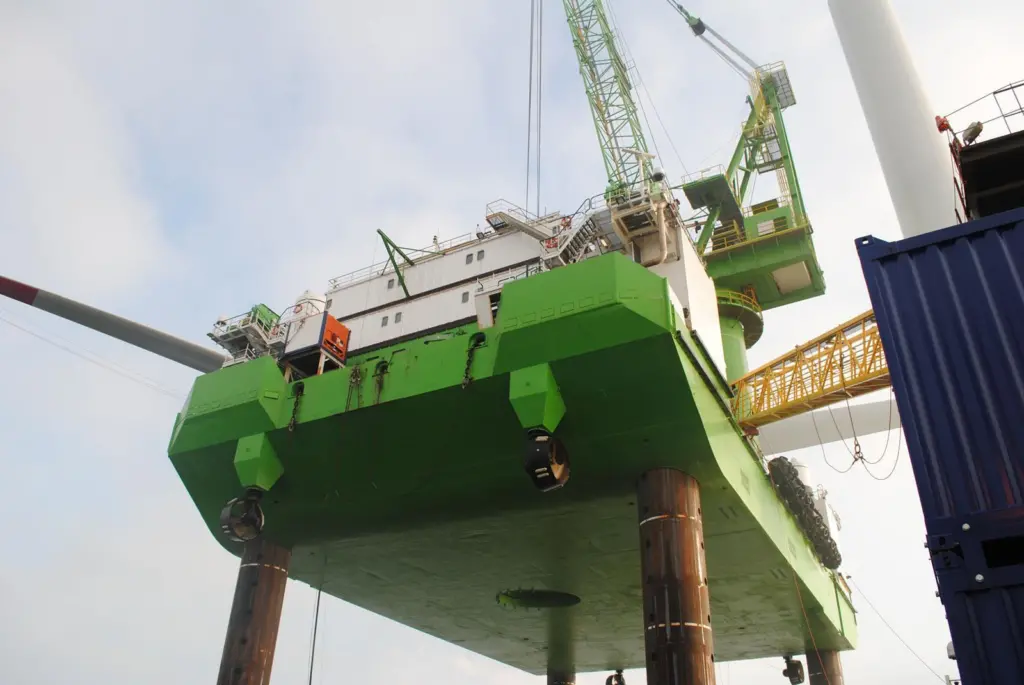
Other practical problems lurk on the seabed: Mr Spearman explains that wind farm installation vessels or jackup barges usually want to put their feet down to provide a stable platform for load out, especially given very heavy components.
The actual feet can present a problem here. “Since their legs usually end in spud-can ‘shoes’, jackups can’t stand up on a rocky surface without risk,” says Mr Spearman. Further, the thousands of tonnes of pressure exerted by each of the jackup’s feet as it presses down is followed by a huge release of force on retraction, potentially undermining the quay’s own footings. Nantes Saint-Nazaire Port’s clever answer for loading is flooding an old drydock in order to provide a strong, even bottom, although the side will still need some reinforcing.
However, it is what happens in the yard that is critical: “Space has been the biggest challenge for us,” says Ms Gérard, explaining that St Nazaire has tied up a 12ha area for the reception, storage and pre-assembly of turbine components, not easy in a port that already has a good number of ro-ro, container and other activities going on.
It’s a point picked up by Mauricio de Lejarza, director of Acciona Forwarding who puts wind components through Bilbao for export: “Even the blades, which are quite light, are over 70m long so you can’t bring them in to the port inside a day. They arrive at night during the previous month or so and you need storage areas to collect them together.” Then there’s the transfer to quay for crane pick up: “The blades are, for their size, quite fragile and if a tip hits anything it will have to go back to the factory again, so you need a wide, free area to manoeuvre.” Further, their attendant nacelles often travel over 500km to get to port, requiring advance permits and police co-operation at every point along the way.
On the positive side, it seems that unlike fickle transhipment cargo, wind cargo will tend to stick with good service. The logistics “needs a very experienced, familiar team at the port”, says Mr Lejarza – and Acciona for one prefers to stick with continuity.
All this means ports need make sure they are investment-ready, but given swathes of political and economic uncertainty, the future remains unpredictable.
Therefore in St Nazaire, ‘strategy’ has been refined alongside the practicalities, says Ms Gérard. “In this economic climate, we have to be careful and tailor each step to what’s actually needed: so, we will, for example, be asking exactly where the 15 tonnes per metre strengthening is required on our new 350m quay, not simply go ahead for the whole length.” And, Ms Gerard adds, the port won’t be investing too much too soon in things that have not yet shown themselves a necessity – though she admits it’s a fine balance.
American disconnect
In the US, offshore wind is proving a tough call: ‘disconnection’ is probably the best way to describe the present state of play. This not only covers the disconnection between the generated power and gaining the essential, fixed return for it – Republican opposition to pricing being a regular feature even for established onshore wind – but also disconnection between state and federal bureaucracy on leases and contracts. There’s also a disconnection between the Obama administration’s ambitions, vested interests and outright nimby-ism: Judge Richard Stearns dismissed the 26th lawsuit against the Cape Winds project with the comment: “There comes a point at which the right to litigate can become a vexatious abuse of the democratic process.” However, the project, at one point expected to be America’s first, still lies tangled in a web of local politics and isn’t, as yet, moving.
So, while this summer saw Rhode Island’s Deepwater Wind begin installing the foundations for North America’s first offshore wind farm, the trickle from this tiny, five turbine, 30-megawatt project probably won’t turn into a flood of interest all at once – although Chris Elkinton of DNV GL is “hopeful and expectant” of more.
He points out many facilities might find it worthwhile to keep an open mind. While big ports could decide to climb on the bandwagon when it finally sets off, there’s not the usual tilted table, “so smaller ports could well compete with larger ones, and they might find offshore wind provides them with a golden opportunity”.
Of course there are challenges: “A typical US port is designed for other industries, so while they might be doing a great job, offshore wind has more stringent requirements especially related to ground bearing strength… it’s just not the containers or bulk cargo that most US ports are used to seeing.”
Despite this, a couple of facilities have already taken the plunge: New Bedford in Massachusetts to the tune of $100m and Paulsboro, New Jersey with $200m – with state support. Unfortunately, uncertainty still rules: New Bedford was looking to Cape Wind’s 130-turbine proposition, while Paulsboro was readying itself for developments off the coast of Delaware, New Jersey and maybe Maryland, projects which have proven themselves to be “still a few years away”, explains Mr Elkinton. However, he underscores the point that “neither port would have gone ahead unless there were other industries that could also make use of the upgrades”.
So he says at present US ports “are watching, excited… but still waiting for demand to come through”.
Wind-ready workarounds for ports
The way to accomplish a ‘wind-ready’ port isn’t set in stone and DNV GL’s Chris Elkinton says: “We’ve seen a lot of ingenuity used to make something workable.”
He points out one of the heaviest things to move is a nacelle or monopile. “There are two ways to accomplish this, you can go for a ‘superstrong’ answer as the US port of New Bedford did: they wanted a loaded crawler crane to have almost unrestricted movement.
“However, a port can also be clever about spreading the load. For example, if self-propelled modular transporters are going to be used, there’s the potential of adding more wheels to them, for instance having 30 pairs underneath to take the weight instead of 20.” Further, he explains that a facility could decide to go for a tandem lift of heavy components instead of investing in one big crane, although it takes careful operation. “Even simple things like wood cribbing underneath the cranes helps spread the load,” he adds.
In other words, a little ingenuity comes in handy when a port starts to choose what it’s going to spend its wind-ready money on.