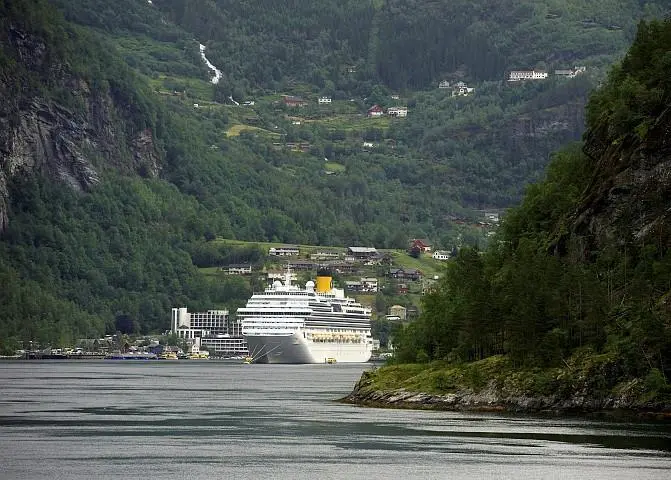
The Norwegian Maritime Authority (NMA) said that following the first cruise season with new regulations for Norway’s fjords, harbourmasters on the fjords have received fewer complaints about smoke, but are backing “stricter regulations”.
Regulations for vessel traffic in the Nerøyfjord, Aurlandsfjord, Geirangerfjord, Sunnylvsfjord and Tafjord were tightened on 1 January this year. A prior study undertaken by the NMA concluded that stricter measures needed to be taken to reduce the emissions of nitrogen oxides (NOx) and sulphur oxides (SOx) in particular. The harbourmasters agree the regulations are seen as positive, important and reasonable, said the NMA.
“We only have one objection: they are not strict enough,” said Rita Berstad Maraak, harbourmaster in Stranda municipality.
She added that taking care of the Norwegian fjords is a national concern, and that the measures should be made applicable to all Norwegian territorial waters to ensure that emissions don’t simply shift elsewhere.
Making actions clearer
Jostein Lange Bergset, harbourmaster in Flåm, pointed out there has been less visible smoke this summer, but also that it is difficult to distinguish legal fumes from those that should not have been emitted in the first place.
“We have reported the examples that we have observed, but fortunately it seems that there has been less really nasty smoke this season,” he said.
He adds that the rules enacted this year are manageable for everybody, though the focus is now more on future regulations.
The regulations will be gradually tightened over a five-year period, in order to enable the cruise industry to conform to the increasingly strict requirements. The IMO’s 0.5% sulphur cap will enforceable from 1 January 2020. A further tightening will come in 2022, while the strictest requirement regarding NOx emissions will be introduced in 2025. This will entail an 80% reduction in NOx emissions, which will require good exhaust gas treatment systems or alternative fuels.
“Although we have seen improvements already this year, the major gains will come in the years ahead,” said Bjørn Pedersen, head of the department of legislation and international relations in the Norwegian Maritime Authority. “We are therefore now considering the possibility of introducing stricter environmental requirements for shipping in Norwegian waters in general, not only in the world heritage fjords.”