Professor Alf Baird of the Transport Research Institute (TRI), Edinburgh Napier University says: “It has become a truism that longer sea routes means less CO2, but while the bigger, longer operations do actually give a net benefit, when you look at some island ferry routes using smaller vessels, such as going from Aberdeen to Orkney, the reality is that taking the longer road route for the largest slice of the journey followed by a very short sea crossing over the Pentland Firth is more efficient and creates less carbon than taking a longer route by sea. In fact, even flying by air is less polluting.”
The conclusion comes as a result of a recent study carried out by TRI on the Scottish Island routes.
The study, when all the numbers came in, showed the land transport options followed by a very short ferry crossing combined with a longer road route came out some 10 times more CO2 efficient – despite heavy public subsidies pushing people to go via the much longer Aberdeen ferry.
Prof Baird explains that this is because the modest sized ferries typically used on the Scottish Island trades, have a single freight and car deck, plus one or two decks for passengers. However, the small 450 lane metre ferries serving the Aberdeen-Orkney route actually have the same engine power (about 20 Mw) as the largest 4,500 lane metre DFDS ships running between Tilbury or Immingham to Gothenburg, and use the same heavier polluting Heavy Fuel Oil (HFO), not the lighter, cleaner Marine Diesel Oil (MDO) that lower-powered boats use.
Hydrodynamics and the bow shape
A lot of the problem lies in the hydrodynamics and the bow shape, says Prof Baird. “From a naval architect’s point of view, this is a major part of the fuel to mile equation. The ship’s length doesn’t matter anywhere near as much, indeed longer vessels offer greater efficiency. The problem with small island ferries like those serving Aberdeen is that they need a very high power in order to achieve over 20 knots, yet are only specified with a single freight deck, and a short length so that they fit into Aberdeen harbour,” he points out; “so essentially much of the subsidy is going up the funnel in fuel and this means that, for smaller ferries, land transport by truck or car is far more efficient per kilometre than sea transport.”
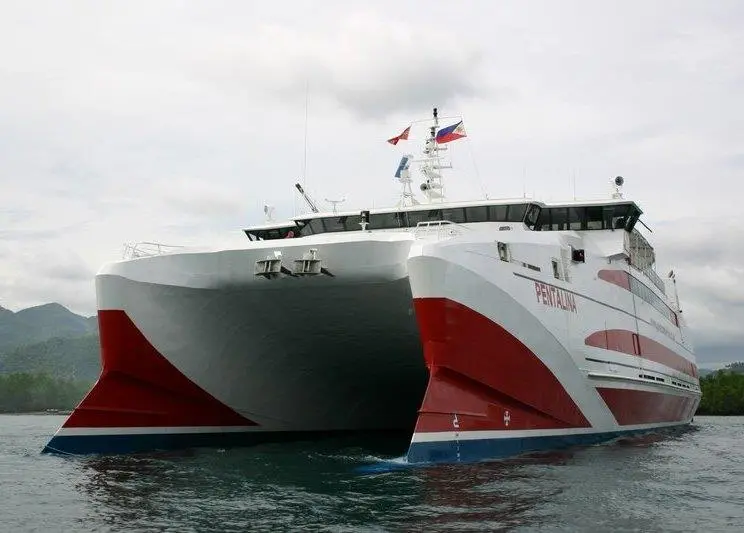
By contrast the MV Pentalina operated by Pentland Ferries, which runs the short route from Caithness to Orkney, is a medium speed catamaran with an extremely fine hull form which helps reduce resistance and lowers the amount of power needed.
A vessel’s tailoring for its purpose is particularly relevant. In the case of the Pentalina, Sea Transport Solutions came up with a design which is able to operate in very exposed conditions in the North Sea. For example it has been designed with a high tunnel under the bridge to prevent slamming.
This vessel operates on a shorter and hence much higher frequency service than the longer Aberdeen routes, and when the numbers are crunched both CO2 and outright cost savings despite the combined longer road travel and shorter sea run are obvious – plus the medium speed catamaran’s capital cost (just £7 million compared with the Aberdeen monohulls’ cost of £31 million each) is only around a quarter of its longer-route competitors who employ expensively fitted out monohulls.
Further, the latter ferries are owned by Royal Bank of Scotland and leased to the Scottish Government under a long term 18-year ‘PFI-type’ deal, which is enormously expensive (i.e. costing over £100 million over the 18-year period just for the lease payments on two ships).
Competing against subsidised operations
“The shorter Pentland Ferries route competes against subsidised operations and still comes out ahead, and is now carrying most of the accompanied car traffic to Orkney and a large share of the freight traffic,” says Prof Baird. “Operating costs are kept down, partly because crew costs are lower, as well as low fuel costs – the crew goes home at night, which should be the norm for most Scottish ferries operating on relatively short routes, and the ferry plugs into cleaner shore side power overnight. Lower capital and operating costs means no subsidy is needed.”
Norwegian operators, says Prof Baird, caught on to this a long time ago, and have sought to minimise much of the sea-going part of the journey, limiting ferries to short hop distances across the fjords of just a couple of miles while upping the frequency and putting in investment to better connect the road systems with these routes.
It’s not just the Norwegians. A new Philippine venture has just ordered ten of the same vessel design as the Pentalina. Prof Baird explains in the wake of a number of terrible ferry disasters in the country, a new operator, Archipelago Ferries, has been set up by shipping interests with finance through the World Bank. “The previous routes were very long and tended to use older, Japanese ferries that were then overloaded.” Now the idea is to link up the islands and where possible keep the ferries to short, frequent connections, like the Orkney and Pentland hops, which will improve safety and hopefully minimise the overloading.
Safety record
The ferry design wins partly because its a catamaran, “Compared to a typical monohull of the same length, you get 50% more vehicles on board, and there’s usually less power required” says Prof Baird. Plus, the country’s safety record means the fact that catamarans are much more stable and are generally much easier to evacuate is going to be a very prominent feature in the minds of the operators. “There has been one example where a catamaran hull got holed, but the other hull and wet deck keeps it afloat,” he adds.
“Our conclusion is that smaller ferries have to be kept to the shortest possible sea routes when serving islands, even though this requires more land transport, and medium speed catamarans are the best option in terms of lower costs, lower emissions, and also improved safety”, says Prof Baird.
Note: The study first calculated sea transport CO2 emissions and fuel consumption for specific ferries serving the three sea routes connecting mainland Scotland and Orkney, and apportioned this on a per passenger and per car basis calculated, using recent ferry load factors derived from available data. Then, overland transport CO2 emissions and fuel consumption levels for each route taking into account a common inland destination (in this instance Edinburgh), were calculated per passenger for public transport (bus and rail) and on a per car basis, for each ferry route option. To broaden out the analysis the study also estimated the comparative CO2 emissions per passenger for air transport. Thereafter, by summing both overland and sea transport legs, the overall total level of CO2 emissions and fuel consumption per trip was calculated on per passenger and per car, bus and train basis for each route.