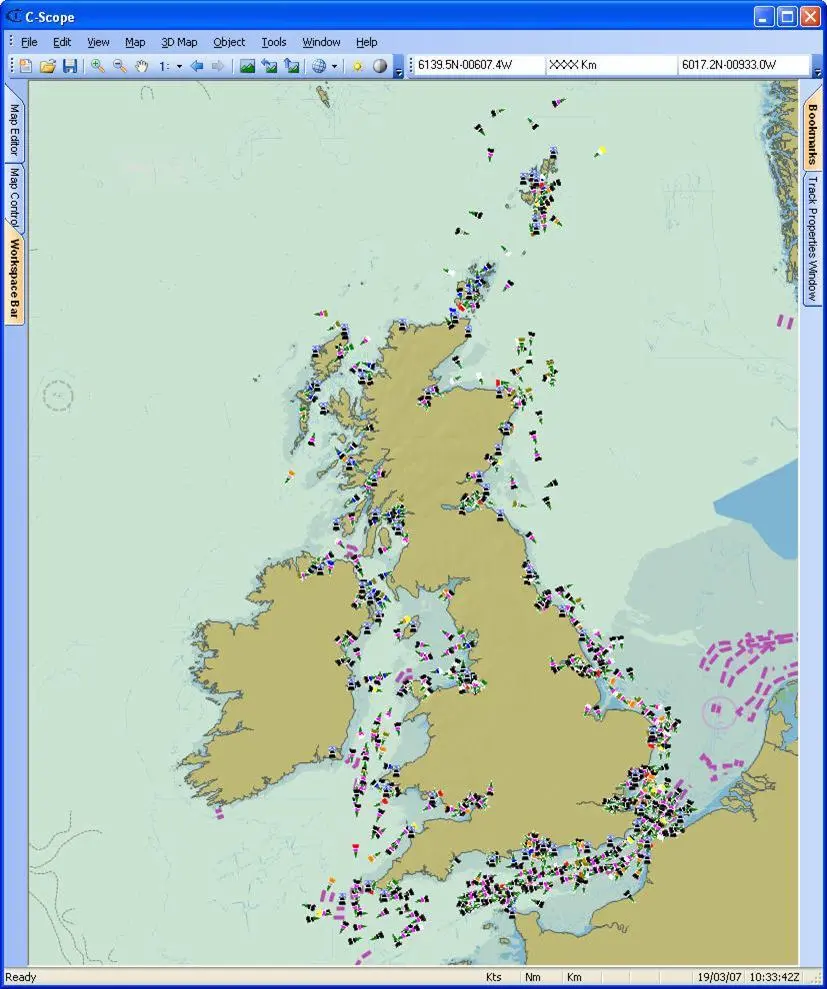
The International Association of Lighthouse Authorities (IALA) pouring a great deal of effort into the development of e-Navigation (e-Nav) and Vessel Traffic Management (VTM), of which Vessel Tracking Service (VTS), Automatic Identification Systems (AIS) and Long Range Identification & Tracking (LRIT) systems are all part of the bigger maritime domain awareness picture.
But what exactly is VTM? The latest IALA VTS Technical Working Group approved definition says: “VTM is the strategic provision of measures and services to enhance the safety, efficiency and security of marine transportation and protection of the marine environment.”
Steve Guest of Kongsberg Norcontrol IT, which supplies a range of equipment and services in this developing new area, says that ports are seeking to implement VTS packages all the time, but these have to scalable to reflect evolution of traffic and infrastructure over time.
“Just one vessel arrival per day carrying dangerous goods could easily justify provision of a VTS, if the risk to the vessel or the marine environment was high,” says Mr Guest, citing the IALA recommendation that VTS should be “designed to improve the safety of vessel traffic and to protect the environment”.
In virtually all cases, he says, VTS should improve efficiency of navigation, thereby increasing arrival and departure windows and shortening ship turn-round times. Since this generally has an associated positive impact on other port service provision, profit per ship handled increases.
The introduction of a good VTS can radically improve a port’s traffic management. The key, he suggests, lies in providing the correct mix of sensors types (radar, AIS, Electro Optics and underwater) and then fusing this data into a single traffic image, which is then used as the basis for decision support tools, such as dynamic risk assessments, warnings and resource management. The port’s resources must be used efficiently if it is to maximise its profitability, he says. Furthermore, the utilisation of resources can only be optimised if all stakeholders are provided with timely and relevant information.
Several port commentators have noted that, in some senses, the LRIT element of overall VTS systems is more focussed on security and less on traffic management per se, thereby questioning its use. Mr Guest points out, however, that recent VTM definitions take security issues into account, too. This notwithstanding, he does not agree with the premise that LRIT has little to do with traffic management.
“Some ports are becoming extremely congested and the sooner they know if a vessel is going to make its allocated slot-time the better. AIS typically provides coverage out to approx 30 nautical miles, which can give just two-three hours notice of arrival,” says Mr Guest, adding that LRIT will also play a role in tightening security, if only because of its effective global coverage.
He acknowledges that subscription services available to ports, such as AIS Live and SeaSearcher, play an important role by providing arrival notification and vessel data for traffic analysis and scheduling.
“If these meet the port’s requirements, then there is certainly no need to purchase similar products or services from us,” he stresses. “However, it would be completely wrong to suggest these services could be used for the provision of a VTS. Indeed, IALA Recommendation V-128 gives clear guidance on operational and technical performance requirements for a VTS system. As a result, Kongsberg Norcontrol IT is of the opinion that radar should always be the primary sensor in any VTS system.”
He also points out that, as VTS has evolved into more sophisticated Vessel Traffic Management & Information Systems (VTMIS), data is nowadays captured just once, thereby dramatically cutting costs. And, he continues: “if the VTMIS is designed correctly, savings should be made throughout the whole marine and land side handling process, including booking the ship’s visit, servicing the visit, invoicing, maintenance of port facilities and subsequent customer relations”.
Nowadays, ports look at the total cost of ownership rather than just the initial capital expenditure. However, to make upgrades more affordable, some Kongsberg Norcontrol IT modules can be integrated into other manufacturers VTS systems, while backward compatibility of its latest upgrades is nowadays a must.