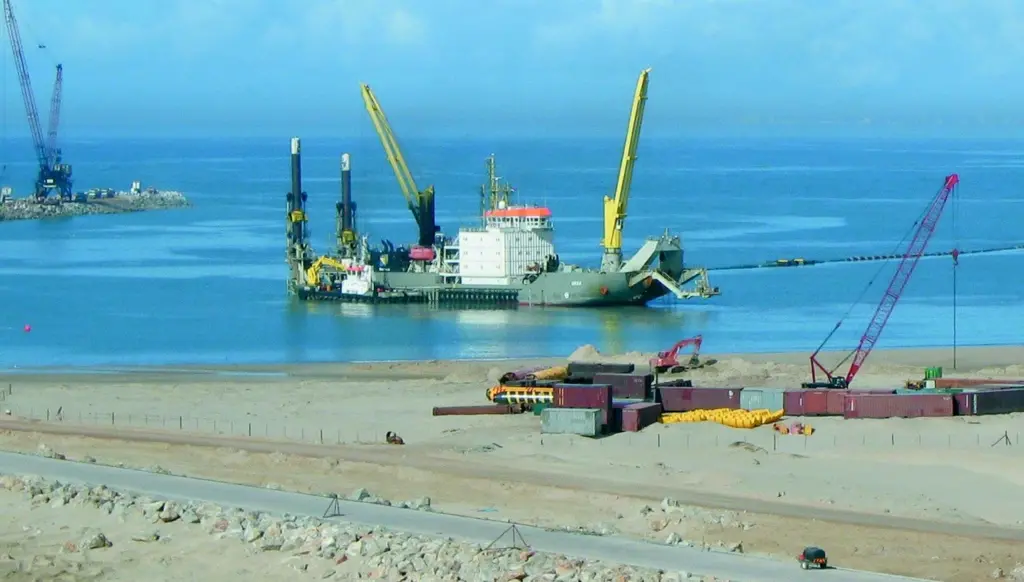
Royal Boskalis spokesman Roel Berends makes this point adding that the company has invested heavily in becoming an environmentally compliant company. Specialists in many fields have been recruited who have helped customers solve potential difficulties on a number of projects.
As to whether the overall cost of contemporary dredging will ultimately make some schemes unaffordable is a contentious issue.
“Environmental factors do not necessarily have to add heavily to the overall cost of a project, although they may force companies to undertake dredging work in a particular way that can sometimes involve greater financial outlay, ” suggests Berends. “It is true that if the budget for a particular project is restricted, having to take environmental issues into consideration could make them more costly.
However, if the need for the infrastructure is there, then we want to help our customers find creative solutions and alternatives to still get the work done, ” says Berends, adding that everything depends on the tangible and intangible benefits that a customer gets from a particular dredging project and the price that they are willing to pay for it.
“It is the client who makes the decision as to the degree of our involvement in planning and costing the project and, ultimately, it is the client that is footing the bill, which is obviously higher in the case of an environmentally complex project, ” he says.
Indeed, Boskalis actively encourages potential clients to contact the company at the environmental impact and feasibility study stage of any project, citing the Port of Melbourne as a recent example. The standards, while at the same time the design of projects may involve more complicated approaches.
Indeed, whilst environmental aspects now do have a major influence on how modern dredging programmes are executed, it does not follow that things that were permitted in the past are now ruled out. “We just have to follow stricter procedures and apply more sophisticated methods, including strict monitoring systems, ” says Berends.
Undoubtedly, environmental issues have had a major say in the way that dredgers are both designed and operated. Operations, for example, now require ISO certification. Dredgers have to be equipped with anti-spill equipment and operated in such a way that spillage is no longer an issue. Suction heads have to be adapted to prevent turtles from being harmed, while there has to be more critical treatment of (polluted) dredged sediment. Furthermore, very specific technology is now being applied to clean polluted river and canal bottoms.
According to Bill Hanson of US-based Great Lakes Dredge & Dock, environmental issues are no longer a surprise element of dredging projects being part and parcel of the planning and execution process.
Sophisticated dredging companies understand this, he stresses, and plan their operations and cost proposals accordingly.
“We find when we effectively communicate what we are doing to those monitoring our work, negative effects to both cost and scheduling can be reduced, ” he observes, adding that actual dredging costs have decreased over the years as a result of improved efficiencies in equipment and methodology. “Despite this, net dredging company is currently working hand-in-glove with the port authority there on a major expansion and deepening project with the aim of ensuring that this can be accomplished in the most environmentally friendly way possible.
According to Berends, not only do dredging techniques nowadays have to be scrutinised for the effects that they may have on the environment, but the client may also be faced with further challenges that are a direct result of changes brought about by the simple act of undertaking the dredging. As a result, vessels and equipment have had to become more sophisticated to accommodate higher costs to our clients have increased as a result of environmental restrictions placed on them.”
Hanson points out that the most extreme example of this has been a tenfold increase in the cost of undertaking maintenance dredging in the New York harbour area; other areas have nevertheless seen increased costs for environmental compliance mitigated by more efficient dredging.
In the south eastern US, where once dredging was permitted allyear-round, there are significant periods of the year where no dredging is allowed so as not to disturb sea turtle migration patterns, while other projects in the northeast and Pacific coast regions have similar restrictions governed by other sensitive marine species.
Clearly, companies today cannot just undertake dredging without considering the environment, whatever restrictions that may or may not place on the optimum way of undertaking a particular project.
“We have to communicate on a daily basis what we are doing to a myriad of agencies, especially if we have to change plans due to some unforeseen occurrence. Because of this, we have to have a Plan B in place at all times!” says Hanson.
He also acknowledges that the design and operation of dredging vessels has changed because of environmental issues. Vessels have to be much more flexible, he explains, not only because of their enormous capital costs, but because of the variety of projects and methods that clients ask dredging companies to undertake. Hopper dredgers, for example, have to be larger and faster to accommodate longer-haul distances, whilst at the same time having to operate in shallower waters. As for cutter dredgers, these have to be more powerful, because blasting is now restricted in many areas, while grab buckets of differing capacity and shapes have to be deployed in order to minimise spillage.
Finally, Hanson confirms that many projects may become unaffordable in the future, given increasing environmental restrictions and the fact that resources to pay for maintenance dredging are dwindling. Ports that receive fixed subsidies for dredging will be forced to augment those subsidies from their own resources or perform less dredging, he warns.
“If neither of these options are feasible, other solutions will need to be found, which may well favour private dredging companies over government-run. For example, many smaller ports that are eligible to receive subsidised dredges using US government vessels are now being forced to consider whether or not they would be better off using private dredging companies, which are much more cost effective and reliable.”
Quizzed as to DEME’s track record on environmental considerations, company spokeman Hubert Fiers points out that responsible environmental dredging methods have been persistently developed since the eighties in anticipation that such issues would unquestionably come to the fore when determining whether sensitive projects would go ahead or not. “We improved our vessels and dredging processes into being really environmental-friendly. Moreover, as a result of applied R&D we invented new techniques, methods and installations to safely stock and treat contaminated silt and soils, to the point of being now absolute European environmental forerunners in the dredging industry.
“Nowadays, I do not think that environmental issues should add to the overall cost of a project, because all dredging companies have acquired the necessary techniques to allow them to work with, not against the environment.”
Van Oord also recognises that environmental factors remain important in all dredging projects, although the company points out that most western dredging companies simply have to comply with tough legislation that covers this whole area. “Van Oord does everything in its power to avoid environmental damage and we have developed dredging techniques that other, smaller regional players simply do not have. Even so, the cost of environmental considerations can push some projects to the upper limits of feasibility, while others may become unaffordable as a result. Nevertheless, these factors have to be discussed early in the planning stage, so dredging companies have only limited influence, since we usually become involved at the tender stage. Nevertheless, we can suggest ways of undertaking a project that might cut costs, but I stress that would normally mean very early consultation.”