The Russian government is considering sanctioning the biggest investment project for the domestic port sector in recent years – the redevelopment of the Port of St. Petersburg and the transfer of key facilities to outside the city.
In contrast to the majority of other Russian seaports, which are traditionally located in the suburbs of cities, most of territory occupied by the Port of St. Petersburg – Russia’s largest seaport in terms of cargo traffic – is located within the boundaries of the City of St. Petersburg.
However, the rapid urban development of the city since 2010 has brought about a lack of vacant space and land, which, in turn, has raised the issue of the transfer of part of the capacities of the Port of St. Petersburg.
The latest proposal in this respect comes from Andrei Bokarev, a well-known Russian businessman and President of Transmashholding, the producer of rail locomotives and rail equipment generally. In a letter to Russian President Vladimir Putin, Bokarev proposes the transfer of more than 20 port facilities to outside the city.
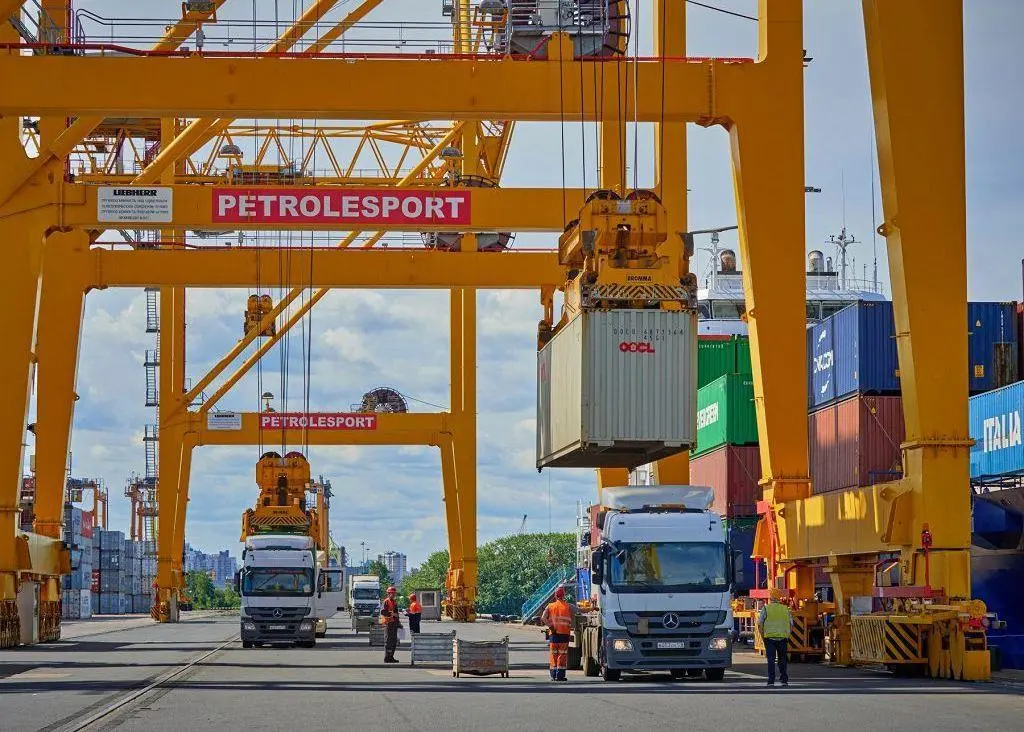
The proposal reportedly covers some of the port’s largest facilities including the “Seaport of St. Petersburg”, the “Container Terminal St. Petersburg” the Baltic Bulk Terminal (“Uralkali”), the First Container Terminal and Petrolesport (Global Ports).
The new location of these facilities, according to Bokarev, should be Ust-Luga, where the businessman owns 48.99%, as a co-owner of Rosterminalugol UMMC, the commodities producer.
On the vacated areas, which would cover some 600 hectares, it is proposed to develop residential and commercial real estate as well as various social infrastructure and cultural facilities. The project could be implemented on a PPP basis with the participation of the Russian financial corporation VEB.RF, and a group of investors affiliated with Bokarev.
So far, the proposal of Bokarev has reportedly received a positive response from the Russian government. Alexander Poshivay, Russia’s Deputy Minister of Transport, in an exclusive interview, stated that the proposed project requires serious consideration from the government and all the interested parties.
“The idea itself is good,” he said, “but the question is in its implementation.… Before starting this project, it is necessary to get an understanding from a number of branches of the Russian economy, how acceptable this decision is. This issue must be worked out.”
This is the second proposal for relocation of the Big Port of St. Petersburg which has been put forward in recent years. In fact, on the last occasion it was discussed by the former governor of St. Petersburg, Georgy Poltavchenko in 2018. This proposal saw port facilities being transferred to the newly built Bronka port.
DOUBT CAST
Hardly surprisingly, the reaction from the majority of operators and stevedoring companies is to oppose the latest initiative. According to Global Ports Group, the proposal has not been worked out and does not provide answers to a number of strategic questions.
At the same time, it is suggested that it carries significant economic and social risks, particularly in terms of investment policies and personnel issues. An official spokeswoman of Global Ports Group press office, comments: “Global Ports Group has been consistently developing terminals in the Big Port of St. Petersburg, with the Petrolesport Terminal possessing the status of a strategic investment project in St. Petersburg. It is not clear how the costs incurred by the investor to build and maintain modern transshipment facilities will be compensated; how land issues will be resolved; how the sources of funding will be determined and redistributed among the affected market participants.
“There is also a serious risk of staff shortages,” she continued. Moreveover, massive sector-specific job cuts in St. Petersburg due to the closure of terminals and, as a consequence, industrial enterprises serving them, will lead to rising unemployment and social tensions.”
According to the company, other potential risks to consider include: the disruption of cargo handling during redeployment; loss of cargo flows and possible damage to Russia’s export potential (today the volume of Russian containerised exports through the Port of St. Petersburg is actively growing).
Further, she points out that costs for shippers may also increase significantly due to longer land distances between the marine terminals and points of cargo origin and destination. The plan is on the table but the jury is still out on the idea.